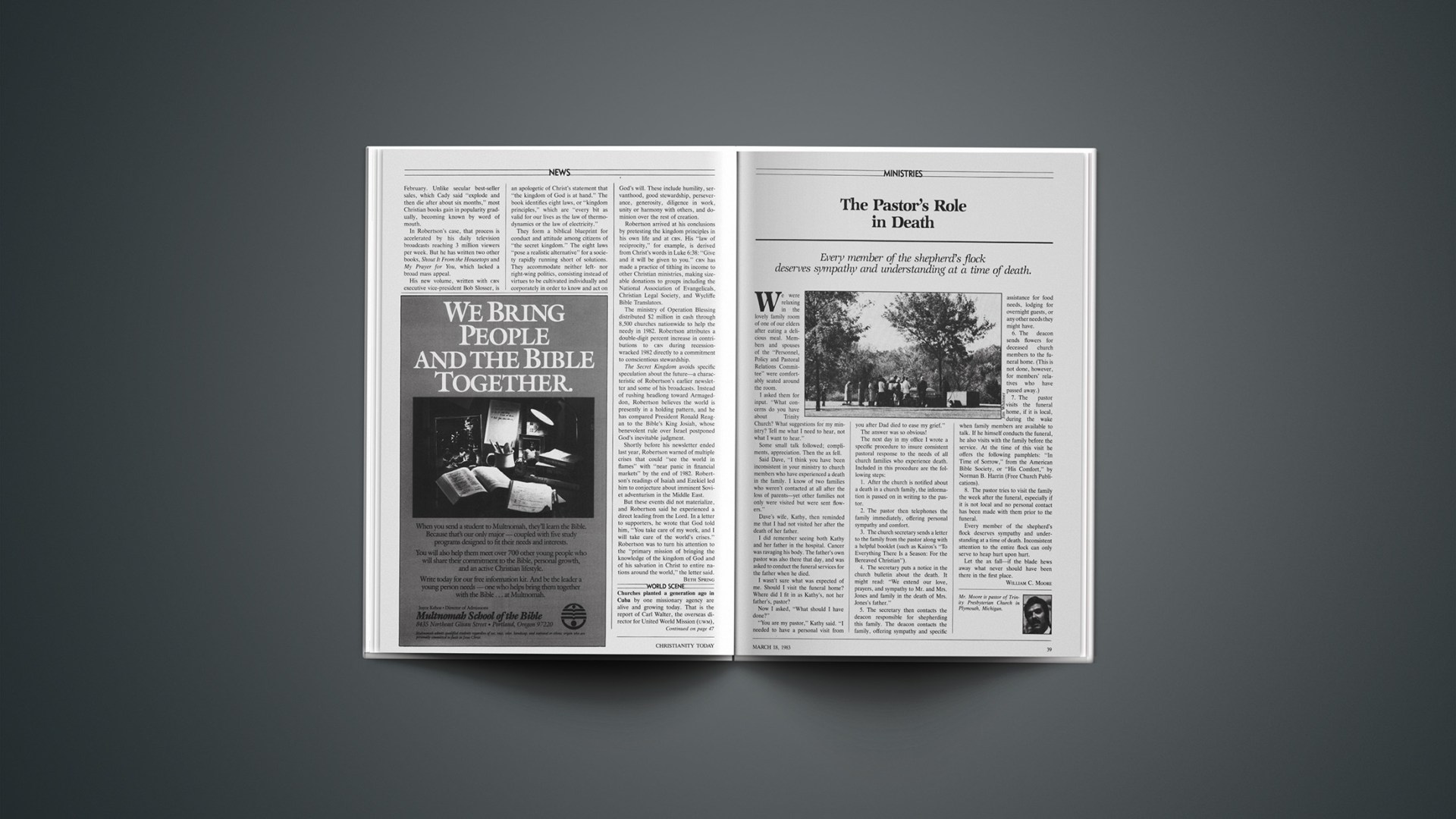

Every member of the shepherd’s flock deserves sympathy and understanding at a time of death.
We were relaxing in the lovely family room of one of our elders after eating a delicious meal. Members and spouses of the “Personnel, Policy and Pastoral Relations Committee” were comfortably seated around the room.
I asked them for input. “What concerns do you have about Trinity Church? What suggestions for my ministry? Tell me what 1 need to hear, not what I want to hear.”
Some small talk followed; compliments, appreciation. Then the ax fell.
Said Dave, “I think you have been inconsistent in your ministry to church members who have experienced a death in the family. I know of two families who weren’t contacted at all after the loss of parents—yet other families not only were visited but were sent flowers.”
Dave’s wife, Kathy, then reminded me that I had not visited her after the death of her father.
I did remember seeing both Kathy and her father in the hospital. Cancer was ravaging his body. The father’s own pastor was also there that day, and was asked to conduct the funeral services for the father when he died.
I wasn’t sure what was expected of me. Should I visit the funeral home? Where did I fit in as Kathy’s, not her father’s, pastor?
Now I asked, “What should I have done?”
“You are my pastor,” Kathy said. “I needed to have a personal visit from you after Dad died to ease my grief.”
The answer was so obvious!
The next day in my office I wrote a specific procedure to insure consistent pastoral response to the needs of all church families who experience death. Included in this procedure are the following steps:
1. After the church is notified about a death in a church family, the information is passed on in writing to the pastor.
2. The pastor then telephones the family immediately, offering personal sympathy and comfort.
3. The church secretary sends a letter to the family from the pastor along with a helpful booklet (such as Kairos’s “To Everything There Is a Season: For the Bereaved Christian”).
4. The secretary puts a notice in the church bulletin about the death. It might read: “We extend our love, prayers, and sympathy to Mr. and Mrs. Jones and family in the death of Mrs. Jones’s father.”
5. The secretary then contacts the deacon responsible for shepherding this family. The deacon contacts the family, offering sympathy and specific assistance for food needs, lodging for overnight guests, or any other needs they might have.
6. The deacon sends flowers for deceased church members to the funeral home. (This is not done, however, for members’ relatives who have passed away.)
7. The pastor visits the funeral home, if it is local, during the wake when family members are available to talk. If he himself conducts the funeral, he also visits with the family before the service. At the time of this visit he offers the following pamphlets: “In Time of Sorrow,” from the American Bible Society, or “His Comfort,” by Norman B. Harrin (Free Church Publications).
8. The pastor tries to visit the family the week after the funeral, especially if it is not local and no personal contact has been made with them prior to the funeral.
Every member of the shepherd’s flock deserves sympathy and understanding at a time of death. Inconsistent attention to the entire flock can only serve to heap hurt upon hurt.
Let the ax fall—if the blade hews away what never should have been there in the first place.
WILLIAM C. MOORE1Mr. Moore is pastor of Trinity Presbyterian Church in Plymouth, Michigan.