
If so, should it be celebrated now with a meal?
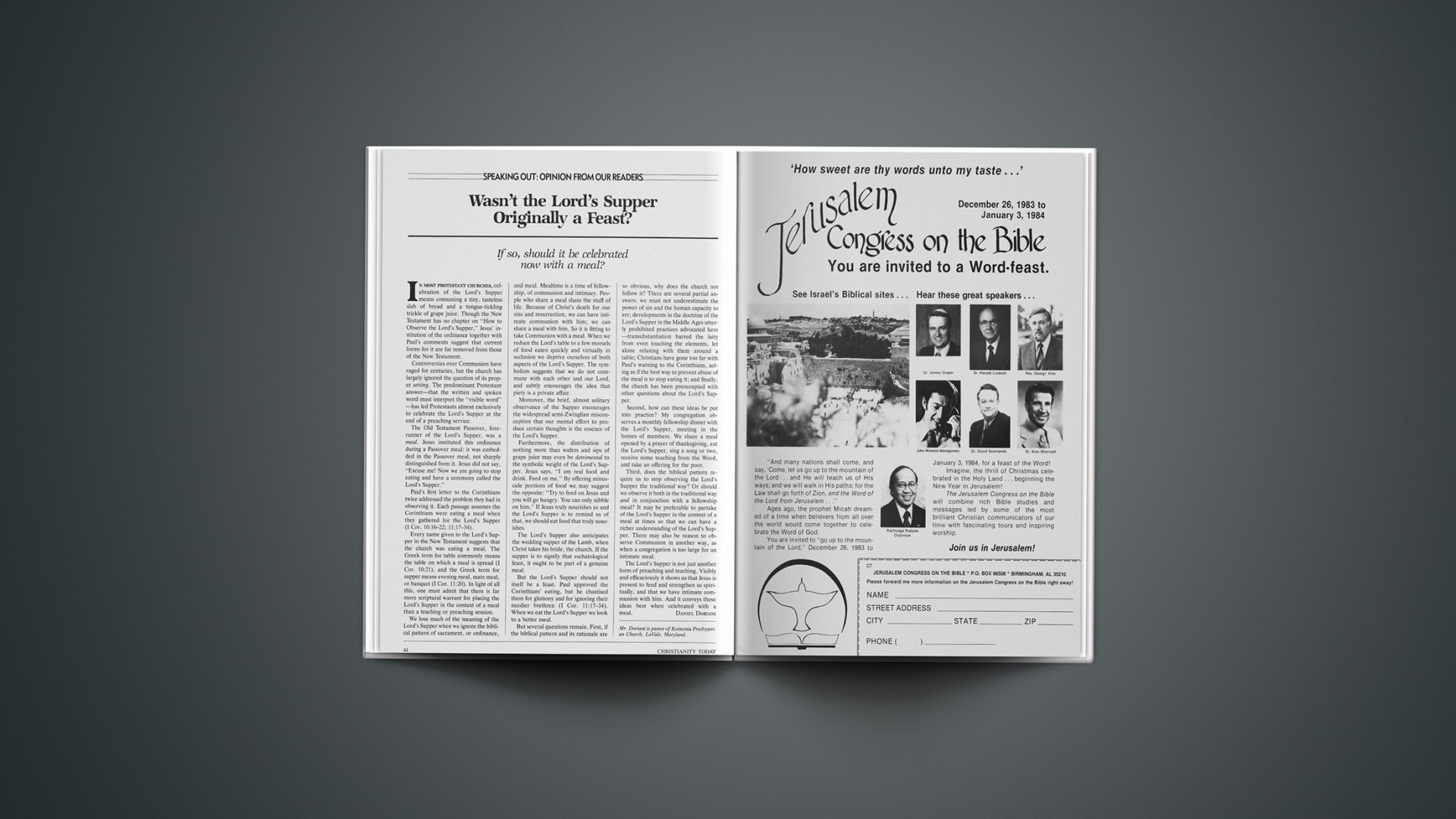
In most Protestant churches, celebration of the Lord’s Supper means consuming a tiny, tasteless slab of bread and a tongue-tickling trickle of grape juice. Though the New Testament has no chapter on “How to Observe the Lord’s Supper,” Jesus’ institution of the ordinance together with Paul’s comments suggest that current forms for it are far removed from those of the New Testament.
Controversies over Communion have raged for centuries, but the church has largely ignored the question of its proper setting. The predominant Protestant answer—that the written and spoken word must interpret the “visible word”—has led Protestants almost exclusively to celebrate the Lord’s Supper at the end of a preaching service.
The Old Testament Passover, forerunner of the Lord’s Supper, was a meal. Jesus instituted this ordinance during a Passover meal: it was embedded in the Passover meal, not sharply distinguished from it. Jesus did not say, “Excuse me! Now we are going to stop eating and have a ceremony called the Lord’s Supper.”
Paul’s first letter to the Corinthians twice addressed the problem they had in observing it. Each passage assumes the Corinthians were eating a meal when they gathered for the Lord’s Supper (1 Cor. 10:16–22; 11:17–34).
Every name given to the Lord’s Supper in the New Testament suggests that the church was eating a meal. The Greek term for table commonly means the table on which a meal is spread (1 Cor. 10:21), and the Greek term for supper means evening meal, main meal, or banquet (1 Cor. 11:20). In light of all this, one must admit that there is far more scriptural warrant for placing the Lord’s Supper in the context of a meal than a teaching or preaching session.
We lose much of the meaning of the Lord’s Supper when we ignore the biblical pattern of sacrament, or ordinance, and meal. Mealtime is a time of fellowship, of communion and intimacy. People who share a meal share the stuff of life. Because of Christ’s death for our sins and resurrection, we can have intimate communion with him; we can share a meal with him. So it is fitting to take Communion with a meal. When we reduce the Lord’s table to a few morsels of food eaten quickly and virtually in seclusion we deprive ourselves of both aspects of the Lord’s Supper. The symbolism suggests that we do not commune with each other and our Lord, and subtly encourages the idea that piety is a private affair.
Moreover, the brief, almost solitary observance of the Supper encourages the widespread semi-Zwinglian misconception that our mental effort to produce certain thoughts is the essence of the Lord’s Supper.
Furthermore, the distribution of nothing more than wafers and sips of grape juice may even be detrimental to the symbolic weight of the Lord’s Supper. Jesus says, “I am real food and drink. Feed on me.” By offering minuscule portions of food we may suggest the opposite: “Try to feed on Jesus and you will go hungry. You can only nibble on him.” If Jesus truly nourishes us and the Lord’s Supper is to remind us of that, we should eat food that truly nourishes.
The Lord’s Supper also anticipates the wedding supper of the Lamb, when Christ takes his bride, the church. If the supper is to signify that eschatological feast, it ought to be part of a genuine meal.
But the Lord’s Supper should not itself be a feast. Paul approved the Corinthians’ eating, but he chastised them for gluttony and for ignoring their needier brethren (1 Cor. 11:17–34). When we eat the Lord’s Supper we look to a better meal.
But several questions remain. First, if the biblical pattern and its rationale are so obvious, why does the church not follow it? There are several partial answers: we must not underestimate the power of sin and the human capacity to err; developments in the doctrine of the Lord’s Supper in the Middle Ages utterly prohibited practices advocated here—transubstantiation barred the laity from even touching the elements, let alone relaxing with them around a table; Christians have gone too far with Paul’s warning to the Corinthians, acting as if the best way to prevent abuse of the meal is to stop eating it; and finally, the church has been preoccupied with other questions about the Lord’s Supper.
Second, how can these ideas be put into practice? My congregation observes a monthly fellowship dinner with the Lord’s Supper, meeting in the homes of members. We share a meal opened by a prayer of thanksgiving, eat the Lord’s Supper, sing a song or two, receive some teaching from the Word, and take an offering for the poor.
Third, does the biblical pattern require us to stop observing the Lord’s Supper the traditional way? Or should we observe it both in the traditional way and in conjunction with a fellowship meal? It may be preferable to partake of the Lord’s Supper in the context of a meal at times so that we can have a richer understanding of the Lord’s Supper. There may also be reason to observe Communion in another way, as when a congregation is too large for an intimate meal.
The Lord’s Supper is not just another form of preaching and teaching. Visibly and efficaciously it shows us that Jesus is present to feed and strengthen us spiritually, and that we have intimate communion with him. And it conveys these ideas best when celebrated with a meal.
DANIEL DORIANI1Mr. Doriani is pastor ofKoinonia Presbyterian Church, LaVale, Maryland.