
Did she betray society, or did it betray her?
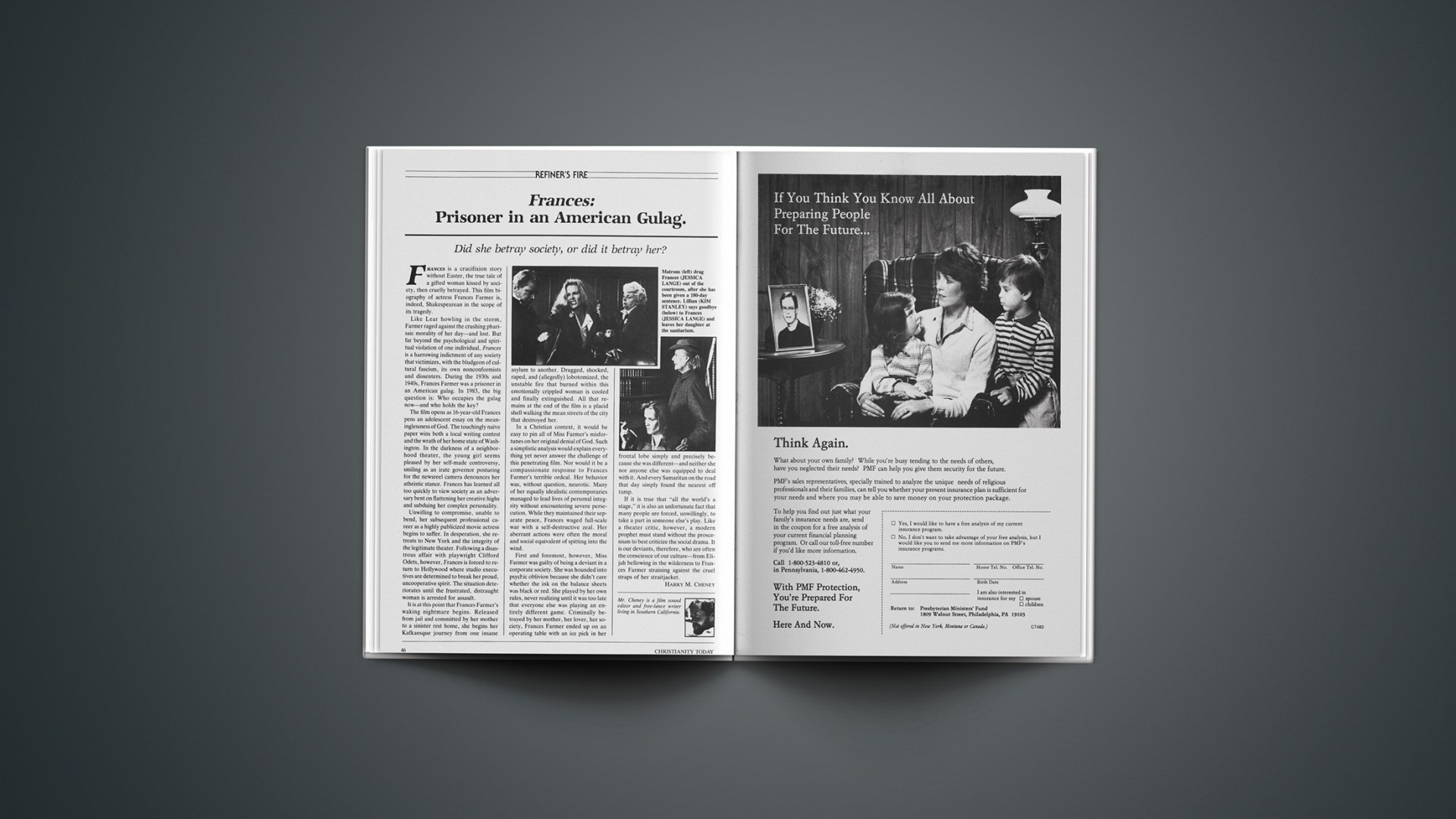
Frances is a crucifixion story without Easter, the true tale of a gifted woman kissed by society, then cruelly betrayed. This film biography of actress Frances Farmer is, indeed, Shakespearean in the scope of its tragedy.
Like Lear howling in the storm, Farmer raged against the crushing Pharisaic morality of her day—and lost. But far beyond the psychological and spiritual violation of one individual, Frances is a harrowing indictment of any society that victimizes, with the bludgeon of cultural fascism, its own nonconformists and dissenters. During the 1930s and 1940s, Frances Farmer was a prisoner in an American gulag. In 1983, the big question is: Who occupies the gulag now—and who holds the key?
The film opens as 16-year-old Frances pens an adolescent essay on the meaninglessness of God. The touchingly naïve paper wins both a local writing contest and the wrath of her home state of Washington. In the darkness of a neighborhood theater, the young girl seems pleased by her self-made controversy, smiling as an irate governor posturing for the newsreel camera denounces her atheistic stance. Frances has learned all too quickly to view society as an adversary bent on flattening her creative highs and subduing her complex personality.
Unwilling to compromise, unable to bend, her subsequent professional career as a highly publicized movie actress begins to suffer. In desperation, she retreats to New York and the integrity of the legitimate theater. Following a disastrous affair with playwright Clifford Odets, however, Frances is forced to return to Hollywood where studio executives are determined to break her proud, uncooperative spirit. The situation deteriorates until the frustrated, distraught woman is arrested for assault.
It is at this point that Frances Farmer’s waking nightmare begins. Released from jail and committed by her mother to a sinister rest home, she begins her Kafkaesque journey from one insane asylum to another. Drugged, shocked, raped, and (allegedly) lobotomized, the unstable fire that burned within this emotionally crippled woman is cooled and finally extinguished. All that remains at the end of the film is a placid shell walking the mean streets of the city that destroyed her.
In a Christian context, it would be easy to pin all of Miss Farmer’s misfortunes on her original denial of God. Such a simplistic analysis would explain everything yet never answer the challenge of this penetrating film. Nor would it be a compassionate response to Frances Farmer’s terrible ordeal. Her behavior was, without question, neurotic. Many of her equally idealistic contemporaries managed to lead lives of personal integrity without encountering severe persecution. While they maintained their separate peace, Frances waged full-scale war with a self-destructive zeal. Her aberrant actions were often the moral and social equivalent of spitting into the wind.
First and foremost, however, Miss Farmer was guilty of being a deviant in a corporate society. She was hounded into psychic oblivion because she didn’t care whether the ink on the balance sheets was black or red. She played by her own rules, never realizing until it was too late that everyone else was playing an entirely different game. Criminally betrayed by her mother, her lover, her society, Frances Farmer ended up on an operating table with an ice pick in her frontal lobe simply and precisely because she was different—and neither she nor anyone else was equipped to deal with it. And every Samaritan on the road that day simply found the nearest off ramp.
If it is true that “all the world’s a stage,” it is also an unfortunate fact that many people are forced, unwillingly, to take a part in someone else’s play. Like a theater critic, however, a modern prophet must stand without the proscenium to best criticize the social drama. It is our deviants, therefore, who are often the conscience of our culture—from Elijah bellowing in the wilderness to Frances Farmer straining against the cruel straps of her straitjacket.
HARRY M. CHENEY1Mr. Cheney is a film sound editor and free-lance writer living in Southern California.