
God, Revelation And Authority
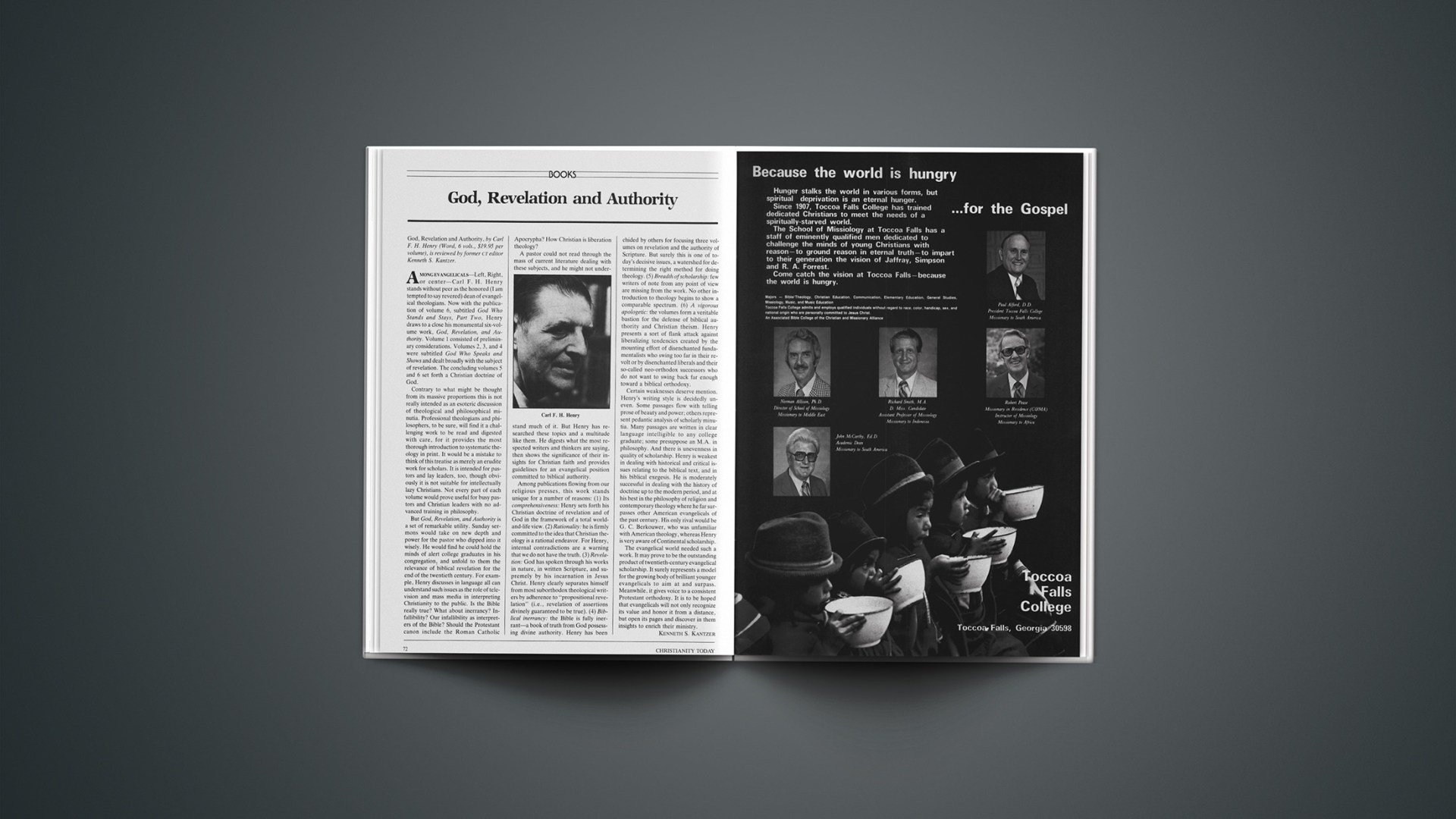
God, Revelation and Authority, by Carl F. H. Henry (Word, 6 vols., $19.95 per volume), is reviewed by former CT editor Kenneth S. Kantzer.
Among evangelicals—Left, Right, or center—Carl F. H. Henry stands without peer as the honored (I am tempted to say revered) dean of evangelical theologians. Now with the publication of volume 6, subtitled God Who Stands and Stays, Part Two, Henry draws to a close his monumental six-volume work, God, Revelation, and Authority. Volume 1 consisted of preliminary considerations. Volumes 2, 3, and 4 were subtitled God Who Speaks and Shows and dealt broadly with the subject of revelation. The concluding volumes 5 and 6 set forth a Christian doctrine of God.
Contrary to what might be thought from its massive proportions this is not really intended as an esoteric discussion of theological and philosophical minutia. Professional theologians and philosophers, to be sure, will find it a challenging work to be read and digested with care, for it provides the most thorough introduction to systematic theology in print. It would be a mistake to think of this treatise as merely an erudite work for scholars. It is intended for pastors and lay leaders, too, though obviously it is not suitable for intellectually lazy Christians. Not every part of each volume would prove useful for busy pastors and Christian leaders with no advanced training in philosophy.
But God, Revelation, and Authority is a set of remarkable utility. Sunday sermons would take on new depth and power for the pastor who dipped into it wisely. He would find he could hold the minds of alert college graduates in his congregation, and unfold to them the relevance of biblical revelation for the end of the twentieth century. For example, Henry discusses in language all can understand such issues as the role of television and mass media in interpreting Christianity to the public. Is the Bible really true? What about inerrancy? Infallibility? Our infallibility as interpreters of the Bible? Should the Protestant canon include the Roman Catholic Apocrypha? How Christian is liberation theology?
A pastor could not read through the mass of current literature dealing with these subjects, and he might not understand much of it. But Henry has researched these topics and a multitude like them. He digests what the most respected writers and thinkers are saying, then shows the significance of their insights for Christian faith and provides guidelines for an evangelical position committed to biblical authority.
Among publications flowing from our religious presses, this work stands unique for a number of reasons: (1) Its comprehensiveness: Henry sets forth his Christian doctrine of revelation and of God in the framework of a total world-and-life view. (2) Rationality: he is firmly committed to the idea that Christian theology is a rational endeavor. For Henry, internal contradictions are a warning that we do not have the truth. (3) Revelation: God has spoken through his works in nature, in written Scripture, and supremely by his incarnation in Jesus Christ. Henry clearly separates himself from most suborthodox theological writers by adherence to “propositional revelation” (i.e., revelation of assertions divinely guaranteed to be true). (4) Biblical inerrancy: the Bible is fully inerrant—a book of truth from God possessing divine authority. Henry has been chided by others for focusing three volumes on revelation and the authority of Scripture. But surely this is one of today’s decisive issues, a watershed for determining the right method for doing theology. (5) Breadth of scholarship: few writers of note from any point of view are missing from the work. No other introduction to theology begins to show a comparable spectrum. (6) A vigorous apologetic: the volumes form a veritable bastion for the defense of biblical authority and Christian theism. Henry presents a sort of flank attack against liberalizing tendencies created by the mounting effort of disenchanted fundamentalists who swing too far in their revolt or by disenchanted liberals and their so-called neo-orthodox successors who do not want to swing back far enough toward a biblical orthodoxy.
Certain weaknesses deserve mention. Henry’s writing style is decidedly uneven. Some passages flow with telling prose of beauty and power; others represent pedantic analysis of scholarly minutia. Many passages are written in clear language intelligible to any college graduate; some presuppose an M.A. in philosophy. And there is unevenness in quality of scholarship. Henry is weakest in dealing with historical and critical issues relating to the biblical text, and in his biblical exegesis. He is moderately successful in dealing with the history of doctrine up to the modern period, and at his best in the philosophy of religion and contemporary theology where he far surpasses other American evangelicals of the past century. His only rival would be G. C. Berkouwer, who was unfamiliar with American theology, whereas Henry is very aware of Continental scholarship.
The evangelical world needed such a work. It may prove to be the outstanding product of twentieth-century evangelical scholarship. It surely represents a model for the growing body of brilliant younger evangelicals to aim at and surpass. Meanwhile, it gives voice to a consistent Protestant orthodoxy. It is to be hoped that evangelicals will not only recognize its value and honor it from a distance, but open its pages and discover in them insights to enrich their ministry.
KENNETH S. KANTZER