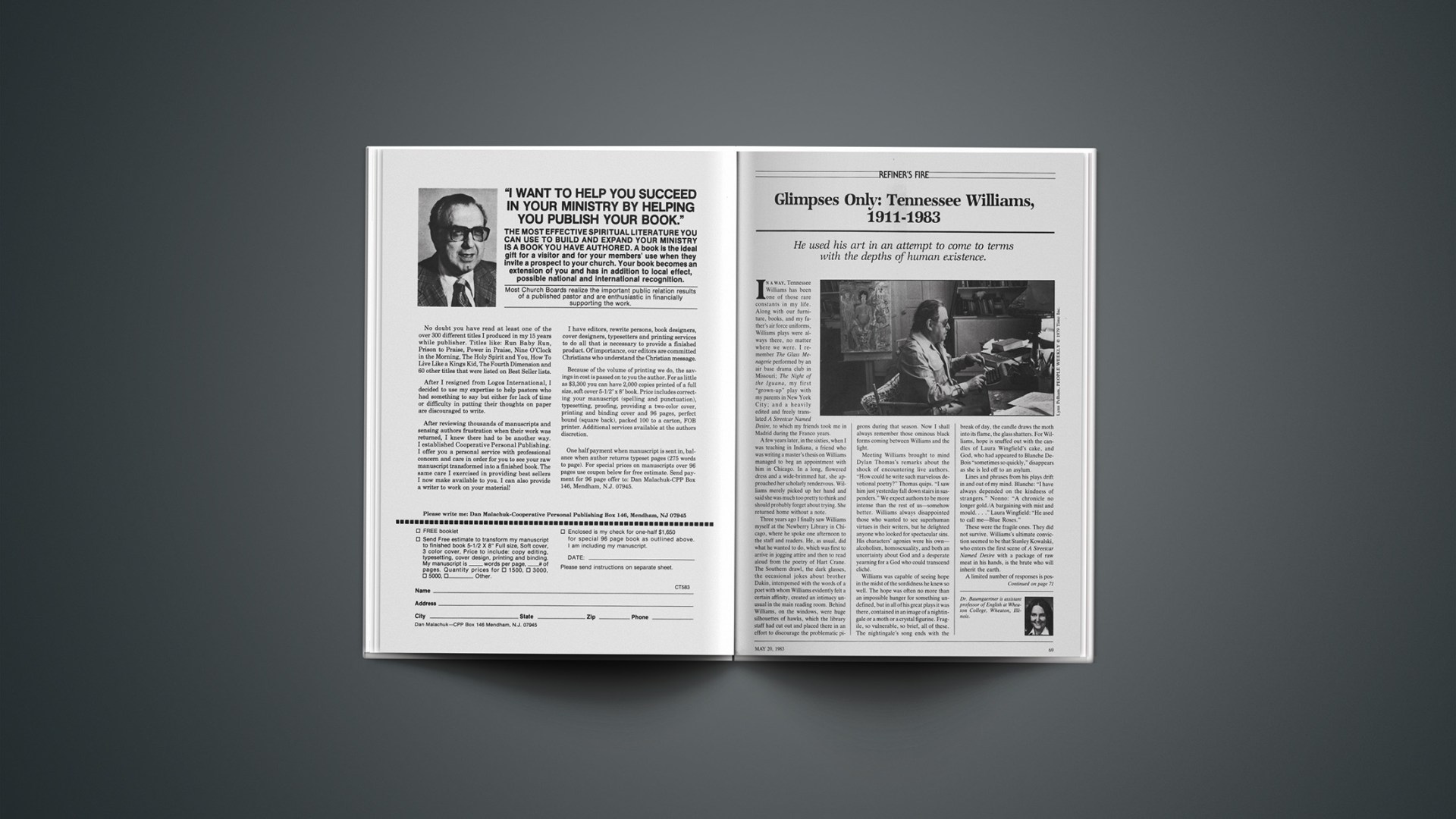

He used his art in an attempt to come to terms with the depths of human existence.
In a way, Tennessee Williams has been one of those rare constants in my life. Along with our furniture, books, and my father’s air force uniforms, Williams plays were always there, no matter where we were. I remember The Glass Menagerie performed by an air base drama club in Missouri; The Night of the Iguana, my first “grown-up” play with my parents in New York City; and a heavily edited and freely translated A Streetcar Named Desire, to which my friends took me in Madrid during the Franco years.
A few years later, in the sixties, when I was teaching in Indiana, a friend who was writing a master’s thesis on Williams managed to beg an appointment with him in Chicago. In a long, flowered dress and a wide-brimmed hat, she approached her scholarly rendezvous. Williams merely picked up her hand and said she was much too pretty to think and should probably forget about trying. She returned home without a note.
Three years ago I finally saw Williams myself at the Newberry Library in Chicago, where he spoke one afternoon to the staff and readers. He, as usual, did what he wanted to do, which was first to arrive in jogging attire and then to read aloud from the poetry of Hart Crane. The Southern drawl, the dark glasses, the occasional jokes about brother Dakin, interspersed with the words of a poet with whom Williams evidently felt a certain affinity, created an intimacy unusual in the main reading room. Behind Williams, on the windows, were huge silhouettes of hawks, which the library staff had cut out and placed there in an effort to discourage the problematic pigeons during that season. Now I shall always remember those ominous black forms coming between Williams and the light.
Meeting Williams brought to mind Dylan Thomas’s remarks about the shock of encountering live authors. “How could he write such marvelous devotional poetry?” Thomas quips. “I saw him just yesterday fall down stairs in suspenders.” We expect authors to be more intense than the rest of us—somehow better. Williams always disappointed those who wanted to see superhuman virtues in their writers, but he delighted anyone who looked for spectacular sins. His characters’ agonies were his own—alcoholism, homosexuality, and both an uncertainty about God and a desperate yearning for a God who could transcend cliché.
Williams was capable of seeing hope in the midst of the sordidness he knew so well. The hope was often no more than an impossible hunger for something undefined, but in all of his great plays it was there, contained in an image of a nightingale or a moth or a crystal figurine. Fragile, so vulnerable, so brief, all of these. The nightingale’s song ends with the break of day, the candle draws the moth into its flame, the glass shatters. For Williams, hope is snuffed out with the candles of Laura Wingfield’s cake, and God, who had appeared to Blanche De-Bois “sometimes so quickly,” disappears as she is led off to an asylum.
Lines and phrases from his plays drift in and out of my mind. Blanche: “I have always depended on the kindness of strangers.” Nonno: “A chronicle no longer gold./A bargaining with mist and mould.…” Laura Wingfield: “He used to call me—Blue Roses.”
These were the fragile ones. They did not survive. Williams’s ultimate conviction seemed to be that Stanley Kowalski, who enters the first scene of A Streetcar Named Desire with a package of raw meat in his hands, is the brute who will inherit the earth.
A limited number of responses is possible for a human being caught in such a universe—and Williams tried all of them.
Like Stella Kowalski, one can plunge into the world of passion and brutality and learn to love it. That Williams did.
One can despair. That he did, too.
Like Blanche, one can look elsewhere—outside of human reason and limitations. That Williams also tried to do occasionally.
One can use one’s art to try to come to terms with the chasms of human existence, to try to exorcise the devil of hopelessness. That he also did.
Finally, however, there is prayer—and Williams’s characters (along with the author himself) do utter prayers. At the end of The Night of the Iguana Hannah says, “Oh, God, can’t we stop now? Finally? Please let us. It’s so quiet here now.” Nonno dies and she is left absolutely alone. Is this God’s answer? For Blanche, the anonymous operator is the recipient of her final appeal: “Operator! Operator! Never mind long-distance. Get Western Union. There isn’t time to be—Western—Western Union!… Western Union? Yes! I—want to—Take down this message! ‘In desperate circumstances! Help me! Caught in a trap. Caught in’—.” This is her prayer, but it is cut off by Stanley’s brutality.
What do Christians do with Tennessee Williams? First, we must admit that some of Williams’s questions are our own. As Christians, what, for example, are we to do with life’s brutes? Certainly more than stand in judgment. Williams’s dramas, as filled with broken people and human failures as they are, allow us to see fallen human nature, to understand it, to empathize. They allow us to go beyond stultifying stereotype. They force us to confront human agony, and to transcend religious cliché in trying to deal with human sinfulness.
As Christians we need not be afraid of Williams; we need not wag our fingers at him. His self-destructiveness did enough of that for him. We do need to see, however, that while Williams writes of the broken human spirit, his personal tragedy is no less than the world’s tragedy. We cannot hate people for their blindness. But neither can we give in to those who hold blindness up as a standard. That is where we must part ways with Williams.
We love Williams for his glimpses—however brief—of transcendence. Oh, that he could have enlarged them into visions.
JILL BAUMGAERTNER1Dr. Baumgaertner is assistant professor of English at Wheaton College, Wheaton, Illinois.