In this series

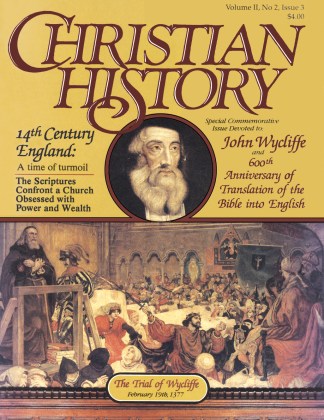
For John Wycliffe, the Bible became the sole authority for all of life. He wrote:
“Holy Scripture is the preeminent authority for every Christian, and the rule of faith and of all human perfection.”
Again, he wrote:
“Forasmuch as the Bible contains Christ, that is all that is necessary for salvation, it is necessary for all men, nor for priests alone. It alone is the supreme law that is to rule Church, State, and Christian life, without human traditions and statutes.”
Wycliffe developed five rules for studying the Bible:
“Obtain a reliable text, understand the logic of Scripture, compare the parts of Scripture with one another, maintain an attitude of humble seeking, and receive the instruction of the Spirit.”
Wycliffe felt that the laity could not know the basics of the faith unless they knew the Bible. And they could best know the Bible when it was in their own language:
“Christ and His Apostles taught the people in the language best known to them. It is certain that the truth of the Christian faith becomes more evident the more faith itself is known. Therefore, the doctrine should not only be in Latin but in the vulgar tongue and, as the faith of the church is contained in the Scriptures, the more these are known in a true sense the better. The laity ought to understand the faith and, as doctrines of our faith are in the Scriptures, believers should have the Scriptures in a language which they fully understand.”
From the Midland English Translation of Wycliffe’s Bible
And so Wycliffe and his fellow scholars translated the entire Bible from the Latin Vulgate into the Midland English dialect.
As you interpret for yourself the following biblical texts from Wycliffe’s own early English, you may wish to compare the passages with the King James version.
Start with a familiar text (John 3:16):
“Forsothe God so louede the world, that he gaf his oon bigetun sone, that ech man that bileueth in to him perische not, but haue euerlastynge lyf.”
And the message to the shepherds on the first Christmas morning (Luke 2:9–11):
“And loo! the aungel of the Lord stood by sydis hem, and the clerenesse of God schynede aboute hem; and thei dredden with greet drede. And the aungel seide to hem, Nyle ye drede; lo! sothli I euangelise to you a grete ioye, that schal be to al peple. For a sauyour is borun to day to vs. that is Crist the Lord, in the cite of Dauith.”
Or the “love” passage (1 Corinthians 13:1–13):
“If I speke with tungis of men and aungels, sothli I haue not charite, I am maad as bras sownnynge, or a symbal tynkynge. And if I schal haue prophesye, and haue knowun alle mysteries, and al kunnynge, or science, and if I schal haue al feith, so that I bere ouere hillis fro o place to another, forsoth if I schal not haue charite, I am nogt. And if I schal departe alle my goodis into metis of pore men, and if I schal bytake my body, so that I brenne, forsothe if I schal not haue charite, it profitith to me no thing. Charite is pacient, it is benygne or of good will, charite enuyeth not, it doth not gyle, it is not inblowyn with pride, it is not ambicious, or coueitous of worschipis, it sekith not the thingis that ben her owne, it is not stirid to wraththe, it thenkith no yuel, it ioyeth not in wickidnesse, forsoth it ioyeth tog idere to treuthe; it suffrith alle thingis, it bileueth alle thingis, it hopith alle thingis, it susteyneth alle thingis. Charite fallith not down, where prophecyes schulen be voydid, either langagis schulen ceesse, ether science schal be distroyed. Forsoth of party we han knowen, and of party we prophesier, forsothe whanne that schal come that is perfyt, that thing that is a party, schal be avoydid. Whanne I was a litil child, I spak as a litil child, I vndirstood as a litil child, I thouyte as a litil child; forsoth whanne I was maad man, I auoydide tho thingis that weren of a litil child. Forsoth we seen now by a myrour in a derknesse, thanne forsothe face to face; now I knowe of party, thanne forsoth I schal knowe, as and I am knowyn. Now forsothe dweller feith, hope, and charite, the thre; forsoth the mooste of the is charite.”
What Medieval Critics Said of Wycliffe’s Bible
Translating the Bible into the “vulgar” tongue of the people was heresy, because the Church felt that only the sacred tongue of Latin was acceptable. And so, Henry Knighton, a Catholic chronicler of Wycliffe’s times, wrote:
“Christ gave His Gospel to the clergy and the learned doctors of the Church so that they might give it to the laity and to weaker persons, according to the message of the season and personal need. But this Master John Wyclif translated the Gospel from Latin into the English—the Angle not the angel language. And Wyclif, by thus translating the Bible, made it the property of the masses and common to all and more open to the laity, and even to women who were able to read … And so the pearl of the Gospel is thrown before swine and trodden underfoot and what is meant to be the treasure both of clergy and laity is now become a joke of both. The jewel of the clergy has been turned into the sport of the laity, so that what used to be the highest gift of the clergy and the learned members of the Church has become common to the laity.”
Some years later, the Archbishop of Canterbury Arundel was even more bitter in his criticism:
“That pestilent and most wretched John Wycliffe, of damnable memory, a child of the old devil, and himself a child or pupil of Antichrist, who, while he lived, walking in the vanity of his mind—with a few other adjectives, adverbs, and verbs, which I shall not give—crowned his wickedness by translating the Scriptures into the mother tongue.”
This same Archbishop Arundel summoned a synod of clergy which in 1408 gave this finding:
“Since it is dangerous, as St. Jerome witnesses, to translate the text of Holy Scripture from one language into another, because in such translations the same meaning is not easily retained in all particulars… we decree and ordain that no one shall in future translate on his authority any text of Scripture into the English tongue or into any other tongue, by way of book, booklet, or treatise. Nor shall any man read, in public or in private, this kind of book, booklet, or treatise, now recently composed in the time of the said John Wycliffe … under penalty of the greater excommunication.”
Copyright © 1983 by the author or Christianity Today/Christian History magazine. Click here for reprint information on Christian History.