
Or do we adjust Scripture to fit our political convictions?
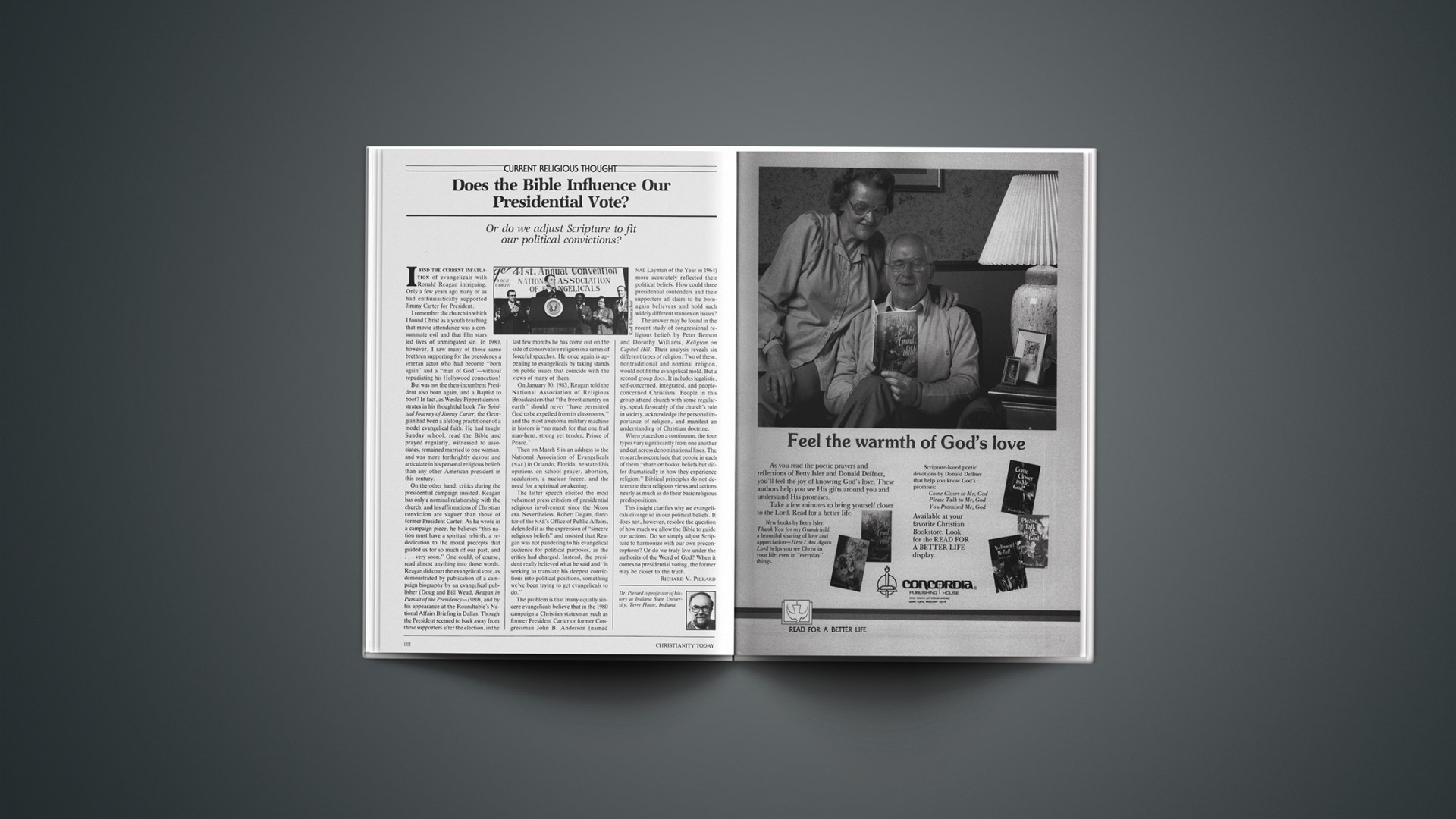
I find the current infatuation of evangelicals with Ronald Reagan intriguing.
Only a few years ago many of us had enthusiastically supported Jimmy Carter for President.
I remember the church in which I found Christ as a youth teaching that movie attendance was a consummate evil and that film stars led lives of unmitigated sin. In 1980, however, I saw many of those same brethren supporting for the presidency a veteran actor who had become “born again” and a “man of God”—without repudiating his Hollywood connection!
But was not the then-incumbent President also born again, and a Baptist to boot? In fact, as Wesley Pippert demonstrates in his thoughtful book The Spiritual Journey of Jimmy Carter, the Georgian had been a lifelong practitioner of a model evangelical faith. He had taught Sunday school, read the Bible and prayed regularly, witnessed to associates, remained married to one woman, and was more forthrightly devout and articulate in his personal religious beliefs than any other American president in this century.
On the other hand, critics during the presidential campaign insisted, Reagan has only a nominal relationship with the church, and his affirmations of Christian conviction are vaguer than those of former President Carter. As he wrote in a campaign piece, he believes “this nation must have a spiritual rebirth, a rededication to the moral precepts that guided us for so much of our past, and … very soon.” One could, of course, read almost anything into those words. Reagan did court the evangelical vote, as demonstrated by publication of a campaign biography by an evangelical publisher (Doug and Bill Wead, Reagan in Pursuit of the Presidency—1980), and by his appearance at the Roundtable’s National Affairs Briefing in Dallas. Though the President seemed to back away from these supporters after the election, in the last few months he has come out on the side of conservative religion in a series of forceful speeches. He once again is appealing to evangelicals by taking stands on public issues that coincide with the views of many of them.
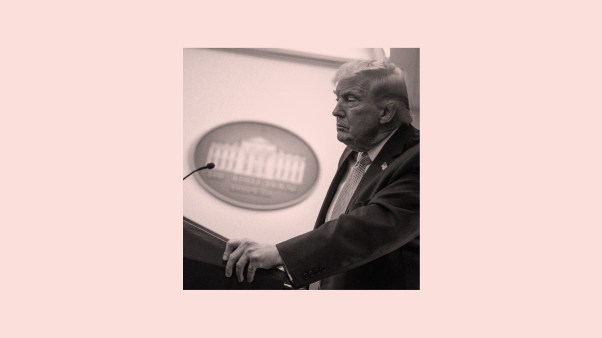
On January 30, 1983, Reagan told the National Association of Religious Broadcasters that “the freest country on earth” should never “have permitted God to be expelled from its classrooms,” and the most awesome military machine in history is “no match for that one frail man-hero, strong yet tender, Prince of Peace.”
Then on March 8 in an address to the National Association of Evangelicals (NAE) in Orlando, Florida, he stated his opinions on school prayer, abortion, secularism, a nuclear freeze, and the need for a spiritual awakening.
The latter speech elicited the most vehement press criticism of presidential religious involvement since the Nixon era. Nevertheless, Robert Dugan, director of the NAE’S Office of Public Affairs, defended it as the expression of “sincere religious beliefs” and insisted that Reagan was not pandering to his evangelical audience for political purposes, as the critics had charged. Instead, the president really believed what he said and “is seeking to translate his deepest convictions into political positions, something we’ve been trying to get evangelicals to do.”
The problem is that many equally sincere evangelicals believe that in the 1980 campaign a Christian statesman such as former President Carter or former Congressman John B. Anderson (named NAE Layman of the Year in 1964) more accurately reflected their political beliefs. How could three presidential contenders and their supporters all claim to be born-again believers and hold such widely different stances on issues?
The answer may be found in the recent study of congressional religious beliefs by Peter Benson and Dorothy Williams, Religion on Capitol Hill. Their analysis reveals six different types of religion. Two of these, nontraditional and nominal religion, would not fit the evangelical mold. But a second group does. It includes legalistic, self-concerned, integrated, and people-concerned Christians. People in this group attend church with some regularity, speak favorably of the church’s role in society, acknowledge the personal importance of religion, and manifest an understanding of Christian doctrine.
When placed on a continuum, the four types vary significantly from one another and cut across denominational lines. The researchers conclude that people in each of them “share orthodox beliefs but differ dramatically in how they experience religion.” Biblical principles do not determine their religious views and actions nearly as much as do their basic religious predispositions.
This insight clarifies why we evangelicals diverge so in our political beliefs. It does not, however, resolve the question of how much we allow the Bible to guide our actions. Do we simply adjust Scripture to harmonize with our own preconceptions? Or do we truly live under the authority of the Word of God? When it comes to presidential voting, the former may be closer to the truth.
Dr. Pierard is professor of history at Indiana State University, Terre Haute, Indiana.