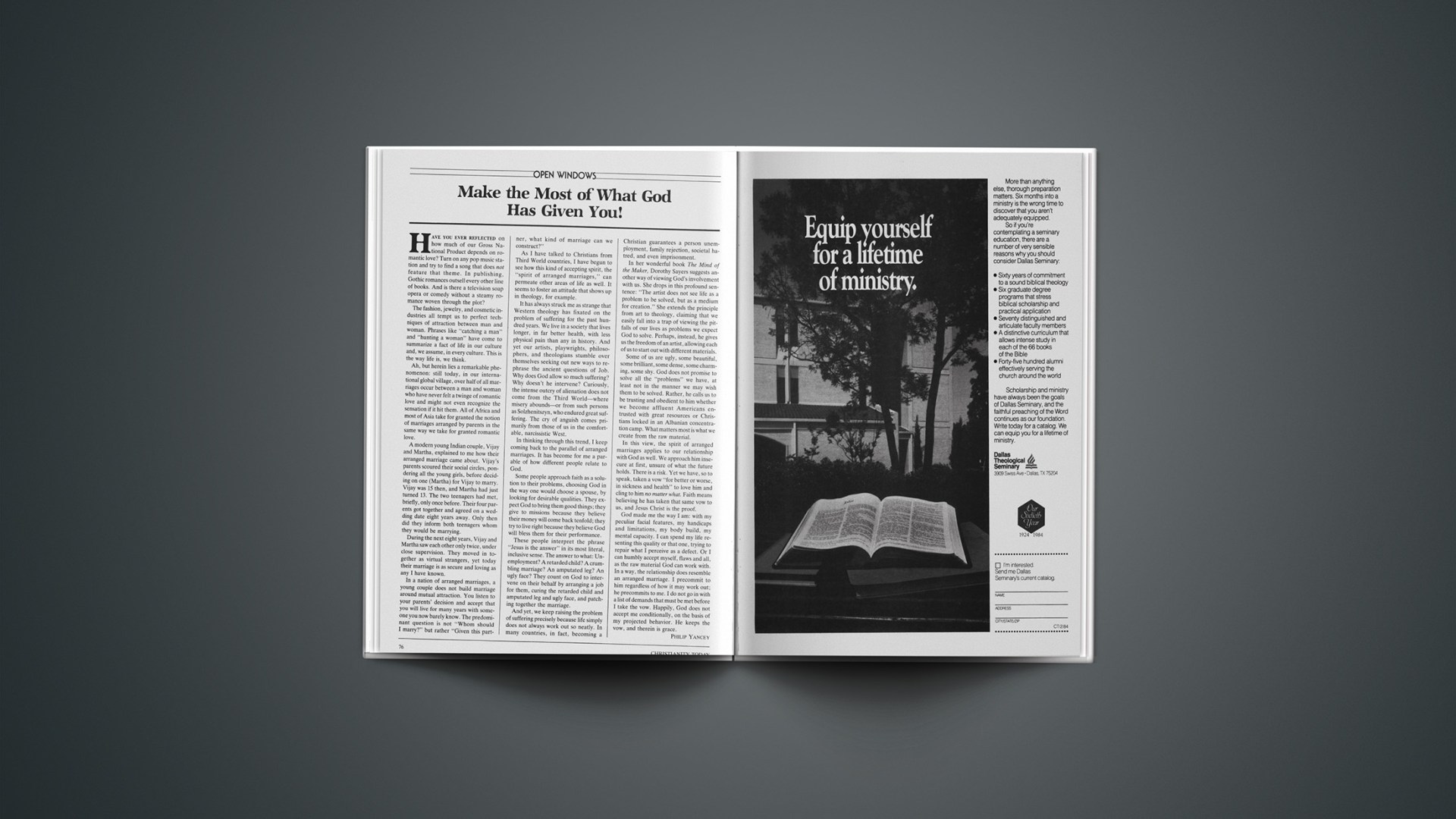

Have you ever reflected on how much of our Gross National Product depends on romantic love? Turn on any pop music station and try to find a song that does not feature that theme. In publishing, Gothic romances outsell every other line of books. And is there a television soap opera or comedy without a steamy romance woven through the plot?
The fashion, jewelry, and cosmetic industries all tempt us to perfect techniques of attraction between man and woman. Phrases like “catching a man” and “hunting a woman” have come to summarize a fact of life in our culture and, we assume, in every culture. This is the way life is, we think.
Ah, but herein lies a remarkable phenomenon: still today, in our international global village, over half of all marriages occur between a man and woman who have never felt a twinge of romantic love and might not even recognize the sensation if it hit them. All of Africa and most of Asia take for granted the notion of marriages arranged by parents in the same way we take for granted romantic love.
A modern young Indian couple, Vijay and Martha, explained to me how their arranged marriage came about. Vijay’s parents scoured their social circles, pondering all the young girls, before deciding on one (Martha) for Vijay to marry. Vijay was 15 then, and Martha had just turned 13. The two teenagers had met, briefly, only once before. Their four parents got together and agreed on a wedding date eight years away. Only then did they inform both teenagers whom they would be marrying.
During the next eight years, Vijay and Martha saw each other only twice, under close supervision. They moved in together as virtual strangers, yet today their marriage is as secure and loving as any I have known.
In a nation of arranged marriages, a young couple does not build marriage around mutual attraction. You listen to your parents’ decision and accept that you will live for many years with someone you now barely know. The predominant question is not “Whom should I marry?” but rather “Given this partner, what kind of marriage can we construct?”
As I have talked to Christians from Third World countries, I have begun to see how this kind of accepting spirit, the “spirit of arranged marriages,” can permeate other areas of life as well. It seems to foster an attitude that shows up in theology, for example.
It has always struck me as strange that Western theology has fixated on the problem of suffering for the past hundred years. We live in a society that lives longer, in far better health, with less physical pain than any in history. And yet our artists, playwrights, philosophers, and theologians stumble over themselves seeking out new ways to rephrase the ancient questions of Job. Why does God allow so much suffering? Why doesn’t he intervene? Curiously, the intense outcry of alienation does not come from the Third World—where misery abounds—or from such persons as Solzhenitszyn, who endured great suffering. The cry of anguish comes primarily from those of us in the comfortable, narcissistic West.
In thinking through this trend, I keep coming back to the parallel of arranged marriages. It has become for me a parable of how different people relate to God.
Some people approach faith as a solution to their problems, choosing God in the way one would choose a spouse, by looking for desirable qualities. They expect God to bring them good things; they give to missions because they believe their money will come back tenfold; they try to live right because they believe God will bless them for their performance.
These people interpret the phrase “Jesus is the answer” in its most literal, inclusive sense. The answer to what: Unemployment? A retarded child? A crumbling marriage? An amputated leg? An ugly face? They count on God to intervene on their behalf by arranging a job for them, curing the retarded child and amputated leg and ugly face, and patching together the marriage.
And yet, we keep raising the problem of suffering precisely because life simply does not always work out so neatly. In many countries, in fact, becoming a Christian guarantees a person unemployment, family rejection, societal hatred, and even imprisonment.
In her wonderful book The Mind of the Maker, Dorothy Sayers suggests another way of viewing God’s involvement with us. She drops in this profound sentence: “The artist does not see life as a problem to be solved, but as a medium for creation.” She extends the principle from art to theology, claiming that we easily fall into a trap of viewing the pitfalls of our lives as problems we expect God to solve. Perhaps, instead, he gives us the freedom of an artist, allowing each of us to start out with different materials.
Some of us are ugly, some beautiful, some brilliant, some dense, some charming, some shy. God does not promise to solve all the “problems” we have, at least not in the manner we may wish them to be solved. Rather, he calls us to be trusting and obedient to him whether we become affluent Americans entrusted with great resources or Christians locked in an Albanian concentration camp. What matters most is what we create from the raw material.
In this view, the spirit of arranged marriages applies to our relationship with God as well. We approach him insecure at first, unsure of what the future holds. There is a risk. Yet we have, so to speak, taken a vow “for better or worse, in sickness and health” to love him and cling to him no matter what. Faith means believing he has taken that same vow to us, and Jesus Christ is the proof.
God made me the way I am: with my peculiar facial features, my handicaps and limitations, my body build, my mental capacity. I can spend my life resenting this quality or that one, trying to repair what I perceive as a defect. Or I can humbly accept myself, flaws and all, as the raw material God can work with. In a way, the relationship does resemble an arranged marriage. I precommit to him regardless of how it may work out; he precommits to me. I do not go in with a list of demands that must be met before I take the vow. Happily, God does not accept me conditionally, on the basis of my projected behavior. He keeps the vow, and therein is grace.