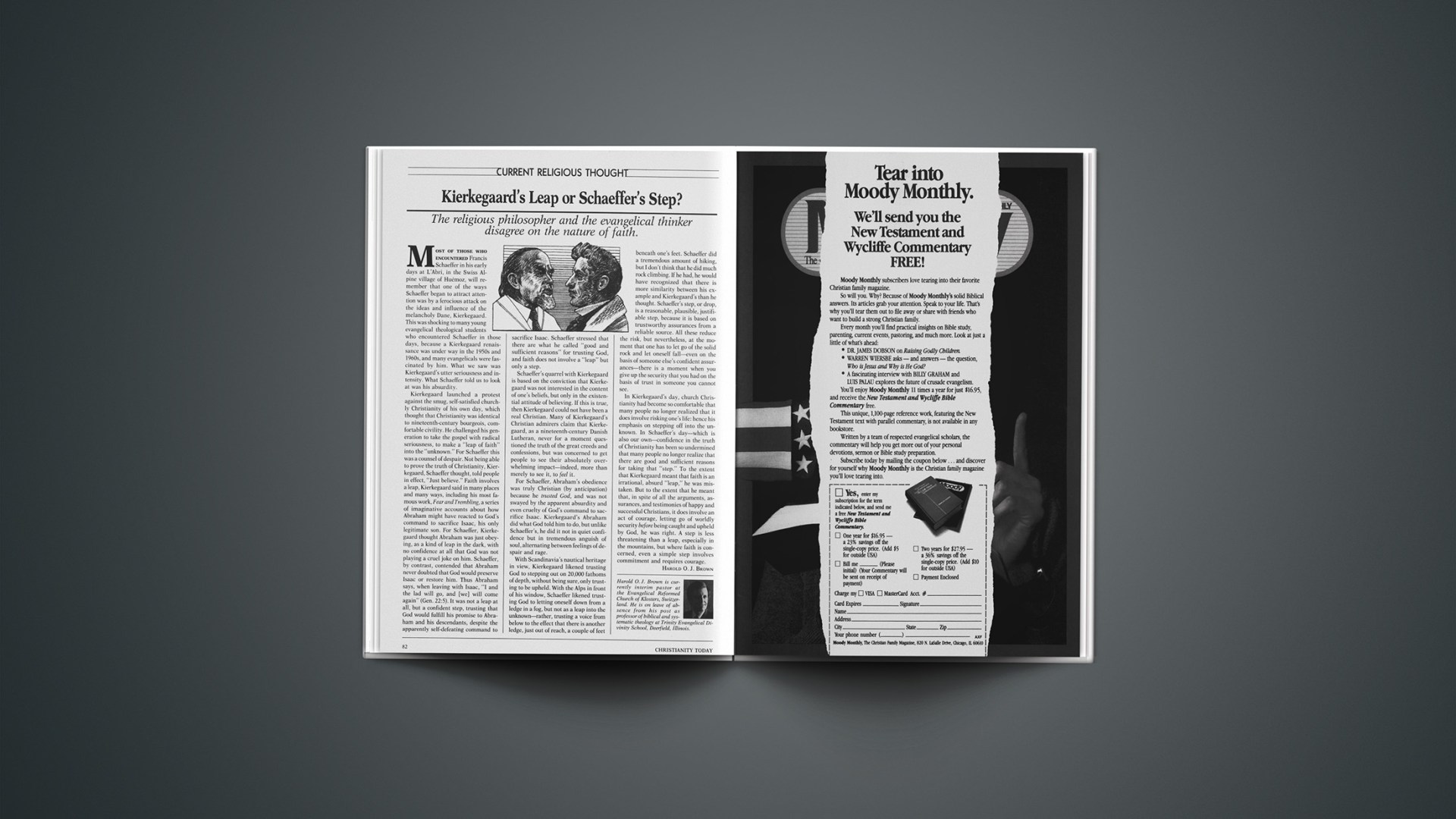

The religious philosopher and the evangelical thinker disagree on the nature of faith.
Most of those who encountered Francis Schaeffer in his early days at L’Abri, in the Swiss Alpine village of Huémoz, will remember that one of the ways Schaeffer began to attract attention was by a ferocious attack on the ideas and influence of the melancholy Dane, Kierkegaard. This was shocking to many young evangelical theological students who encountered Schaeffer in those days, because a Kierkegaard renaissance was under way in the 1950s and 1960s, and many evangelicals were fascinated by him. What we saw was Kierkegaard’s utter seriousness and intensity. What Schaeffer told us to look at was his absurdity.
Kierkegaard launched a protest against the smug, self-satisfied churchly Christianity of his own day, which thought that Christianity was identical to nineteenth-century bourgeois, comfortable civility. He challenged his generation to take the gospel with radical seriousness, to make a “leap of faith” into the “unknown.” For Schaeffer this was a counsel of despair. Not being able to prove the truth of Christianity, Kierkegaard, Schaeffer thought, told people in effect, “Just believe.” Faith involves a leap, Kierkegaard said in many places and many ways, including his most famous work, Fear and Trembling, a series of imaginative accounts about how Abraham might have reacted to God’s command to sacrifice Isaac, his only legitimate son. For Schaeffer, Kierkegaard thought Abraham was just obeying, as a kind of leap in the dark, with no confidence at all that God was not playing a cruel joke on him. Schaeffer, by contrast, contended that Abraham never doubted that God would preserve Isaac or restore him. Thus Abraham says, when leaving with Isaac, “I and the lad will go, and [we] will come again” (Gen. 22:5). It was not a leap at all, but a confident step, trusting that God would fulfill his promise to Abraham and his descendants, despite the apparently self-defeating command to sacrifice Isaac. Schaeffer stressed that there are what he called “good and sufficient reasons” for trusting God, and faith does not involve a “leap” but only a step.
Schaeffer’s quarrel with Kierkegaard is based on the conviction that Kierkegaard was not interested in the content of one’s beliefs, but only in the existential attitude of believing. If this is true, then Kierkegaard could not have been a real Christian. Many of Kierkegaard’s Christian admirers claim that Kierkegaard, as a nineteenth-century Danish Lutheran, never for a moment questioned the truth of the great creeds and confessions, but was concerned to get people to see their absolutely overwhelming impact—indeed, more than merely to see it, to feel it.
For Schaeffer, Abraham’s obedience was truly Christian (by anticipation) because he trusted God, and was not swayed by the apparent absurdity and even cruelty of God’s command to sacrifice Isaac. Kierkegaard’s Abraham did what God told him to do, but unlike Schaeffer’s, he did it not in quiet confidence but in tremendous anguish of soul, alternating between feelings of despair and rage.
With Scandinavia’s nautical heritage in view, Kierkegaard likened trusting God to stepping out on 20,000 fathoms of depth, without being sure, only trusting to be upheld. With the Alps in front of his window, Schaeffer likened trusting God to letting oneself down from a ledge in a fog, but not as a leap into the unknown—rather, trusting a voice from below to the effect that there is another ledge, just out of reach, a couple of feet beneath one’s feet. Schaeffer did a tremendous amount of hiking, but I don’t think that he did much rock climbing. If he had, he would have recognized that there is more similarity between his example and Kierkegaard’s than he thought. Schaeffer’s step, or drop, is a reasonable, plausible, justifiable step, because it is based on trustworthy assurances from a reliable source. All these reduce the risk, but nevertheless, at the moment that one has to let go of the solid rock and let oneself fall—even on the basis of someone else’s confident assurances—there is a moment when you give up the security that you had on the basis of trust in someone you cannot see.
In Kierkegaard’s day, church Christianity had become so comfortable that many people no longer realized that it does involve risking one’s life: hence his emphasis on stepping off into the unknown. In Schaeffer’s day—which is also our own—confidence in the truth of Christianity has been so undermined that many people no longer realize that there are good and sufficient reasons for taking that “step.” To the extent that Kierkegaard meant that faith is an irrational, absurd “leap,” he was mistaken. But to the extent that he meant that, in spite of all the arguments, assurances, and testimonies of happy and successful Christians, it does involve an act of courage, letting go of worldly security before being caught and upheld by God, he was right. A step is less threatening than a leap, especially in the mountains, but where faith is concerned, even a simple step involves commitment and requires courage.
Harold O. J. Brown is currently interim pastor at the Evangelical Reformed Church of Klosters, Switzerland. He is on leave of absence from his post as professor of biblical and systematic theology at Trinity Evangelical Divinity School, Deerfield, Illinois.