





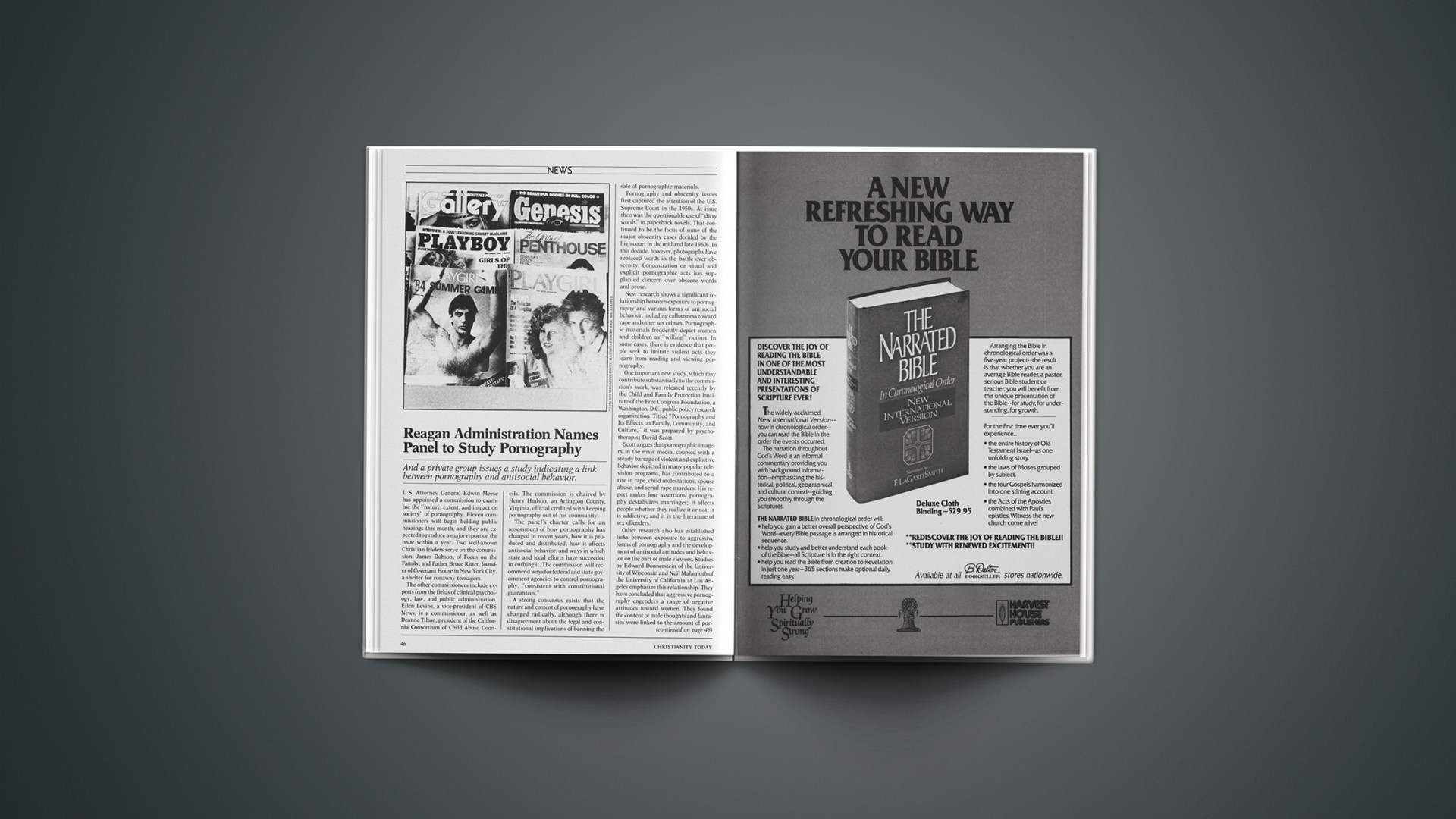

And a private group issues a study indicating a link between pornography and antisocial behavior.
U.S. Attorney General Edwin Meese has appointed a commission to examine the “nature, extent, and impact on society” of pornography. Eleven commissioners will begin holding public hearings this month, and they are expected to produce a major report on the issue within a year. Two well-known Christian leaders serve on the commission: James Dobson, of Focus on the Family; and Father Bruce Ritter, founder of Covenant House in New York City, a shelter for runaway teenagers.
The other commissioners include experts from the fields of clinical psychology, law, and public administration. Ellen Levine, a vice-president of CBS News, is a commissioner, as well as Deanne Tilton, president of the California Consortium of Child Abuse Councils. The commission is chaired by Henry Hudson, an Arlington County, Virginia, official credited with keeping pornography out of his community.
The panel’s charter calls for an assessment of how pornography has changed in recent years, how it is produced and distributed, how it affects antisocial behavior, and ways in which state and local efforts have succeeded in curbing it. The commission will recommend ways for federal and state government agencies to control pornography, “consistent with constitutional guarantees.”
A strong consensus exists that the nature and content of pornography have changed radically, although there is disagreement about the legal and constitutional implications of banning the sale of pornographic materials.
Pornography and obscenity issues first captured the attention of the U.S. Supreme Court in the 1950s. At issue then was the questionable use of “dirty words” in paperback novels. That continued to be the focus of some of the major obscenity cases decided by the high court in the mid and late 1960s. In this decade, however, photographs have replaced words in the battle over obscenity. Concentration on visual and explicit pornographic acts has supplanted concern over obscene words and prose.
New research shows a significant relationship between exposure to pornography and various forms of antisocial behavior, including callousness toward rape and other sex crimes. Pornographic materials frequently depict women and children as “willing” victims. In some cases, there is evidence that people seek to imitate violent acts they learn from reading and viewing pornography.
One important new study, which may contribute substantially to the commission’s work, was released recently by the Child and Family Protection Institute of the Free Congress Foundation, a Washington, D.C., public policy research organization. Titled “Pornography and Its Effects on Family, Community, and Culture,” it was prepared by psychotherapist David Scott.
Scott argues that pornographic imagery in the mass media, coupled with a steady barrage of violent and exploitive behavior depicted in many popular television programs, has contributed to a rise in rape, child molestations, spouse abuse, and serial rape murders. His report makes four assertions: pornography destabilizes marriages; it affects people whether they realize it or not; it is addictive; and it is the literature of sex offenders.
Other research also has established links between exposure to aggressive forms of pornography and the development of antisocial attitudes and behavior on the part of male viewers. Studies by Edward Donnerstein of the University of Wisconsin and Neil Malamuth of the University of California at Los Angeles emphasize this relationship. They have concluded that aggressive pornography engenders a range of negative attitudes toward women. They found the content of male thoughts and fantasies were linked to the amount of pornography to which they were exposed.
Scott’s study, however, makes a bolder and more controversial claim. His evidence indicates that repeated exposure—even to nonviolent, soft-core pornography—can produce negative effects. He argues that pornography can adversely affect “normal persons” as well as individuals with a variety of personality disorders.
“Pornographic material decreases sexual satisfaction and contributes to an overall decline in belief in the viability of marriage,” Scott writes. Massive exposure to these materials leads to a devaluation and depreciation of the importance of monogamy, he reports, causing nonmonogamous relationships to be viewed as normal. In addition, he says, pornography whets the appetite for more deviant material, and viewers incorporate what they see into their sexual practices.
Evidence is presented to depict pornography as addictive—forcing the consumer to require greater quantities of more intense material to maintain a level of gratification. Many move from “soft” pornography to the violent and explicit “hard” pornography being made more accessible by the television and film industries, Scott writes.
Perhaps most disturbing are Scott’s conclusions regarding links between pornography and crime. He claims that dangerous offenders, such as rapists and child molesters, incorporate deviant pornographic material into their preparatory stimulation before seeking a victim.
The results of Scott’s research directly contradict conclusions in a 1970 report from a presidential commission on pornography. That commission argued that there was insufficient evidence to show whether pornography causes harm to individuals or society. Pornography might even have a potentially therapeutic and cathartic value for some, the report said. It recommended the repeal of laws controlling pornography for adults.
Critics of the 1970 commission charged that it ignored or suppressed available evidence. Its findings ultimately were rejected by the U.S. Senate and by the U.S. Supreme Court. However, Scott says the mass media did not reject the report, and the general public thus began to accept the commission’s “no-harm” conclusions. The pornography industry has grown to a $7 billion-a-year business.







