





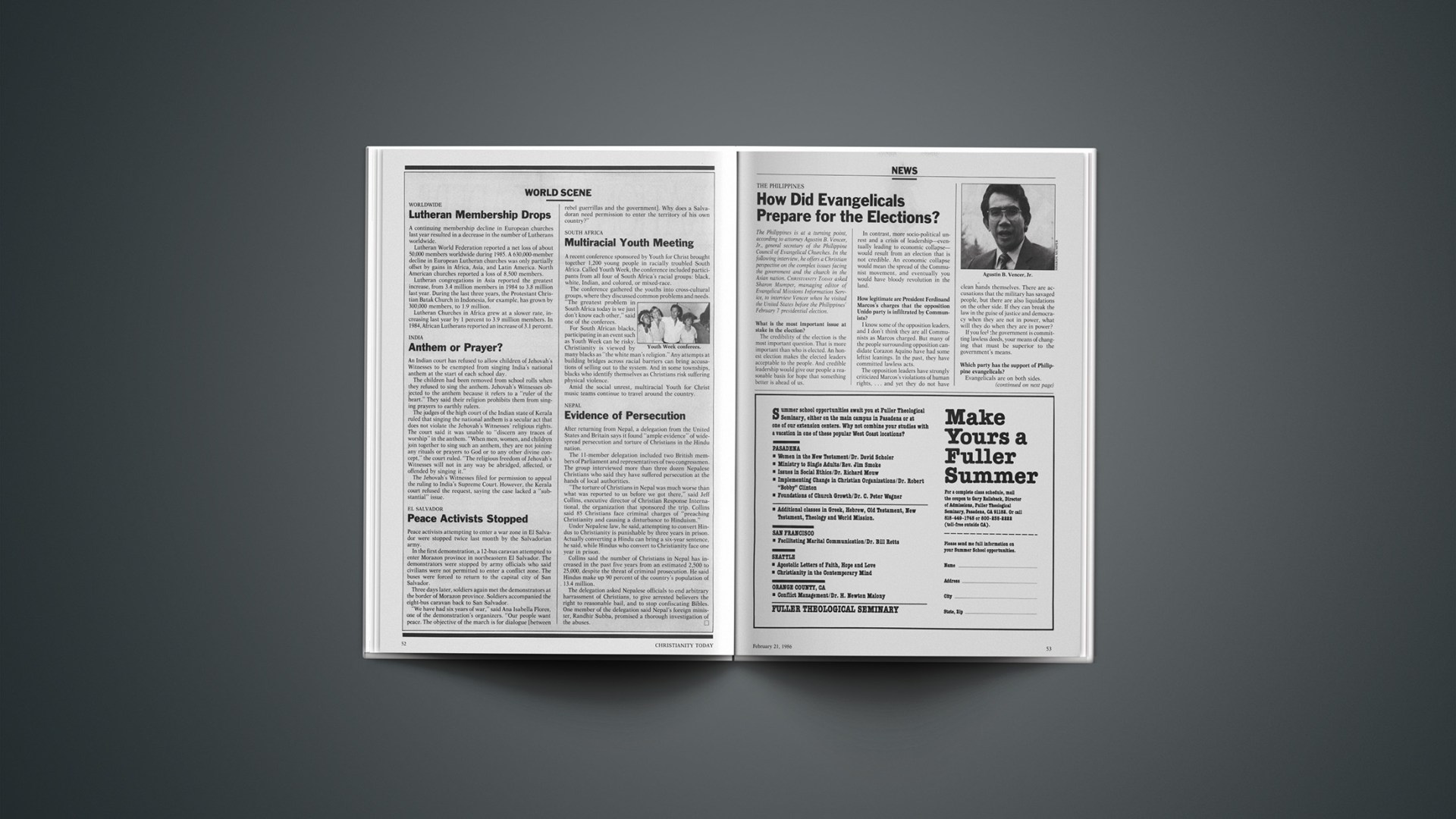

The Philippines is at a turning point, according to attorney Agustin B. Veneer, Jr., general secretary of the Philippine Council of Evangelical Churches. In the following interview, he offers a Christian perspective on the complex issues facing the government and the church in the Asian nation. CHRISTIANITY TODAY asked Sharon Mumper, managing editor of Evangelical Missions Information Service, to interview Veneer when he visited the United States before the Philippines’ February 7 presidential election.
What is the most important issue at stake in the election?
The credibility of the election is the most important question. That is more important than who is elected. An honest election makes the elected leaders acceptable to the people. And credible leadership would give our people a reasonable basis for hope that something better is ahead of us.
In contrast, more socio-political unrest and a crisis of leadership—eventually leading to economic collapse—would result from an election that is not credible. An economic collapse would mean the spread of the Communist movement, and eventually you would have bloody revolution in the land.
How legitimate are President Ferdinand Marcos’s charges that the opposition Unido party is infiltrated by Communists?
I know some of the opposition leaders, and I don’t think they are all Communists as Marcos charged. But many of the people surrounding opposition candidate Corazon Aquino have had some leftist leanings. In the past, they have committed lawless acts.
The opposition leaders have strongly criticized Marcos’s violations of human rights, … and yet they do not have clean hands themselves. There are accusations that the military has savaged people, but there are also liquidations on the other side. If they can break the law in the guise of justice and democracy when they are not in power, what will they do when they are in power?
If you feel the government is committing lawless deeds, your means of changing that must be superior to the government’s means.
Which party has the support of Philippine evangelicals?
Evangelicals are on both sides.
As a Christian leader, what recommendations have you made to evangelicals in the Philippines?
We did not suggest they vote for a particular candidate. But we did ask them to pray and work for a credible election. We told them to campaign hard for their candidates, but to be the leaven of the kingdom in their respective political parties. We asked church leaders to tell their people not to engage in fraud and violence. And we asked evangelicals who were helping to implement the election codes to do it faithfully and honestly. Beyond that, we encouraged them to vote and pray.
How do Philippine evangelicals view involvement in social and political programs?
The era of social responsibility is dawning. Our people are responding to the needs of their countrymen. Without neglecting evangelism, they are trying to proclaim the whole counsel of God in word and in work.
Evangelical writers are encouraging people to be involved in social and political issues. In the years ahead, God will lay his hand upon young men and women to work in politics and government.
What is the state of the church in the Philippines?
It is growing. Within the denominations that have submitted membership data, growth during the past year ranges from 20 to 150 percent. During the past decade, the average growth rate of denominations in the Philippine Council of Evangelical Churches was about 150 percent.
How has the church been affected by civil unrest and violence?
Many people have given their lives for the gospel. Some Christians have told me they have been prohibited from holding Bible studies or prayer meetings. In spite of such conditions, our people are experiencing a new commitment to the Lord. Many of them remain in dangerous areas, and their churches are growing. There is a sense of unity and caring among the churches. When one church is needy, the others respond.
Churches have held evangelistic meetings in towns that are declared to be dangerous. Most people in those areas close their houses early in the evening and remain indoors. But the Christians pray and fast, and then hold evangelistic meetings in the evening. Thousands of people have come to those meetings, and hundreds have come to the altar. In one place, the town’s only church was burned. Now there are two churches in that town.







