
Theocracy advocates and home schoolers call for the wholesale abandonment of public schools.
Fifteen years ago public education was the only viable option for most children of Christian parents. Today, not only are there other options, but public education’s most radical opponents say the public school is not a genuine option for Christians truly concerned about their children and their world.
This stance came through strongly at a conference last month organized by leaders in a movement known as Christian Reconstruction. Paul Lindstrom, head of the Christian Liberty Academy (a church school) in the Chicago suburb of Arlington Heights, categorically rejected the authority of the state in all matters related to education.
Lindstrom, whose academy hosted the meeting, suggested that Christian parents commit “blasphemy against Jesus Christ” by enrolling their children in the schools of “the Philistines.” He labeled public education a “multi-billion dollar taxpayer rip-off” and called for warfare against the humanist elite that controls America’s culture and its schools.
Lindstrom, also the pastor of his academy’s sponsoring church, oversees a satellite school system for home educators with an enrollment of over 22,000 children in 36 countries. Among his home school families are thousands of Catholics and Mormons, including the son of the head of the Mormon church (Ezra Taft Benson).
The strong support of seminar leader Bill Gothard has generated many of the participants in the academy program, which costs a family $210 per child annually. Lindstrom encourages families to avoid seeking permission from state authorities to conduct home schools and “simply take their stand on biblical grounds.”
The Christian Reconstruction movement, also called theonomy, is characterized by its support for a theocracy in which conservative Christians would be in charge. The movement’s influence is generally regarded as small, but growing. Its aggressive posture and the scholarly demeanor of some of its leaders have earned the movement a hearing among Christian parents frustrated with public schools.
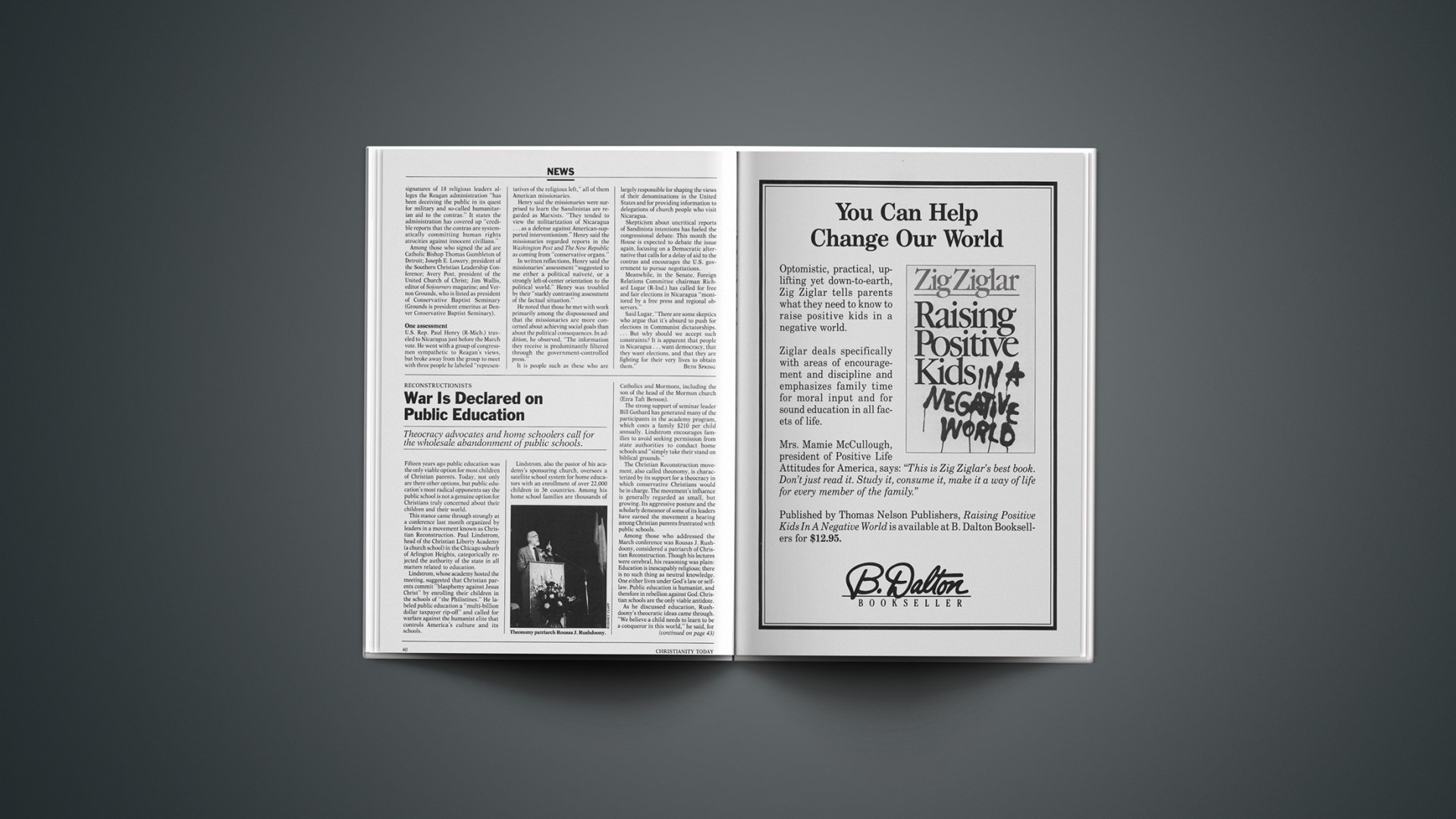
Among those who addressed the March conference was Rousas J. Rush-doony, considered a patriarch of Christian Reconstruction. Though his lectures were cerebral, his reasoning was plain: Education is inescapably religious; there is no such thing as neutral knowledge. One either lives under God’s law or selflaw. Public education is humanist, and therefore in rebellion against God. Christian schools are the only viable antidote.
As he discussed education, Rushdoony’s theocratic ideas came through. “We believe a child needs to learn to be a conqueror in this world,” he said, for “a generation of barbarians is busily destroying this civilization.” He went on: “But nothing is secular for God. All things are to be governed by his Word. The Bible is binding on the state as much as the church. It gives us God’s marching orders.”
Samuel Blumenfeld, a writer, educator, and harsh critic of public education, leveled the most ambitious charge against public education. He alleged that public educators have deliberately downgraded the literary skills of Americans to make them more amenable to socialism. The main instrument for this conspiracy, he said, was the “look-say” method of reading instruction installed in the 1930s to replace traditional phonics methods.
Blumenfeld praised the Reconstruction movement for its separatist stance and its willingness to oppose the “Satanic control” of the schools. “We must first remove the obstacles,” he proposed, “including the restrictions on home schooling, mandatory attendance laws, and teacher certification requirements. Then we must separate ourselves financially and stop paying for education that is calculated to destroy us. This is a war that only one side can win.”
Even Christian schools did not escape criticism at the conference. Speakers attacked the use of humanistic texts by some Christian educators and alleged that teachers certified at university-related colleges of education were tainted with anti-Christian values and methodologies. The implication was that Christian educators need to make a radical break from secular schools and build a system based solely on biblical principles.
The Reconstructionist claim that the Bible must undergird and inform every discipline has attracted parents seeking a Christian alternative. But at the conference there was little guidance on how this is to be implemented.
One publisher in attendance enjoyed steady sales of such nineteenth-century classics as McGuffey’s Readers. But beyond revised American history texts and phonics reading manuals, there was little new material that lived up to the ideals of a Christian curriculum espoused by Rushdoony.
in Arlington Heights