





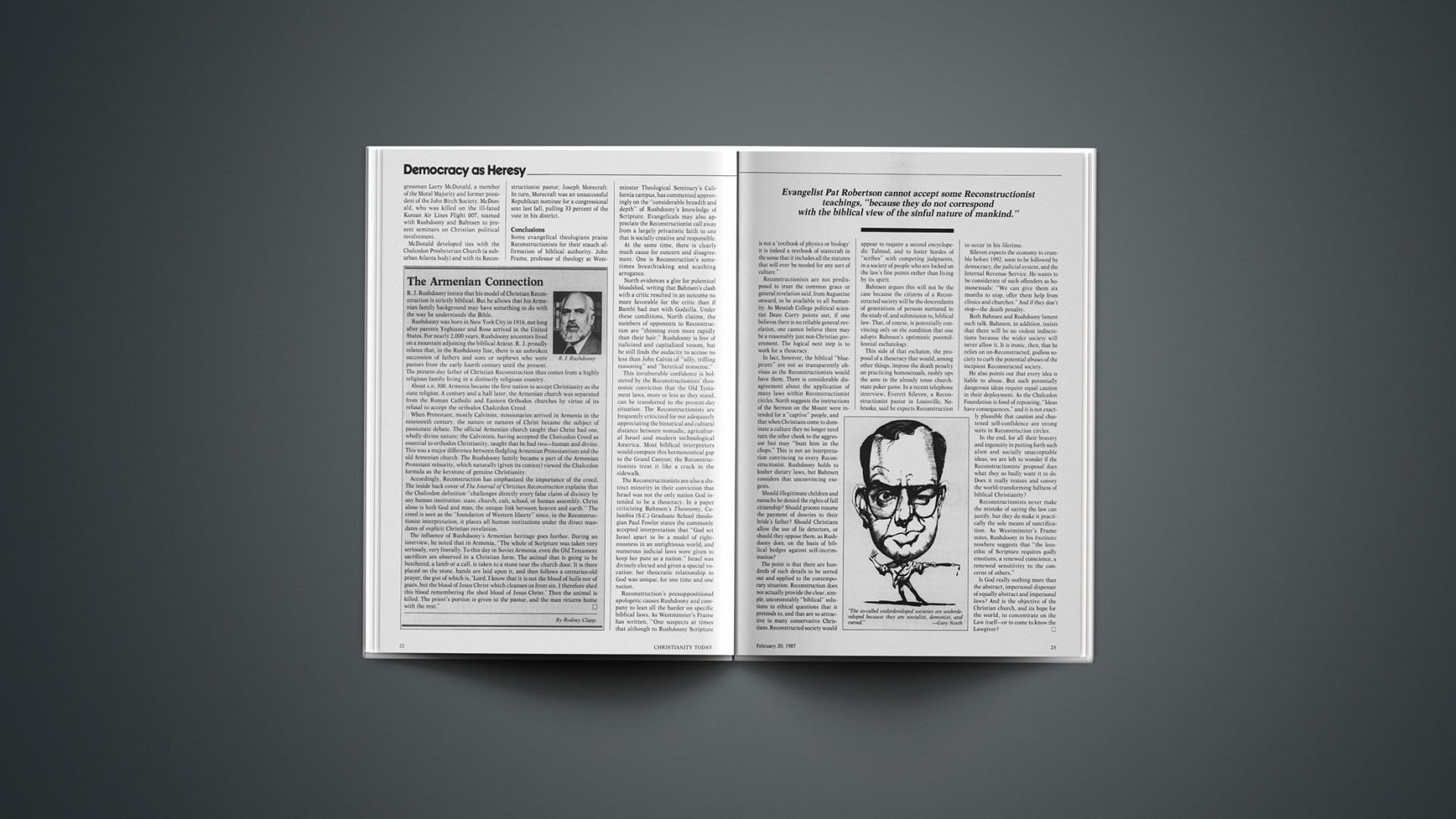

R. J. Rushdoony insists that his model of Christian Reconstruction is strictly biblical. But he allows that his Armenian family background may have something to do with the way he understands the Bible.
Rushdoony was born in New York City in 1916, not long after parents Yeghiazar and Rose arrived in the United States. For nearly 2,000 years, Rushdoony ancestors lived on a mountain adjoining the biblical Ararat. R. J. proudly relates that, in the Rushdoony line, there is an unbroken succession of fathers and sons or nephews who were pastors from the early fourth century until the present. The present-day father of Christian Reconstruction thus comes from a highly religious family living in a distinctly religious country.
About A.D. 300, Armenia became the first nation to accept Christianity as the state religion. A century and a half later, the Armenian church was separated from the Roman Catholic and Eastern Orthodox churches by virtue of its refusal to accept the orthodox Chalcedon Creed.
When Protestant, mostly Calvinist, missionaries arrived in Armenia in the nineteenth century, the nature or natures of Christ became the subject of passionate debate. The official Armenian church taught that Christ had one, wholly divine nature; the Calvinists, having accepted the Chalcedon Creed as essential to orthodox Christianity, taught that he had two—human and divine. This was a major difference between fledgling Armenian Protestantism and the old Armenian church. The Rushdoony family became a part of the Armenian Protestant minority, which naturally (given its context) viewed the Chalcedon formula as the keystone of genuine Christianity.
Accordingly, Reconstruction has emphasized the importance of the creed. The inside back cover of The Journal of Christian Reconstruction explains that the Chalcedon definition “challenges directly every false claim of divinity by any human institution: state, church, cult, school, or human assembly. Christ alone is both God and man, the unique link between heaven and earth.” The creed is seen as the “foundation of Western liberty” since, in the Reconstructionist interpretation, it places all human institutions under the direct mandates of explicit Christian revelation.
The influence of Rushdoony’s Armenian heritage goes further. During an interview, he noted that in Armenia, “The whole of Scripture was taken very seriously, very literally. To this day in Soviet Armenia, even the Old Testament sacrifices are observed in a Christian form. The animal that is going to be butchered, a lamb or a calf, is taken to a stone near the church door. It is there placed on the stone, hands are laid upon it, and then follows a centuries-old prayer, the gist of which is, ‘Lord, I know that it is not the blood of bulls nor of goats, but the blood of Jesus Christ which cleanses us from sin. I therefore shed this blood remembering the shed blood of Jesus Christ.’ Then the animal is killed. The priest’s portion is given to the pastor, and the man returns home with the rest.”
By Rodney Clapp.







