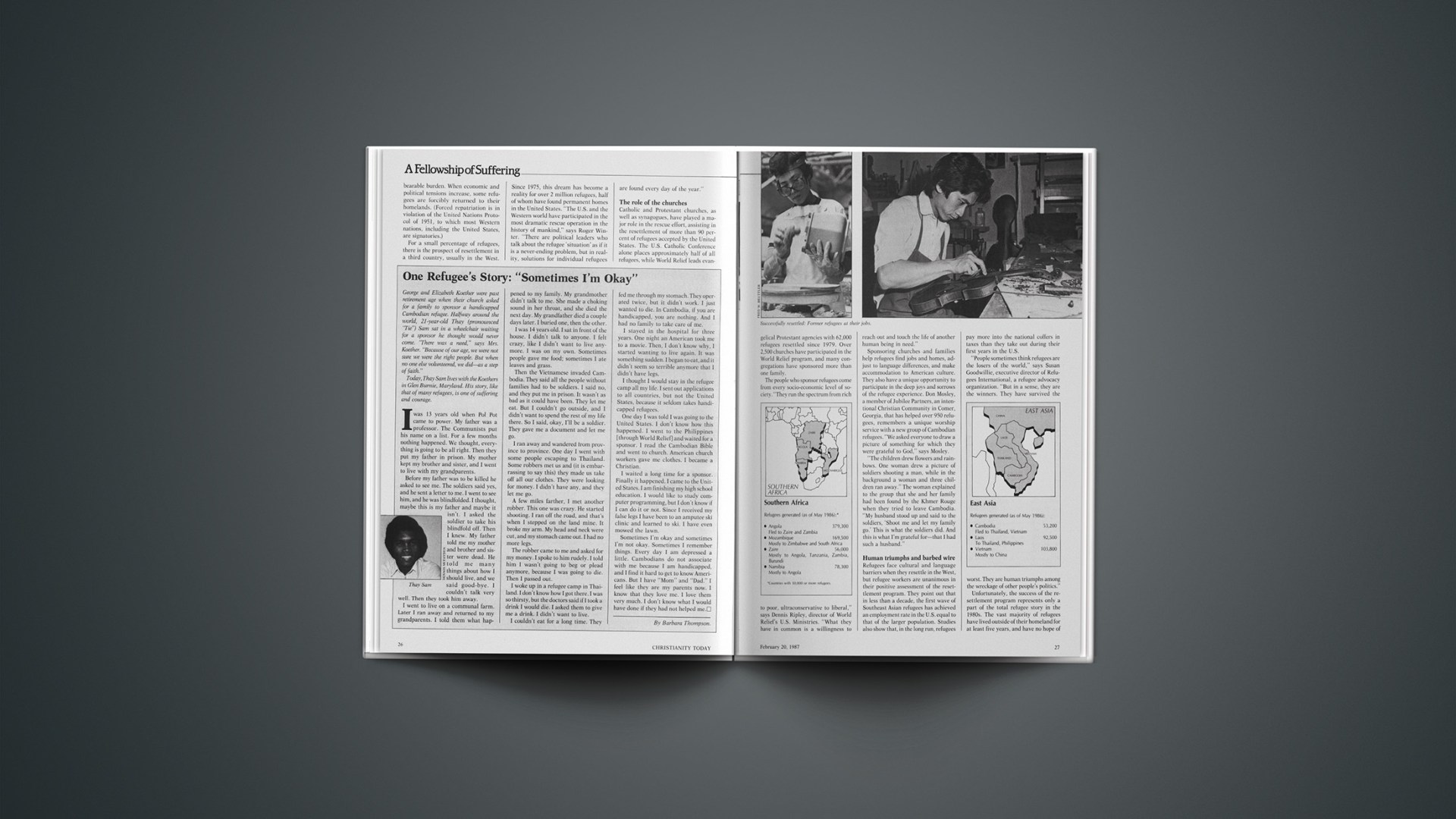

George and Elizabeth Koether were past retirement age when their church asked for a family to sponsor a handicapped Cambodian refugee. Halfway around the world, 21-year-old Thay (pronounced “Tie”) Sam sat in a wheelchair waiting for a sponsor he thought would never come. “There was a need,” says Mrs. Koether. “Because of our age, we were not sure we were the right people. But when no one else volunteered, we did—as a step of faith.”
Today, Thay Sam lives with the Koethers in Glen Burnie, Maryland. His story, like that of many refugees, is one of suffering and courage.
I was 13 years old when Pol Pot came to power. My father was a professor. The Communists put his name on a list. For a few months nothing happened. We thought, everything is going to be all right. Then they put my father in prison. My mother kept my brother and sister, and I went to live with my grandparents.
Before my father was to be killed he asked to see me. The soldiers said yes, and he sent a letter to me. I went to see him, and he was blindfolded. I thought, maybe this is my father and maybe it isn’t. I asked the soldier to take his blindfold off. Then I knew. My father told me my mother and brother and sister were dead. He told me many things about how I should live, and we said good-bye. I couldn’t talk very well. Then they took him away.
I went to live on a communal farm. Later I ran away and returned to my grandparents. I told them what happened to my family. My grandmother didn’t talk to me. She made a choking sound in her throat, and she died the next day. My grandfather died a couple days later. I buried one, then the other.
I was 14 years old. I sat in front of the house. I didn’t talk to anyone. I felt crazy, like I didn’t want to live anymore. I was on my own. Sometimes people gave me food; sometimes I ate leaves and grass.
Then the Vietnamese invaded Cambodia. They said all the people without families had to be soldiers. I said no, and they put me in prison. It wasn’t as bad as it could have been. They let me eat. But I couldn’t go outside, and I didn’t want to spend the rest of my life there. So I said, okay, I’ll be a soldier. They gave me a document and let me go.
I ran away and wandered from province to province. One day I went with some people escaping to Thailand. Some robbers met us and (it is embarrassing to say this) they made us take off all our clothes. They were looking for money. I didn’t have any, and they let me go.
A few miles farther, I met another robber. This one was crazy. He started shooting. I ran off the road, and that’s when I stepped on the land mine. It broke my arm. My head and neck were cut, and my stomach came out. I had no more legs.
The robber came to me and asked for my money. I spoke to him rudely. I told him I wasn’t going to beg or plead anymore, because I was going to die. Then I passed out.
I woke up in a refugee camp in Thailand. I don’t know how I got there. I was so thirsty, but the doctors said if I took a drink I would die. I asked them to give me a drink. I didn’t want to live.
I couldn’t eat for a long time. They fed me through my stomach. They operated twice, but it didn’t work. I just wanted to die. In Cambodia, if you are handicapped, you are nothing. And I had no family to take care of me.
I stayed in the hospital for three years. One night an American took me to a movie. Then, I don’t know why, I started wanting to live again. It was something sudden. I began to eat, and it didn’t seem so terrible anymore that I didn’t have legs.
I thought I would stay in the refugee camp all my life. I sent out applications to all countries, but not the United States, because it seldom takes handicapped refugees.
One day I was told I was going to the United States. I don’t know how this happened. I went to the Philippines [through World Relief] and waited for a sponsor. I read the Cambodian Bible and went to church. American church workers gave me clothes. I became a Christian.
I waited a long time for a sponsor. Finally it happened. I came to the United States. I am finishing my high school education. I would like to study computer programming, but I don’t know if I can do it or not. Since I received my false legs I have been to an amputee ski clinic and learned to ski. I have even mowed the lawn.
Sometimes I’m okay and sometimes I’m not okay. Sometimes I remember things. Every day I am depressed a little. Cambodians do not associate with me because I am handicapped, and I find it hard to get to know Americans. But I have “Mom” and “Dad.” I feel like they are my parents now. I know that they love me. I love them very much. I don’t know what I would have done if they had not helped me.
By Barbara Thompson.