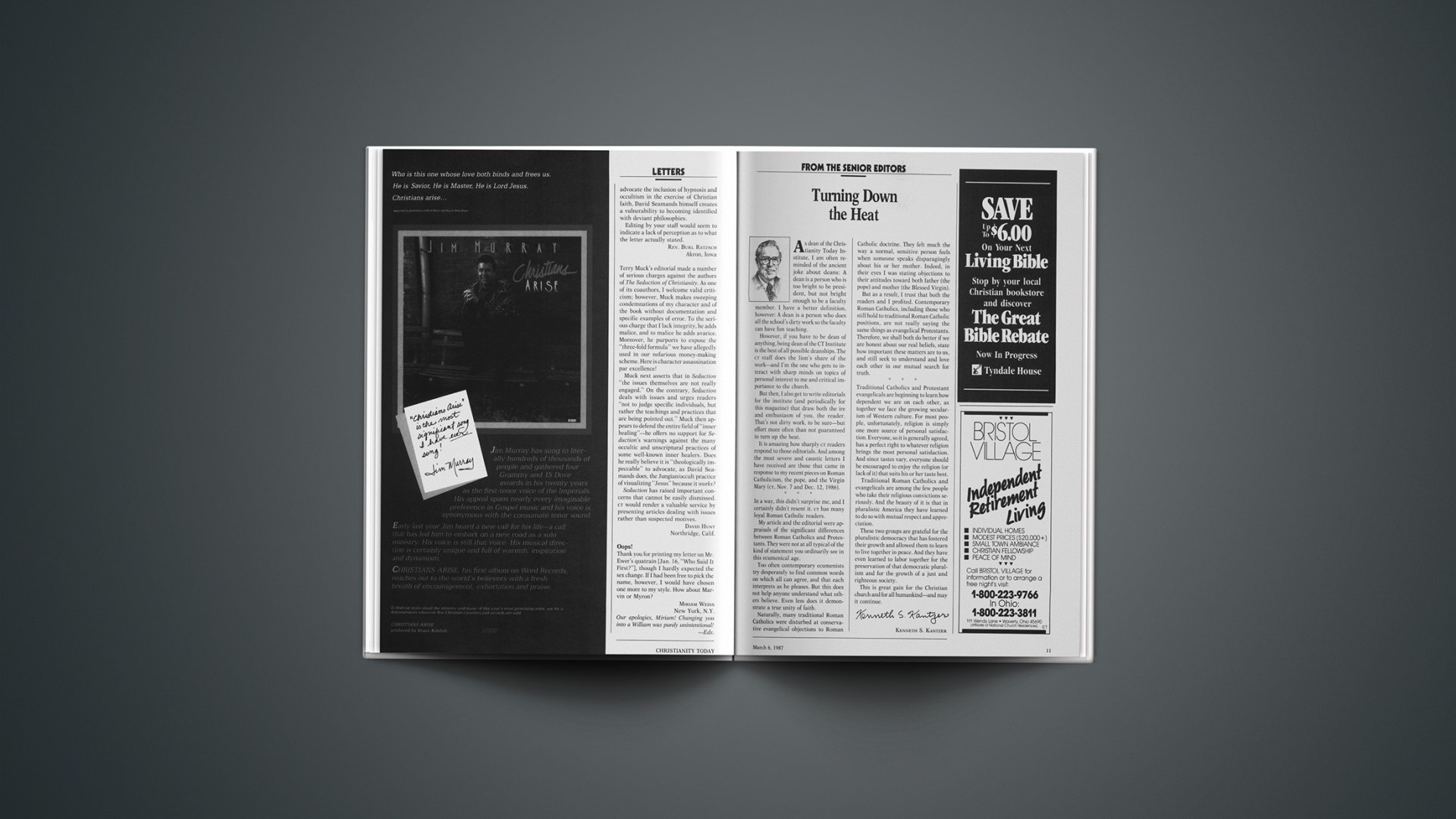

As dean of the Christianity Today Institute, I am often reminded of the ancient joke about deans: A dean is a person who is too bright to be president, but not bright enough to be a faculty member. I have a better definition, however: A dean is a person who does all the school’s dirty work so the faculty can have fun teaching.
However, if you have to be dean of anything, being dean of the CT Institute is the best of all possible deanships. The CT staff does the lion’s share of the work—and I’m the one who gets to interact with sharp minds on topics of personal interest to me and critical importance to the church.
But then, I also get to write editorials for the institute (and periodically for this magazine) that draw both the ire and enthusiasm of you, the reader. That’s not dirty work, to be sure—but effort more often than not guaranteed to turn up the heat.
It is amazing how sharply CT readers respond to those editorials. And among the most severe and caustic letters I have received are those that came in response to my recent pieces on Roman Catholicism, the pope, and the Virgin Mary (CT, NOV. 7 and Dec. 12, 1986).
In a way, this didn’t surprise me, and I certainly didn’t resent it. CT has many loyal Roman Catholic readers.
My article and the editorial were appraisals of the significant differences between Roman Catholics and Protestants. They were not at all typical of the kind of statement you ordinarily see in this ecumenical age.
Too often contemporary ecumenists try desperately to find common words on which all can agree, and that each interprets as he pleases. But this does not help anyone understand what others believe. Even less does it demonstrate a true unity of faith.
Naturally, many traditional Roman Catholics were disturbed at conservative evangelical objections to Roman Catholic doctrine. They felt much the way a normal, sensitive person feels when someone speaks disparagingly about his or her mother. Indeed, in their eyes I was stating objections to their attitudes toward both father (the pope) and mother (the Blessed Virgin).
But as a result, I trust that both the readers and I profited. Contemporary Roman Catholics, including those who still hold to traditional Roman Catholic positions, are not really saying the same things as evangelical Protestants. Therefore, we shall both do better if we are honest about our real beliefs, state how important these matters are to us, and still seek to understand and love each other in our mutual search for truth.
Traditional Catholics and Protestant evangelicals are beginning to learn how dependent we are on each other, as together we face the growing secularism of Western culture. For most people, unfortunately, religion is simply one more source of personal satisfaction. Everyone, so it is generally agreed, has a perfect right to whatever religion brings the most personal satisfaction. And since tastes vary, everyone should be encouraged to enjoy the religion (or lack of it) that suits his or her taste best.
Traditional Roman Catholics and evangelicals are among the few people who take their religious convictions seriously. And the beauty of it is that in pluralistic America they have learned to do so with mutual respect and appreciation.
These two groups are grateful for the pluralistic democracy that has fostered their growth and allowed them to learn to live together in peace. And they have even learned to labor together for the preservation of that democratic pluralism and for the growth of a just and righteous society.
This is great gain for the Christian church and for all humankind—and may it continue.
KENNETH S. KANTZER