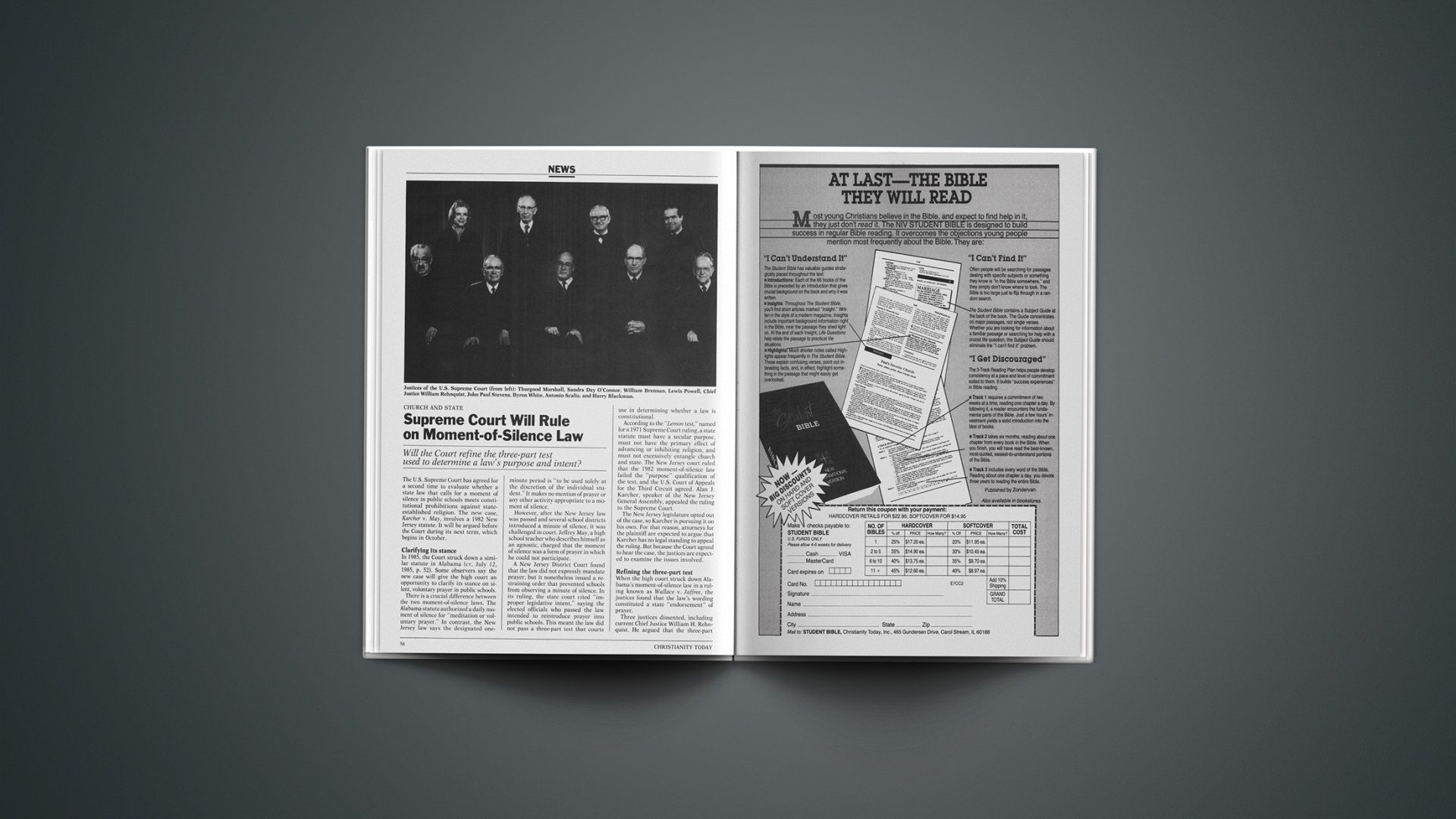

The U.S. Supreme Court has agreed for a second time to evaluate whether a state law that calls for a moment of silence in public schools meets constitutional prohibitions against state-established religion. The new case, Karcher v. May, involves a 1982 New Jersey statute. It will be argued before the Court during its next term, which begins in October.
Clarifying Its Stance
In 1985, the Court struck down a similar statute in Alabama (CT, July 12, 1985, p. 52). Some observers say the new case will give the high court an opportunity to clarify its stance on silent, voluntary prayer in public schools.
There is a crucial difference between the two moment-of-silence laws. The Alabama statute authorized a daily moment of silence for “meditation or voluntary prayer.” In contrast, the New Jersey law says the designated one-minute period is “to be used solely at the discretion of the individual student.” It makes no mention of prayer or any other activity appropriate to a moment of silence.
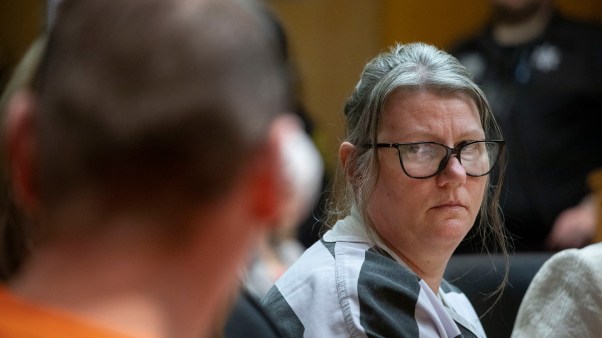
However, after the New Jersey law was passed and several school districts introduced a minute of silence, it was challenged in court. Jeffrey May, a high school teacher who describes himself as an agnostic, charged that the moment of silence was a form of prayer in which he could not participate.
A New Jersey District Court found that the law did not expressly mandate prayer, but it nonetheless issued a restraining order that prevented schools from observing a minute of silence. In its ruling, the state court cited “improper legislative intent,” saying the elected officials who passed the law intended to reintroduce prayer into public schools. This meant the law did not pass a three-part test that courts use in determining whether a law is constitutional.
According to the “Lemon test,” named for a 1971 Supreme Court ruling, a state statute must have a secular purpose, must not have the primary effect of advancing or inhibiting religion, and must not excessively entangle church and state. The New Jersey court ruled that the 1982 moment-of-silence law failed the “purpose” qualification of the test, and the U.S. Court of Appeals for the Third Circuit agreed. Alan J. Karcher, speaker of the New Jersey General Assembly, appealed the ruling to the Supreme Court.
The New Jersey legislature opted out of the case, so Karcher is pursuing it on his own. For that reason, attorneys for the plaintiff are expected to argue that Karcher has no legal standing to appeal the ruling. But because the Court agreed to hear the case, the justices are expected to examine the issues involved.
Refining the Three-Part Test
When the high court struck down Alabama’s moment-of-silence law in a ruling known as Wallace v. Jaffree, the justices found that the law’s wording constituted a state “endorsement” of prayer.
Three justices dissented, including current Chief Justice William H. Rehnquist. He argued that the three-part Lemon test should be scrapped, and attention should be paid instead to the intent of the people who wrote the U.S. Constitution. He said the notion that a state legislature should not endorse prayer would come as “a shock to those who drafted the Bill of Rights.”
The problem with the Lemon test, Rehnquist said in Wallace v. Jaffree, is that “its secular purpose prong has proven mercurial in application because it has never been fully defined.” In the New Jersey district court’s ruling, the Lemon precedent was stretched to cover legislative intent, even though the law in question is worded in completely neutral terms.
According to briefs filed in behalf of the New Jersey law, the district court expanded the meaning of the purpose test to say the state needed to have an “overwhelmingly obvious and important secular purpose.” The brief says the district court “engaged in a wholly unprecedented inquiry into the alleged subjective motivation of some legislators” when they enacted the moment-of-silence law.
Whether the Lemon test works or not, it remains “the only coherent test a majority of this court has ever adopted,” observed Supreme Court Justice Lewis Powell. Lemon has been applied in all but two cases involving the First Amendment’s establishment clause since the three-prong test was developed. It is likely the Supreme Court will explore and further refine the test’s application as it considers New Jersey’s moment-of-silence law.
Christian Legal Society staff attorney Mike Paulsen plans to submit a friend-of-the-court brief favoring the New Jersey law. He said the Supreme Court’s 1985 ruling against the Alabama law strongly suggested that other, more neutral moment-of-silence provisions fall within the boundaries of what is considered constitutional.