
WORLDWIDE
Greater Access To The Gospel
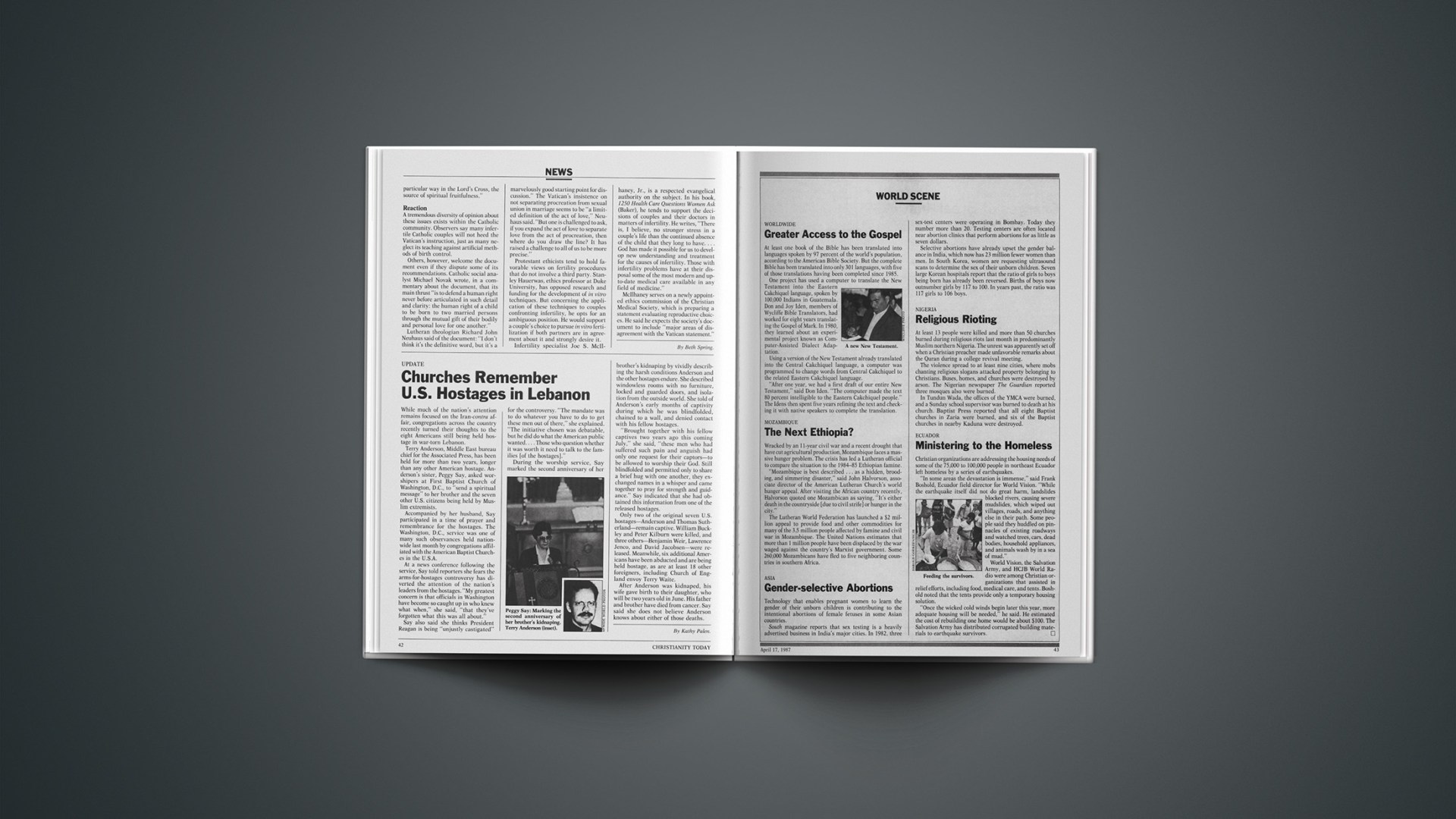
At least one book of the Bible has been translated into languages spoken by 97 percent of the world’s population, according to the American Bible Society. But the complete Bible has been translated into only 301 languages, with five of those translations having been completed since 1985.
One project has used a computer to translate the New Testament into the Eastern Cakchiquel language, spoken by 100,000 Indians in Guatemala. Don and Joy Iden, members of Wycliffe Bible Translators, had worked for eight years translating the Gospel of Mark. In 1980, they learned about an experimental project known as Computer-Assisted Dialect Adaptation.
Using a version of the New Testament already translated into the Central Cakchiquel language, a computer was programmed to change words from Central Cakchiquel to the related Eastern Cakchiquel language.
“After one year, we had a first draft of our entire New Testament,” said Don Iden. “The computer made the text 80 percent intelligible to the Eastern Cakchiquel people.” The Idens then spent five years refining the text and checking it with native speakers to complete the translation.
MOZAMBIQUE
The Next Ethiopia?
Wracked by an 11-year civil war and a recent drought that have cut agricultural production, Mozambique faces a massive hunger problem. The crisis has led a Lutheran official to compare the situation to the 1984–85 Ethiopian famine.
“Mozambique is best described … as a hidden, brooding, and simmering disaster,” said John Halvorson, associate director of the American Lutheran Church’s world hunger appeal. After visiting the African country recently, Halvorson quoted one Mozambican as saying, “It’s either death in the countryside [due to civil strife] or hunger in the city.”
The Lutheran World Federation has launched a $2 million appeal to provide food and other commodities for many of the 3.5 million people affected by famine and civil war in Mozambique. The United Nations estimates that more than 1 million people have been displaced by the war waged against the country’s Marxist government. Some 260,000 Mozambicans have fled to five neighboring countries in southern Africa.
ASIA
Gender-Selective Abortions
Technology that enables pregnant women to learn the gender of their unborn children is contributing to the intentional abortions of female fetuses in some Asian countries.
South magazine reports that sex testing is a heavily advertised business in India’s major cities. In 1982, three sex-test centers were operating in Bombay. Today they number more than 20. Testing centers are often located near abortion clinics that perform abortions for as little as seven dollars.
Selective abortions have already upset the gender balance in India, which now has 23 million fewer women than men. In South Korea, women are requesting ultrasound scans to determine the sex of their unborn children. Seven large Korean hospitals report that the ratio of girls to boys being born has already been reversed. Births of boys now outnumber girls by 117 to 100. In years past, the ratio was 117 girls to 106 boys.
NIGERIA
Religious Rioting
At least 13 people were killed and more than 50 churches burned during religious riots last month in predominantly Muslim northern Nigeria. The unrest was apparently set off when a Christian preacher made unfavorable remarks about the Quran during a college revival meeting.
The violence spread to at least nine cities, where mobs chanting religious slogans attacked property belonging to Christians. Buses, homes, and churches were destroyed by arson. The Nigerian newspaper The Guardian reported three mosques also were burned.
In Tundun Wada, the offices of the YMCA were burned, and a Sunday school supervisor was burned to death at his church. Baptist Press reported that all eight Baptist churches in Zaria were burned, and six of the Baptist churches in nearby Kaduna were destroyed.
ECUADOR
Ministering To The Homeless
Christian organizations are addressing the housing needs of some of the 75,000 to 100,000 people in northeast Ecuador left homeless by a series of earthquakes.
“In some areas the devastation is immense,” said Frank Boshold, Ecuador field director for World Vision. “While the earthquake itself did not do great harm, landslides blocked rivers, causing severe mudslides, which wiped out villages, roads, and anything else in their path. Some people said they huddled on pinnacles of existing roadways and watched trees, cars, dead bodies, household appliances, and animals wash by in a sea of mud.”
World Vision, the Salvation Army, and HCJB World Radio were among Christian organizations that assisted in relief efforts, including food, medical care, and tents. Boshold noted that the tents provide only a temporary housing solution.
“Once the wicked cold winds begin later this year, more adequate housing will be needed,” he said. He estimated the cost of rebuilding one home would be about $100. The Salvation Army has distributed corrugated building materials to earthquake survivors.