






When Pope John Paul II visits the United States later this month, he will encounter a Catholic church that traditionalists say has become too Protestant. In nine U.S. cities, John Paul will see a brand of Catholicism that is comfortable with dissent; less reliant on church hierarchies for guidance; increasingly rooted in Scripture and personal spirituality; and open to far-reaching lay leadership roles.
In New Orleans, the Pope will speak to black Catholics, whose styles of worship, preaching, and evangelism have borrowed heavily from the Protestant tradition. In San Francisco, he will meet with 3,000 lay church members who have reached levels of responsibility in ministry, liturgy, and church governance rarely seen in the Pope’s native Europe or even in the United States just a decade ago.
According to church observers, these features of American Catholicism—including a preference for open debate and broad participation—owe partly to the influence of the American political experience and its emphasis on democratic processes. In addition, some say the U.S. Catholic church’s growing sense of itself as one Christian denomination, rather than a separate religion, has contributed to similarities with other faiths.
Religious Heartland
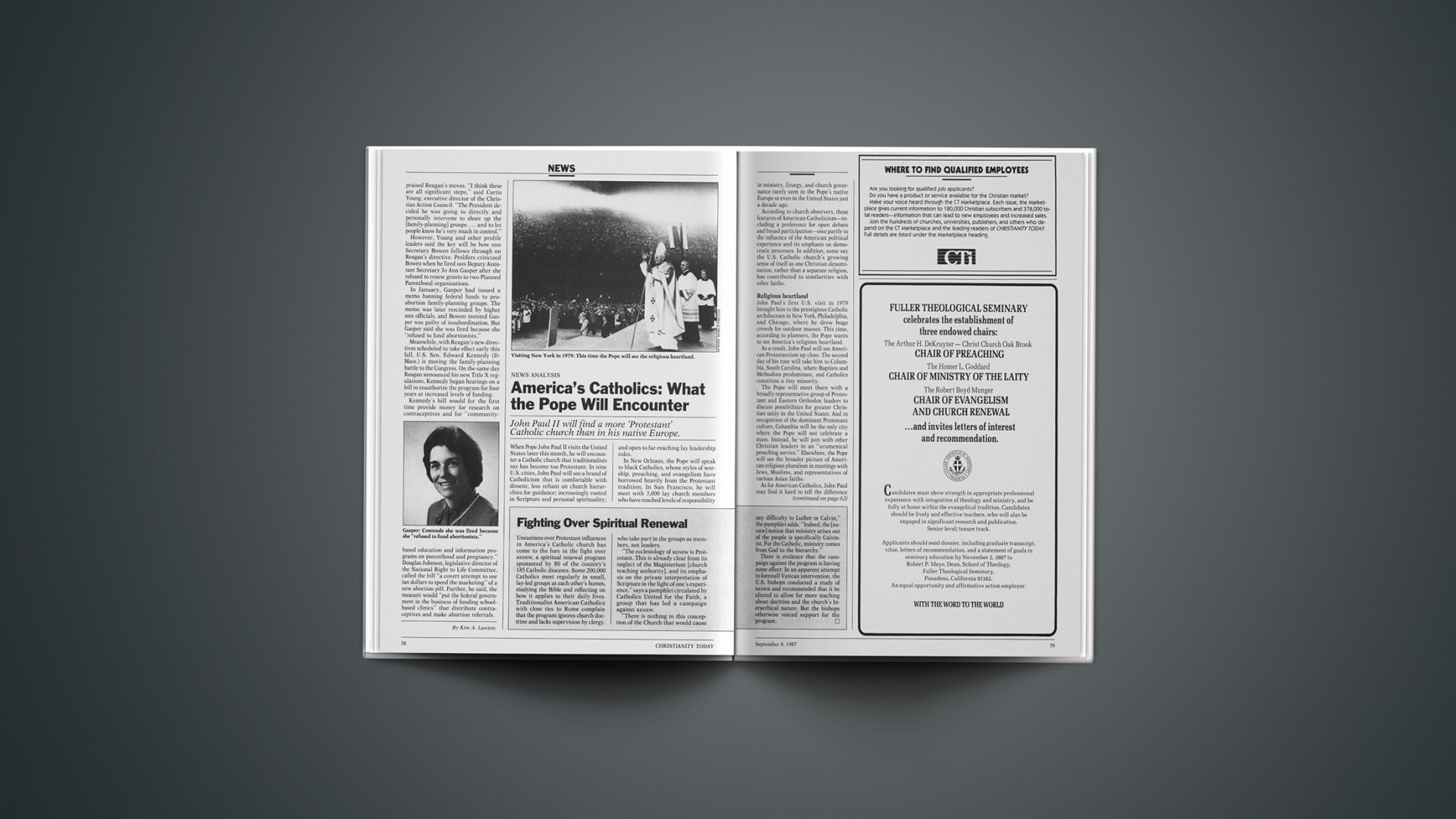
John Paul’s first U.S. visit in 1979 brought him to the prestigious Catholic archdioceses in New York, Philadelphia, and Chicago, where he drew huge crowds for outdoor masses. This time, according to planners, the Pope wants to see America’s religious heartland.
As a result, John Paul will see American Protestantism up close. The second day of his tour will take him to Columbia, South Carolina, where Baptists and Methodists predominate, and Catholics constitute a tiny minority.
The Pope will meet there with a broadly representative group of Protestant and Eastern Orthodox leaders to discuss possibilities for greater Christian unity in the United States. And in recognition of the dominant Protestant culture, Columbia will be the only city where the Pope will not celebrate a mass. Instead, he will join with other Christian leaders in an “ecumenical preaching service.” Elsewhere, the Pope will see the broader picture of American religious pluralism in meetings with Jews, Muslims, and representatives of various Asian faiths.
As for American Catholics, John Paul may find it hard to tell the difference between them and their Protestant neighbors. Among the most enthusiastic Catholics turning out for the Pope’s visit are likely to be charismatics, whose growing numbers in the church bear the clear influence of the American Pentecostal movement. Indeed, at a recent charismatic conference in New Orleans, just over half of the 35,000 participants were Roman Catholics (see related story on p. 44).
Perhaps more revealing of conservative Protestant influences are Gallup polls showing that 32 percent of U.S. Catholics believe the Bible is the “literal word of God.” According to George Gallup, this finding raises the possibility of “a resurgence of Catholic fundamentalism.” If current trends continue, he says, Catholicism will vie with Protestantism as America’s dominant faith near the middle of the next century.
Debating Reforms
U.S. Catholics would argue that their innovations are actually rooted in the church’s own tradition, including the Second Vatican Council (1962–65). That council introduced into Catholicism the idea of the priesthood of all believers, which greatly expanded lay roles; bolstered the importance of Scripture in liturgy and the daily lives of ordinary Catholics; and adopted other ideas and practices traditionally associated with Protestantism.
Also called Vatican II, the church council borrowed “quite deliberately from Protestantism,” says Jesuit theologian Avery Dulles. “I think the whole business of Christocentrism would be one of those [traditionally Protestant] themes incorporated by the council—the idea that one can relate directly to Christ and to the Scriptures,” rather than only through the mediating structure of the church.
While common to Catholics worldwide, the teachings of Vatican II have yielded different interpretations, and there is disagreement over how much reform it licensed. This disagreement lies behind attempts by the Vatican and a vocal minority of American Catholics to roll back some of the church innovations in this country. Remarks George Kelly, an influential conservative Catholic theologian: “It wasn’t the intention [of the Second Vatican Council] that the Catholic church become a Protestant church.”
Concern about liberal, Protestant-like developments can be found between the lines of recent Vatican censures of two church figures. Charles Curran, a champion of the right to responsible dissent from teachings of the church hierarchy, was suspended earlier this year from his teaching post at Catholic University in Washington, D.C. The Vatican declared him to be “neither eligible nor suitable” to teach Catholic theology. And a year ago, the Vatican stripped Seattle Archbishop Raymond Hunthausen of his powers over several key areas of ministry for tolerating what Rome viewed as liberal pastoral practices. His full powers were restored in June, but only after a Vatican-appointed commission chided him for presiding over a “climate of permissiveness.”
Dulles, who was raised in a Presbyterian family before converting to Catholicism, cites both opportunities and dangers in the American Catholic church’s attraction to Protestant ways. On the one hand, he says, a less authoritarian and hierarchical structure can broaden participation in the church and bolster personal commitment. But the danger lies in an “anything goes” mentality, he warns, in which Catholics “pick and choose what church teachings to obey.”
By William Bole.







