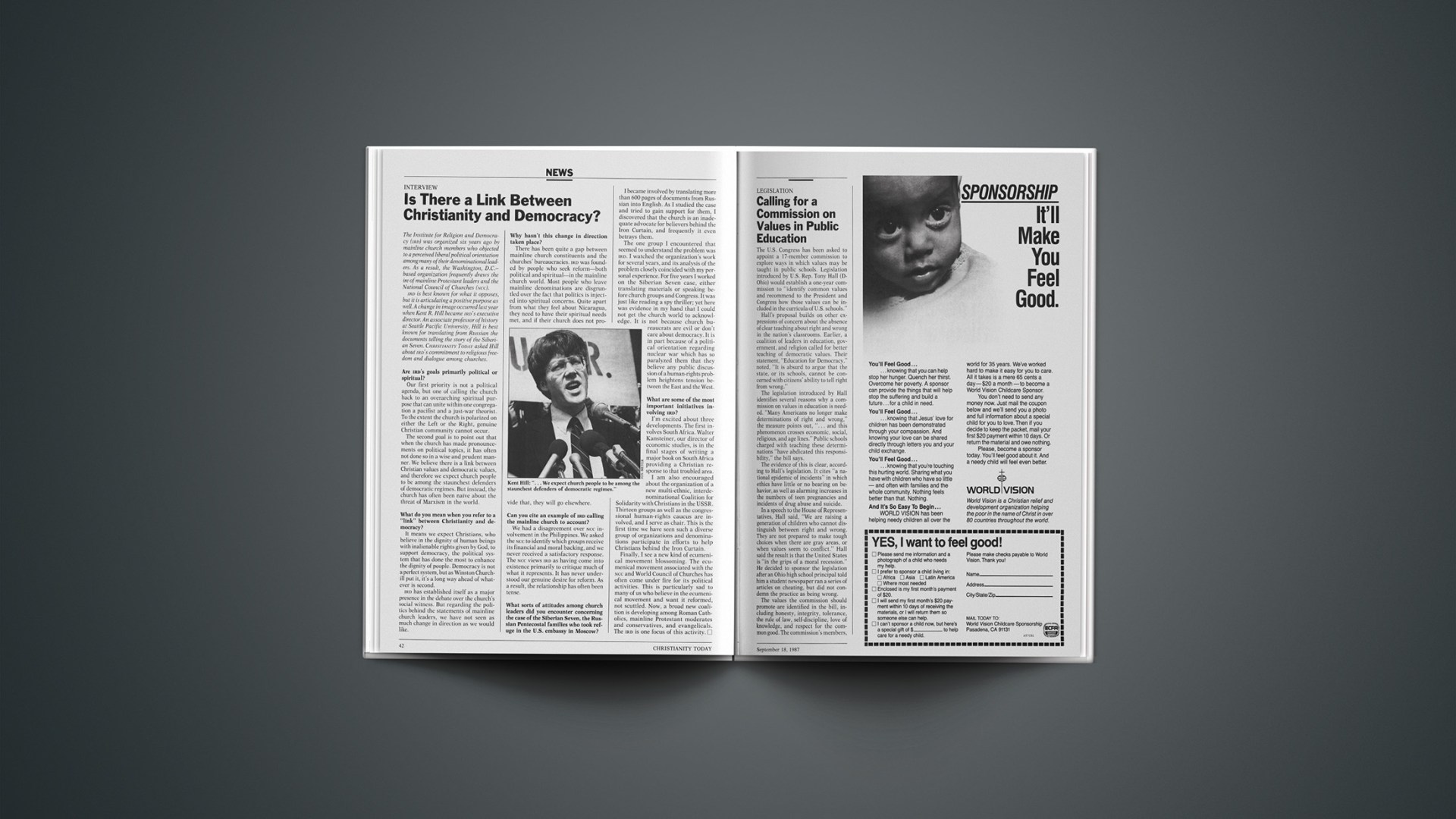

The Institute for Religion and Democracy (IRD) was organized six years ago by mainline church members who objected to a perceived liberal political orientation among many of their denominational leaders. As a result, the Washington, D.C.—based organization frequently draws the ire of mainline Protestant leaders and the National Council of Churches (NCC).
IRD is best known for what it opposes, but it is articulating a positive purpose as well. A change in image occurred last year when Kent R. Hill became IRD’S executive director. An associate professor of history at Seattle Pacific University, Hill is best known for translating from Russian the documents telling the story of the Siberian Seven. CHRISTIANITY TODAY asked Hill about IRD’S commitment to religious freedom and dialogue among churches.
Are IRD’S goals primarily political or spiritual?
Our first priority is not a political agenda, but one of calling the church back to an overarching spiritual purpose that can unite within one congregation a pacifist and a just-war theorist. To the extent the church is polarized on either the Left or the Right, genuine Christian community cannot occur.
The second goal is to point out that when the church has made pronouncements on political topics, it has often not done so in a wise and prudent manner. We believe there is a link between Christian values and democratic values, and therefore we expect church people to be among the staunchest defenders of democratic regimes. But instead, the church has often been naïve about the threat of Marxism in the world.
What do you mean when you refer to a “link” between Christianity and democracy?
It means we expect Christians, who believe in the dignity of human beings with inalienable rights given by God, to support democracy, the political system that has done the most to enhance the dignity of people. Democracy is not a perfect system, but as Winston Churchill put it, it’s a long way ahead of whatever is second.
IRD has established itself as a major presence in the debate over the church’s social witness. But regarding the politics behind the statements of mainline church leaders, we have not seen as much change in direction as we would like.
Why hasn’t this change in direction taken place?
There has been quite a gap between mainline church constituents and the churches’ bureaucracies. IRD was founded by people who seek reform—both political and spiritual—in the mainline church world. Most people who leave mainline denominations are disgruntled over the fact that politics is injected into spiritual concerns. Quite apart from what they feel about Nicaragua, they need to have their spiritual needs met, and if their church does not provide that, they will go elsewhere.
Can you cite an example of IRD calling the mainline church to account?
We had a disagreement over NCC involvement in the Philippines. We asked the NCC to identify which groups receive its financial and moral backing, and we never received a satisfactory response. The NCC views IRD as having come into existence primarily to critique much of what it represents. It has never understood our genuine desire for reform. As a result, the relationship has often been tense.
What sorts of attitudes among church leaders did you encounter concerning the case of the Siberian Seven, the Russian Pentecostal families who took refuge in the U.S. embassy in Moscow?
I became involved by translating more than 600 pages of documents from Russian into English. As I studied the case and tried to gain support for them, I discovered that the church is an inadequate advocate for believers behind the Iron Curtain, and frequently it even betrays them.
The one group I encountered that seemed to understand the problem was IRD. I watched the organization’s work for several years, and its analysis of the problem closely coincided with my personal experience. For five years I worked on the Siberian Seven case, either translating materials or speaking before church groups and Congress. It was just like reading a spy thriller; yet here was evidence in my hand that I could not get the church world to acknowledge. It is not because church bureaucrats are evil or don’t care about democracy. It is in part because of a political orientation regarding nuclear war which has so paralyzed them that they believe any public discussion of a human-rights problem heightens tension between the East and the West.
What are some of the most important initiatives involving IRD?
I’m excited about three developments. The first involves South Africa. Walter Kansteiner, our director of economic studies, is in the final stages of writing a major book on South Africa providing a Christian response to that troubled area.
I am also encouraged about the organization of a new multi-ethnic, interdenominational Coalition for Solidarity with Christians in the USSR. Thirteen groups as well as the congressional human-rights caucus are involved, and I serve as chair. This is the first time we have seen such a diverse group of organizations and denominations participate in efforts to help Christians behind the Iron Curtain.
Finally, I see a new kind of ecumenical movement blossoming. The ecumenical movement associated with the NCC and World Council of Churches has often come under fire for its political activities. This is particularly sad to many of us who believe in the ecumenical movement and want it reformed, not scuttled. Now, a broad new coalition is developing among Roman Catholics, mainline Protestant moderates and conservatives, and evangelicals. The IRD is one focus of this activity.