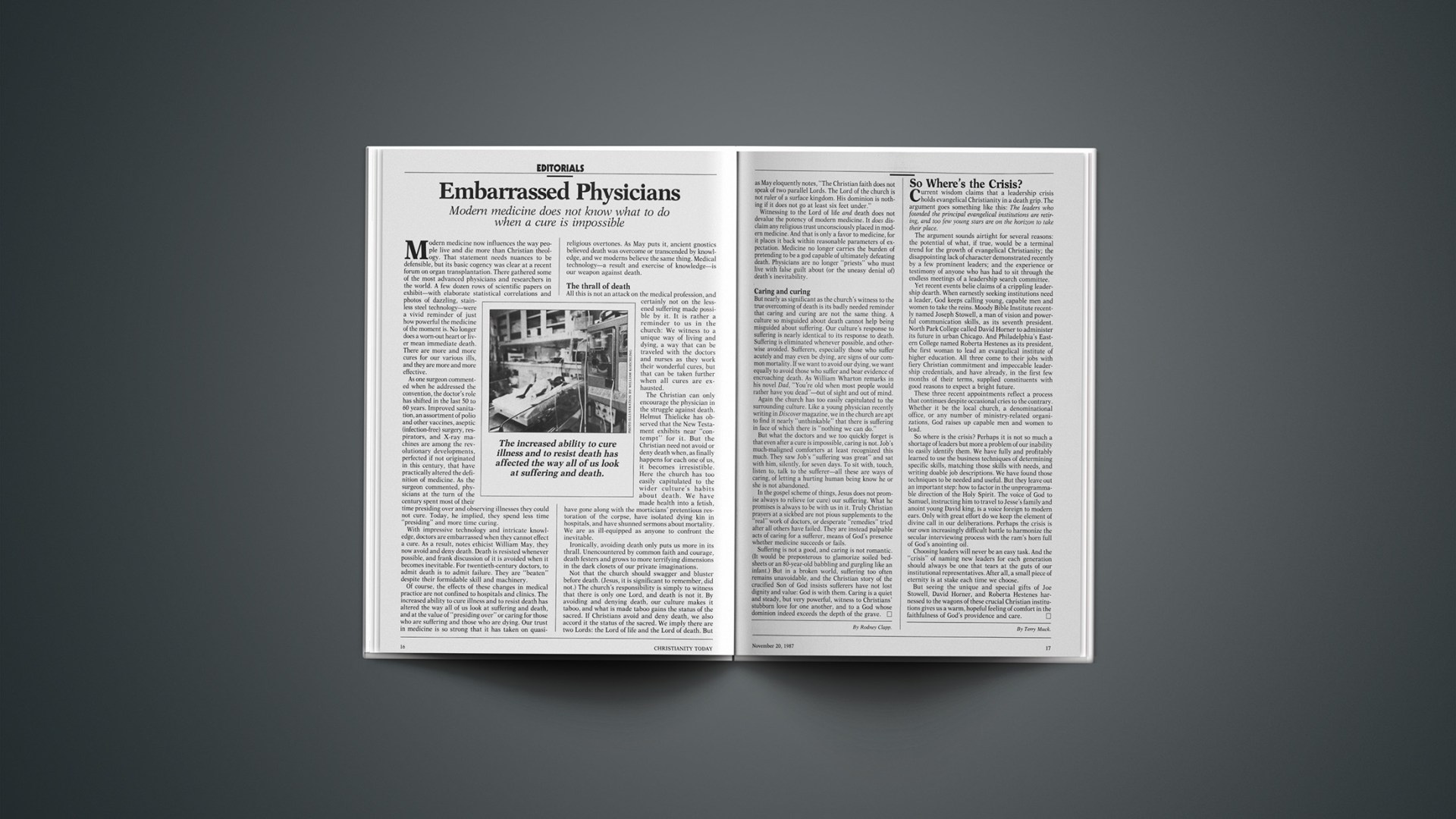

Modern medicine now influences the way people live and die more than Christian theology. That statement needs nuances to be defensible, but its basic cogency was clear at a recent forum on organ transplantation. There gathered some of the most advanced physicians and researchers in the world. A few dozen rows of scientific papers on exhibit—with elaborate statistical correlations and photos of dazzling, stainless steel technology—were a vivid reminder of just how powerful the medicine of the moment is. No longer does a worn-out heart or liver mean immediate death. There are more and more cures for our various ills, and they are more and more effective.
As one surgeon commented when he addressed the convention, the doctor’s role has shifted in the last 50 to 60 years. Improved sanitation, an assortment of polio and other vaccines, aseptic (infection-free) surgery, respirators, and X-ray machines are among the revolutionary developments, perfected if not originated in this century, that have practically altered the definition of medicine. As the surgeon commented, physicians at the turn of the century spent most of their time presiding over and observing illnesses they could not cure. Today, he implied, they spend less time “presiding” and more time curing.
With impressive technology and intricate knowledge, doctors are embarrassed when they cannot effect a cure. As a result, notes ethicist William May, they now avoid and deny death. Death is resisted whenever possible, and frank discussion of it is avoided when it becomes inevitable. For twentieth-century doctors, to admit death is to admit failure. They are “beaten” despite their formidable skill and machinery.
Of course, the effects of these changes in medical practice are not confined to hospitals and clinics. The increased ability to cure illness and to resist death has altered the way all of us look at suffering and death, and at the value of “presiding over” or caring for those who are suffering and those who are dying. Our trust in medicine is so strong that it has taken on quasi-religious overtones. As May puts it, ancient gnostics believed death was overcome or transcended by knowledge, and we moderns believe the same thing. Medical technology—a result and exercise of knowledge—is our weapon against death.
The Thrall Of Death
All this is not an attack on the medical profession, and certainly not on the lessened suffering made possible by it. It is rather a reminder to us in the church: We witness to a unique way of living and dying, a way that can be traveled with the doctors and nurses as they work their wonderful cures, but that can be taken further when all cures are exhausted.
The Christian can only encourage the physician in the struggle against death. Helmut Thielicke has observed that the New Testament exhibits near “contempt” for it. But the Christian need not avoid or deny death when, as finally happens for each one of us, it becomes irresistible. Here the church has too easily capitulated to the wider culture’s habits about death. We have made health into a fetish, have gone along with the morticians’ pretentious restoration of the corpse, have isolated dying kin in hospitals, and have shunned sermons about mortality. We are as ill-equipped as anyone to confront the inevitable.
Ironically, avoiding death only puts us more in its thrall. Unencountered by common faith and courage, death festers and grows to more terrifying dimensions in the dark closets of our private imaginations.
Not that the church should swagger and bluster before death. (Jesus, it is significant to remember, did not.) The church’s responsibility is simply to witness that there is only one Lord, and death is not it. By avoiding and denying death, our culture makes it taboo, and what is made taboo gains the status of the sacred. If Christians avoid and deny death, we also accord it the status of the sacred. We imply there are two Lords: the Lord of life and the Lord of death. But as May eloquently notes, “The Christian faith does not speak of two parallel Lords. The Lord of the church is not ruler of a surface kingdom. His dominion is nothing if it does not go at least six feet under.”
Witnessing to the Lord of life and death does not devalue the potency of modern medicine. It does disclaim any religious trust unconsciously placed in modern medicine. And that is only a favor to medicine, for it places it back within reasonable parameters of expectation. Medicine no longer carries the burden of pretending to be a god capable of ultimately defeating death. Physicians are no longer “priests” who must live with false guilt about (or the uneasy denial of) death’s inevitability.
Caring And Curing
But nearly as significant as the church’s witness to the true overcoming of death is its badly needed reminder that caring and curing are not the same thing. A culture so misguided about death cannot help being misguided about suffering. Our culture’s response to suffering is nearly identical to its response to death. Suffering is eliminated whenever possible, and otherwise avoided. Sufferers, especially those who suffer acutely and may even be dying, are signs of our common mortality. If we want to avoid our dying, we want equally to avoid those who suffer and bear evidence of encroaching death. As William Wharton remarks in his novel Dad, “You’re old when most people would rather have you dead”—out of sight and out of mind.
Again the church has too easily capitulated to the surrounding culture. Like a young physician recently writing in Discover magazine, we in the church are apt to find it nearly “unthinkable” that there is suffering in face of which there is “nothing we can do.”
But what the doctors and we too quickly forget is that even after a cure is impossible, caring is not. Job’s much-maligned comforters at least recognized this much. They saw Job’s “suffering was great” and sat with him, silently, for seven days. To sit with, touch, listen to, talk to the sufferer—all these are ways of caring, of letting a hurting human being know he or she is not abandoned.
In the gospel scheme of things, Jesus does not promise always to relieve (or cure) our suffering. What he promises is always to be with us in it. Truly Christian prayers at a sickbed are not pious supplements to the “real” work of doctors, or desperate “remedies” tried after all others have failed. They are instead palpable acts of caring for a sufferer, means of God’s presence whether medicine succeeds or fails.
Suffering is not a good, and caring is not romantic. (It would be preposterous to glamorize soiled bedsheets or an 80-year-old babbling and gurgling like an infant.) But in a broken world, suffering too often remains unavoidable, and the Christian story of the crucified Son of God insists sufferers have not lost dignity and value: God is with them. Caring is a quiet and steady, but very powerful, witness to Christians’ stubborn love for one another, and to a God whose dominion indeed exceeds the depth of the grave.