





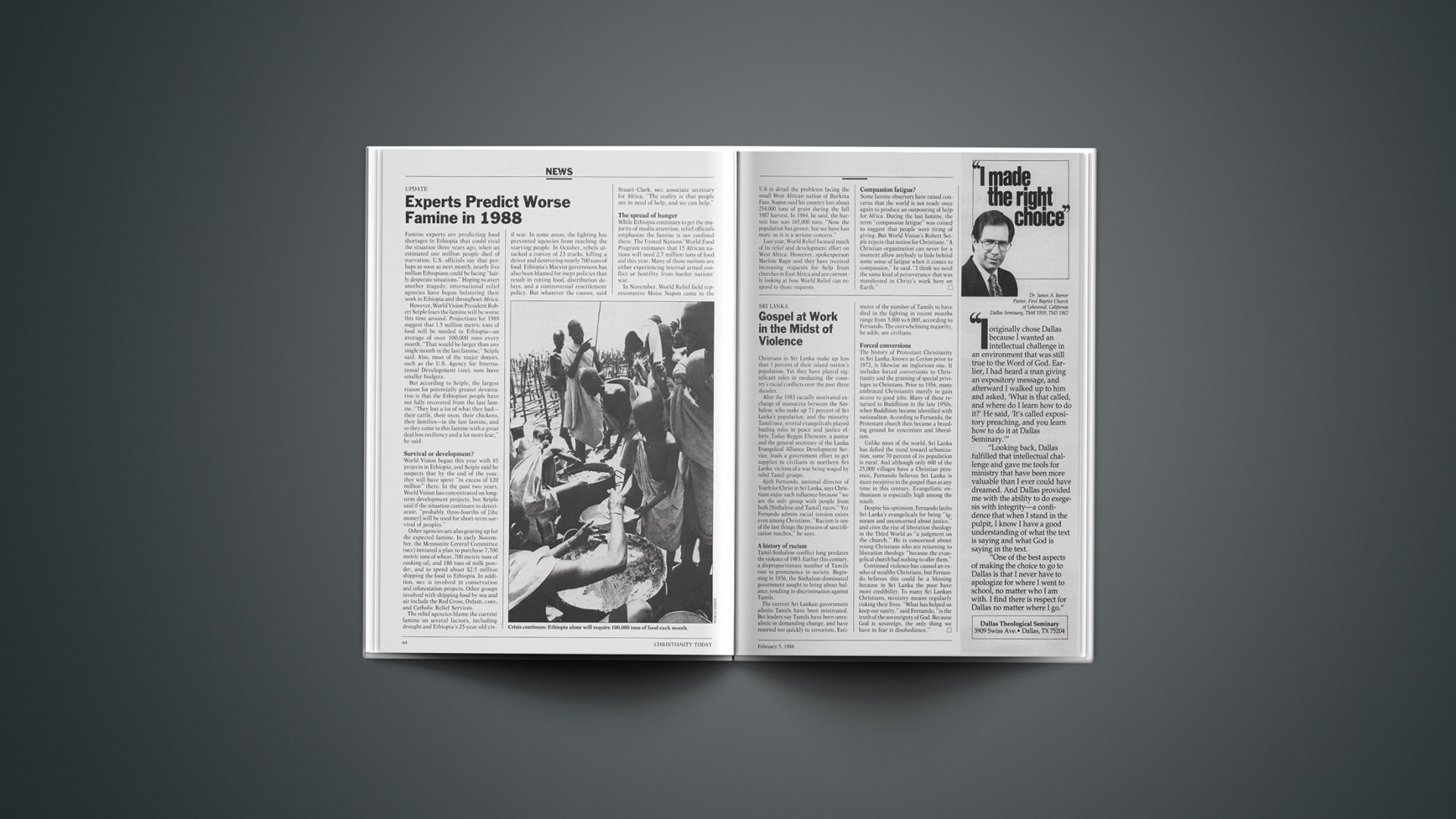

Famine experts are predicting food shortages in Ethiopia that could rival the situation three years ago, when an estimated one million people died of starvation. U.S. officials say that perhaps as soon as next month, nearly five million Ethiopians could be facing “fairly desperate situations.” Hoping to avert another tragedy, international relief agencies have begun bolstering their work in Ethiopia and throughout Africa.
However, World Vision President Robert Seiple fears the famine will be worse this time around. Projections for 1988 suggest that 1.5 million metric tons of food will be needed in Ethiopia—an average of over 100,000 tons every month. “That would be larger than any single month in the last famine,” Seiple said. Also, most of the major donors, such as the U.S. Agency for International Development (AID), now have smaller budgets.
But according to Seiple, the largest reason for potentially greater devastation is that the Ethiopian people have not fully recovered from the last famine. “They lost a lot of what they had—their cattle, their oxen, their chickens, their families—in the last famine, and so they come to this famine with a great deal less resiliency and a lot more fear,” he said.
Survival Or Development?
World Vision began this year with 85 projects in Ethiopia, and Seiple said he suspects that by the end of the year, they will have spent “in excess of $20 million” there. In the past two years, World Vision has concentrated on long-term development projects, but Seiple said if the situation continues to deteriorate, “probably three-fourths of [the money] will be used for short-term survival of peoples.”
Other agencies are also gearing up for the expected famine. In early November, the Mennonite Central Committee (MCC) initiated a plan to purchase 7,700 metric tons of wheat, 700 metric tons of cooking oil, and 180 tons of milk powder, and to spend about $2.5 million shipping the food to Ethiopia. In addition, MCC is involved in conservation and reforestation projects. Other groups involved with shipping food by sea and air include the Red Cross, Oxfam, CARE, and Catholic Relief Services.
The relief agencies blame the current famine on several factors, including drought and Ethiopia’s 25-year old civil war. In some areas, the fighting has prevented agencies from reaching the starving people. In October, rebels attacked a convoy of 23 trucks, killing a driver and destroying nearly 700 tons of food. Ethiopia’s Marxist government has also been blamed for inept policies that result in rotting food, distribution delays, and a controversial resettlement policy. But whatever the causes, said Stuart Clark, MCC associate secretary for Africa, “The reality is that people are in need of help, and we can help.”
The Spread Of Hunger
While Ethiopia continues to get the majority of media attention, relief officials emphasize the famine is not confined there. The United Nations’ World Food Program estimates that 15 African nations will need 2.7 million tons of food aid this year. Many of those nations are either experiencing internal armed conflict or hostility from border nations’ war.
In November, World Relief field representative Moise Napon came to the U.S to detail the problems facing the small West African nation of Burkina Faso. Napon said his country lost about 254,000 tons of grain during the fall 1987 harvest. In 1984, he said, the harvest loss was 165,000 tons. “Now the population has grown, but we have lost more, so it is a serious concern.”
Last year, World Relief focused much of its relief and development effort on West Africa. However, spokesperson Marlene Rapp said they have received increasing requests for help from churches in East Africa and are currently looking at how World Relief can respond to those requests.
Compassion Fatigue?
Some famine observers have raised concerns that the world is not ready once again to produce an outpouring of help for Africa. During the last famine, the term “compassion fatigue” was coined to suggest that people were tiring of giving. But World Vision’s Robert Seiple rejects that notion for Christians. “A Christian organization can never for a moment allow anybody to hide behind some sense of fatigue when it comes to compassion,” he said. “I think we need the same kind of perseverance that was manifested in Christ’s work here on Earth.”







