





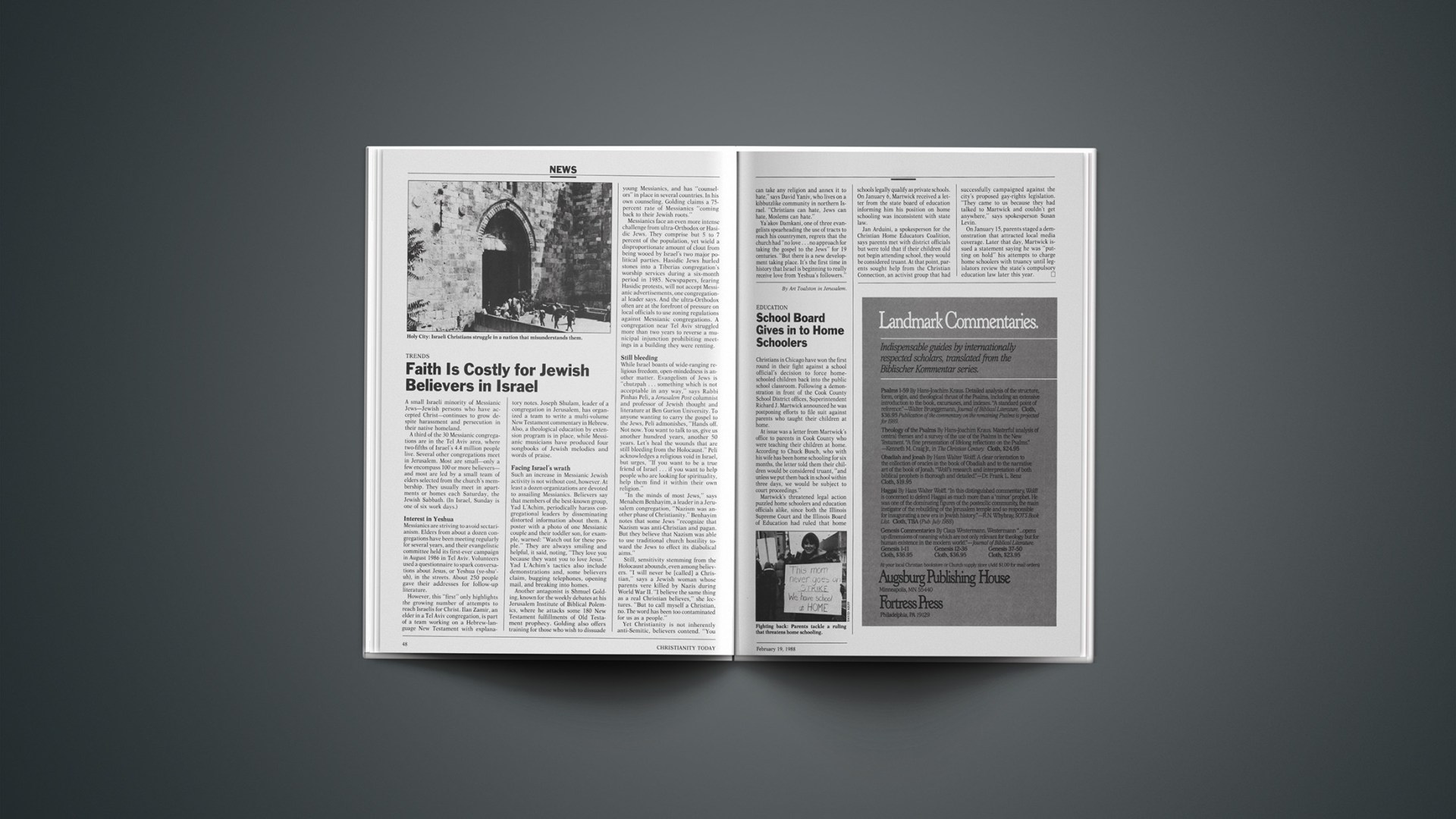

A small Israeli minority of Messianic Jews—Jewish persons who have accepted Christ—continues to grow despite harassment and persecution in their native homeland.
A third of the 30 Messianic congregations are in the Tel Aviv area, where two-fifths of Israel’s 4.4 million people live. Several other congregations meet in Jerusalem. Most are small—only a few encompass 100 or more believers—and most are led by a small team of elders selected from the church’s membership. They usually meet in apartments or homes each Saturday, the Jewish Sabbath. (In Israel, Sunday is one of six work days.)
Interest In Yeshua
Messianics are striving to avoid sectarianism. Elders from about a dozen congregations have been meeting regularly for several years, and their evangelistic committee held its first-ever campaign in August 1986 in Tel Aviv. Volunteers used a questionnaire to spark conversations about Jesus, or Yeshua (ye-shu’-uh), in the streets. About 250 people gave their addresses for follow-up literature.
However, this “first” only highlights the growing number of attempts to reach Israelis for Christ. Ilan Zamir, an elder in a Tel Aviv congregation, is part of a team working on a Hebrew-language New Testament with explanatory notes. Joseph Shulam, leader of a congregation in Jerusalem, has organized a team to write a multi-volume New Testament commentary in Hebrew. Also, a theological education by extension program is in place, while Messianic musicians have produced four songbooks of Jewish melodies and words of praise.
Facing Israel’s Wrath
Such an increase in Messianic Jewish activity is not without cost, however. At least a dozen organizations are devoted to assailing Messianics. Believers say that members of the best-known group, Yad L’Achim, periodically harass congregational leaders by disseminating distorted information about them. A poster with a photo of one Messianic couple and their toddler son, for example, warned: “Watch out for these people.” They are always smiling and helpful, it said, noting, “They love you because they want you to love Jesus.” Yad L’Achim’s tactics also include demonstrations and, some believers claim, bugging telephones, opening mail, and breaking into homes.
Another antagonist is Shmuel Golding, known for the weekly debates at his Jerusalem Institute of Biblical Polemics, where he attacks some 180 New Testament fulfillments of Old Testament prophecy. Golding also offers training for those who wish to dissuade young Messianics, and has “counselors” in place in several countries. In his own counseling, Golding claims a 75-percent rate of Messianics “coming back to their Jewish roots.”
Messianics face an even more intense challenge from ultra-Orthodox or Hasidic Jews. They comprise but 5 to 7 percent of the population, yet wield a disproportionate amount of clout from being wooed by Israel’s two major political parties. Hasidic Jews hurled stones into a Tiberias congregation’s worship services during a six-month period in 1985. Newspapers, fearing Hasidic protests, will not accept Messianic advertisements, one congregational leader says. And the ultra-Orthodox often are at the forefront of pressure on local officials to use zoning regulations against Messianic congregations. A congregation near Tel Aviv struggled more than two years to reverse a municipal injunction prohibiting meetings in a building they were renting.
Still Bleeding
While Israel boasts of wide-ranging religious freedom, open-mindedness is another matter. Evangelism of Jews is “chutzpah … something which is not acceptable in any way,” says Rabbi Pinhas Peli, a Jerusalem Post columnist and professor of Jewish thought and literature at Ben Gurion University. To anyone wanting to carry the gospel to the Jews, Peli admonishes, “Hands off. Not now. You want to talk to us, give us another hundred years, another 50 years. Let’s heal the wounds that are still bleeding from the Holocaust.” Peli acknowledges a religious void in Israel, but urges, “If you want to be a true friend of Israel … if you want to help people who are looking for spirituality, help them find it within their own religion.”
“In the minds of most Jews,” says Menahem Benhayim, a leader in a Jerusalem congregation, “Nazism was another phase of Christianity.” Benhayim notes that some Jews “recognize that Nazism was anti-Christian and pagan. But they believe that Nazism was able to use traditional church hostility toward the Jews to effect its diabolical aims.”
Still, sensitivity stemming from the Holocaust abounds, even among believers. “I will never be [called] a Christian,” says a Jewish woman whose parents vere killed by Nazis during World War II. “I believe the same thing as a real Christian believes,” she lectures. “But to call myself a Christian, no. The word has been too contaminated for us as a people.”
Yet Christianity is not inherently anti-Semitic, believers contend. “You can take any religion and annex it to hate,” says David Yaniv, who lives on a kibbutzlike community in northern Israel. “Christians can hate, Jews can hate, Moslems can hate.”
Ya’akov Damkani, one of three evangelists spearheading the use of tracts to reach his countrymen, regrets that the church had “no love … no approach for taking the gospel to the Jews” for 19 centuries. “But there is a new development taking place. It’s the first time in history that Israel is beginning to really receive love from Yeshua’s followers.”
By Art Toalston in Jerusalem







