
For when the One Great Scorer comes
To write against your name—
He marks—not that you won or lost—
But how you played the game.
—Grantland Rice
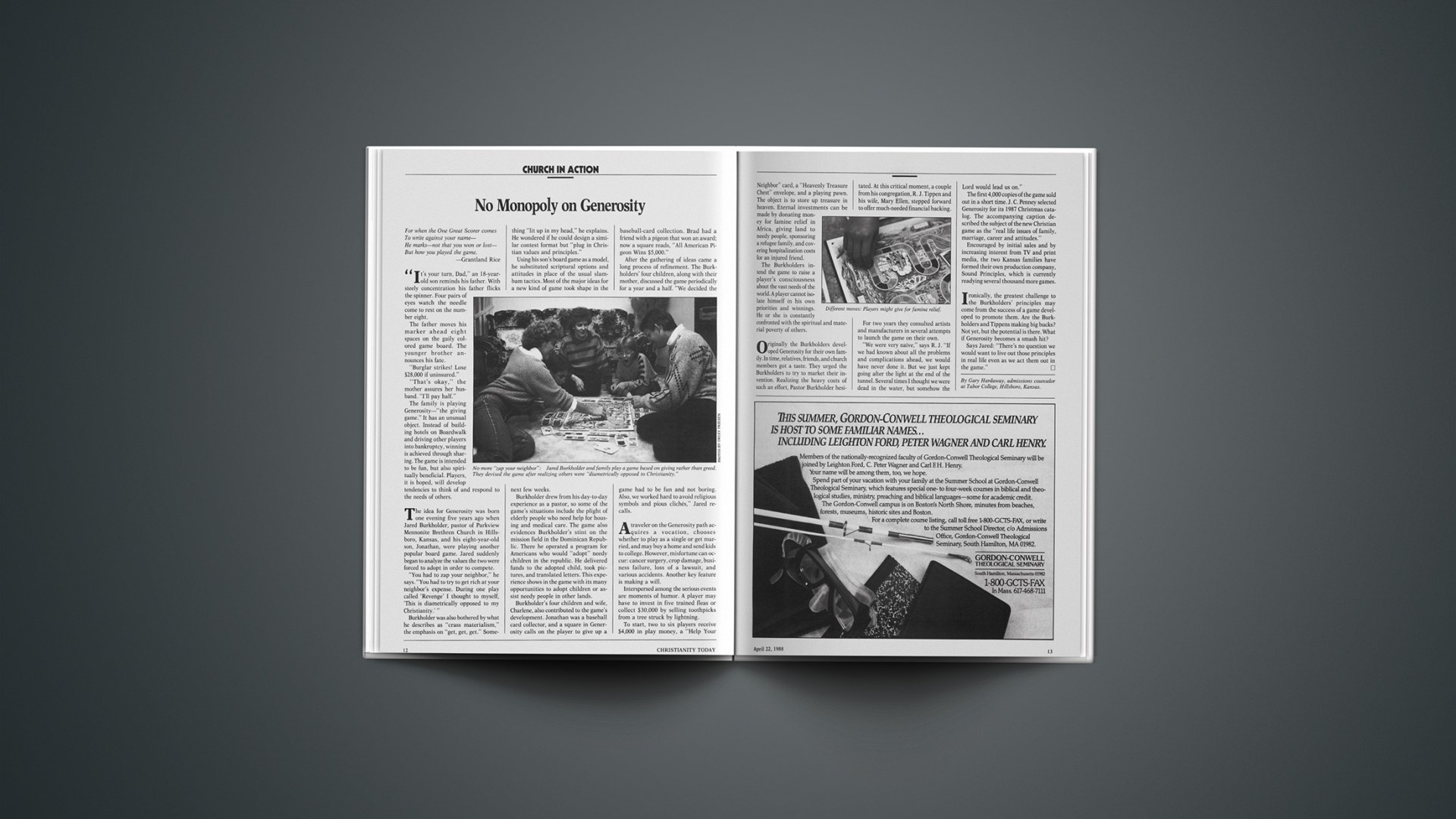
“It’s your turn, Dad,” an 18-year-old son reminds his father. With steely concentration his father flicks the spinner. Four pairs of eyes watch the needle come to rest on the number eight.
The father moves his marker ahead eight spaces on the gaily colored game board. The younger brother announces his fate.
“Burglar strikes! Lose $28,000 if uninsured.”
“That’s okay,” the mother assures her husband. “I’ll pay half.”
The family is playing Generosity—“the giving game.” It has an unusual object. Instead of building hotels on Boardwalk and driving other players into bankruptcy, winning is achieved through sharing. The game is intended to be fun, but also spiritually beneficial. Players, it is hoped, will develop tendencies to think of and respond to the needs of others.
The idea for Generosity was born one evening five years ago when Jared Burkholder, pastor of Parkview Mennonite Brethren Church in Hillsboro, Kansas, and his eight-year-old son, Jonathan, were playing another popular board game. Jared suddenly began to analyze the values the two were forced to adopt in order to compete.
“You had to zap your neighbor,” he says. “You had to try to get rich at your neighbor’s expense. During one play called ‘Revenge’ I thought to myself, ‘This is diametrically opposed to my Christianity.’ ”
Burkholder was also bothered by what he describes as “crass materialism,” the emphasis on “get, get, get.” Something “lit up in my head,” he explains. He wondered if he could design a similar contest format but “plug in Christian values and principles.”
Using his son’s board game as a model, he substituted scriptural options and attitudes in place of the usual slambam tactics. Most of the major ideas for a new kind of game took shape in the next few weeks.
Burkholder drew from his day-to-day experience as a pastor, so some of the game’s situations include the plight of elderly people who need help for housing and medical care. The game also evidences Burkholder’s stint on the mission field in the Dominican Republic. There he operated a program for Americans who would “adopt” needy children in the republic. He delivered funds to the adopted child, took pictures, and translated letters. This experience shows in the game with its many opportunities to adopt children or assist needy people in other lands.
Burkholder’s four children and wife, Charlene, also contributed to the game’s development. Jonathan was a baseball card collector, and a square in Generosity calls on the player to give up a baseball-card collection. Brad had a friend with a pigeon that won an award; now a square reads, “All American Pigeon Wins $5,000.”
After the gathering of ideas came a long process of refinement. The Burkholders’ four children, along with their mother, discussed the game periodically for a year and a half. “We decided the game had to be fun and not boring. Also, we worked hard to avoid religious symbols and pious clichés,” Jared recalls.
A traveler on the Generosity path acquires a vocation, chooses whether to play as a single or get married, and may buy a home and send kids to college. However, misfortune can occur: cancer surgery, crop damage, business failure, loss of a lawsuit, and various accidents. Another key feature is making a will.
Interspersed among the serious events are moments of humor. A player may have to invest in five trained fleas or collect $30,000 by selling toothpicks from a tree struck by lightning.
To start, two to six players receive $4,000 in play money, a “Help Your Neighbor” card, a “Heavenly Treasure Chest” envelope, and a playing pawn. The object is to store up treasure in heaven. Eternal investments can be made by donating money for famine relief in Africa, giving land to needy people, sponsoring a refugee family, and covering hospitalization costs for an injured friend.
The Burkholders intend the game to raise a player’s consciousness about the vast needs of the world. A player cannot isolate himself in his own priorities and winnings. He or she is constantly confronted with the spiritual and material poverty of others.
Originally the Burkholders developed Generosity for their own family. In time, relatives, friends, and church members got a taste. They urged the Burkholders to try to market their invention. Realizing the heavy costs of such an effort, Pastor Burkholder hesitated. At this critical moment, a couple from his congregation, R. J. Tippen and his wife, Mary Ellen, stepped forward to offer much-needed financial backing.
For two years they consulted artists and manufacturers in several attempts to launch the game on their own.
“We were very naïve,” says R. J. “If we had known about all the problems and complications ahead, we would have never done it. But we just kept going after the light at the end of the tunnel. Several times I thought we were dead in the water, but somehow the Lord would lead us on.”
The first 4,000 copies of the game sold out in a short time. J. C. Penney selected Generosity for its 1987 Christmas catalog. The accompanying caption described the subject of the new Christian game as the “real life issues of family, marriage, career and attitudes.”
Encouraged by initial sales and by increasing interest from TV and print media, the two Kansas families have formed their own production company, Sound Principles, which is currently readying several thousand more games.
Ironically, the greatest challenge to the Burkholders’ principles may come from the success of a game developed to promote them. Are the Burkholders and Tippens making big bucks? Not yet, but the potential is there. What if Generosity becomes a smash hit?
Says Jared: “There’s no question we would want to live out those principles in real life even as we act them out in the game.”
By Gary Hardaway, admissions counselor at Tabor College, Hillsboro, Kansas.