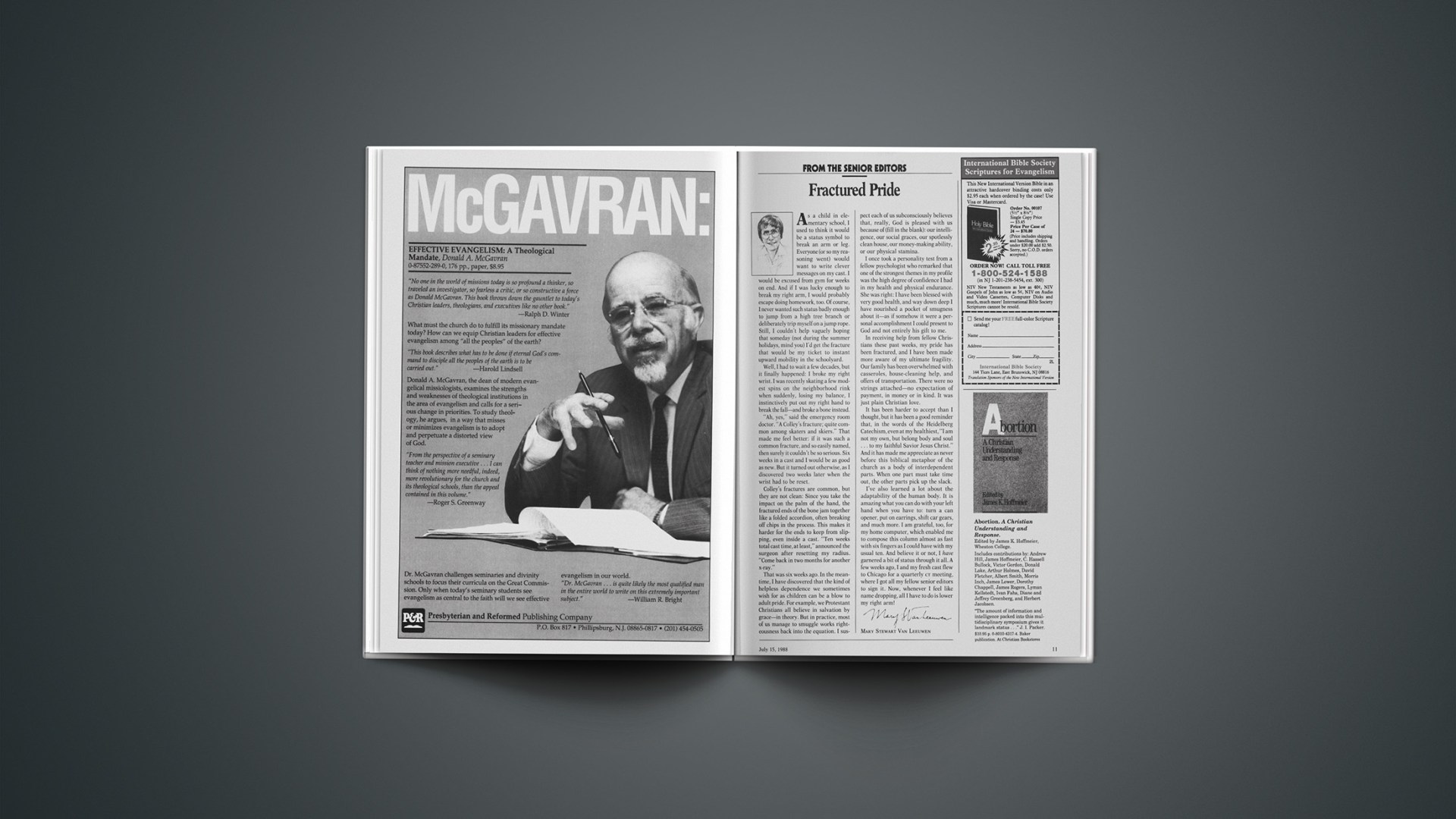

As a child in elementary school, I used to think it would be a status symbol to break an arm or leg. Everyone (or so my reasoning went) would want to write clever messages on my cast. I would be excused from gym for weeks on end. And if I was lucky enough to break my right arm, I would probably escape doing homework, too. Of course, I never wanted such status badly enough to jump from a high tree branch or deliberately trip myself on a jump rope. Still, I couldn’t help vaguely hoping that someday (not during the summer holidays, mind you) I’d get the fracture that would be my ticket to instant upward mobility in the schoolyard.
Well, I had to wait a few decades, but it finally happened: I broke my right wrist. I was recently skating a few modest spins on the neighborhood rink when suddenly, losing my balance, I instinctively put out my right hand to break the fall—and broke a bone instead.
“Ah, yes,” said the emergency room doctor. “A Colley’s fracture; quite common among skaters and skiers.” That made me feel better: if it was such a common fracture, and so easily named, then surely it couldn’t be so serious. Six weeks in a cast and I would be as good as new. But it turned out otherwise, as I discovered two weeks later when the wrist had to be reset.
Colley’s fractures are common, but they are not clean: Since you take the impact on the palm of the hand, the fractured ends of the bone jam together like a folded accordion, often breaking off chips in the process. This makes it harder for the ends to keep from slipping, even inside a cast. “Ten weeks total cast time, at least,” announced the surgeon after resetting my radius. “Come back in two months for another x-ray.”
That was six weeks ago. In the meantime, I have discovered that the kind of helpless dependence we sometimes wish for as children can be a blow to adult pride. For example, we Protestant Christians all believe in salvation by grace—in theory. But in practice, most of us manage to smuggle works righteousness back into the equation. I suspect each of us subconsciously believes that, really, God is pleased with us because of (fill in the blank): our intelligence, our social graces, our spotlessly clean house, our money-making ability, or our physical stamina.
I once took a personality test from a fellow psychologist who remarked that one of the strongest themes in my profile was the high degree of confidence I had in my health and physical endurance. She was right: I have been blessed with very good health, and way down deep I have nourished a pocket of smugness about it—as if somehow it were a personal accomplishment I could present to God and not entirely his gift to me.
In receiving help from fellow Christians these past weeks, my pride has been fractured, and I have been made more aware of my ultimate fragility. Our family has been overwhelmed with casseroles, house-cleaning help, and offers of transportation. There were no strings attached—no expectation of payment, in money or in kind. It was just plain Christian love.
It has been harder to accept than I thought, but it has been a good reminder that, in the words of the Heidelberg Catechism, even at my healthiest, “I am not my own, but belong body and soul … to my faithful Savior Jesus Christ.” And it has made me appreciate as never before this biblical metaphor of the church as a body of interdependent parts. When one part must take time out, the other parts pick up the slack.
I’ve also learned a lot about the adaptability of the human body. It is amazing what you can do with your left hand when you have to: turn a can opener, put on earrings, shift car gears, and much more. I am grateful, too, for my home computer, which enabled me to compose this column almost as fast with six fingers as I could have with my usual ten. And believe it or not, I have garnered a bit of status through it all. A few weeks ago, I and my fresh cast flew to Chicago for a quarterly CT meeting, where I got all my fellow senior editors to sign it. Now, whenever I feel like name dropping, all I have to do is lower my right arm!