
CRITIQUE
The best that can be said of TV justice is that it sometimes pits the victorious underdog against the nefarious oppressor. But that is still a long way from the Old Testament prophets, who rattled the very walls of society until the wicked persons and institutions came crashing down. And it’s an even more distant route to the historic justice of God that sacrificially saves and mercifully condemns.
But you can also leave it to modern television to produce not one, but four competing pictures of justice: “People’s Court,” “Perry Mason,” “Matlock,” and “L.A. Law.” Will the real justice please stand up?
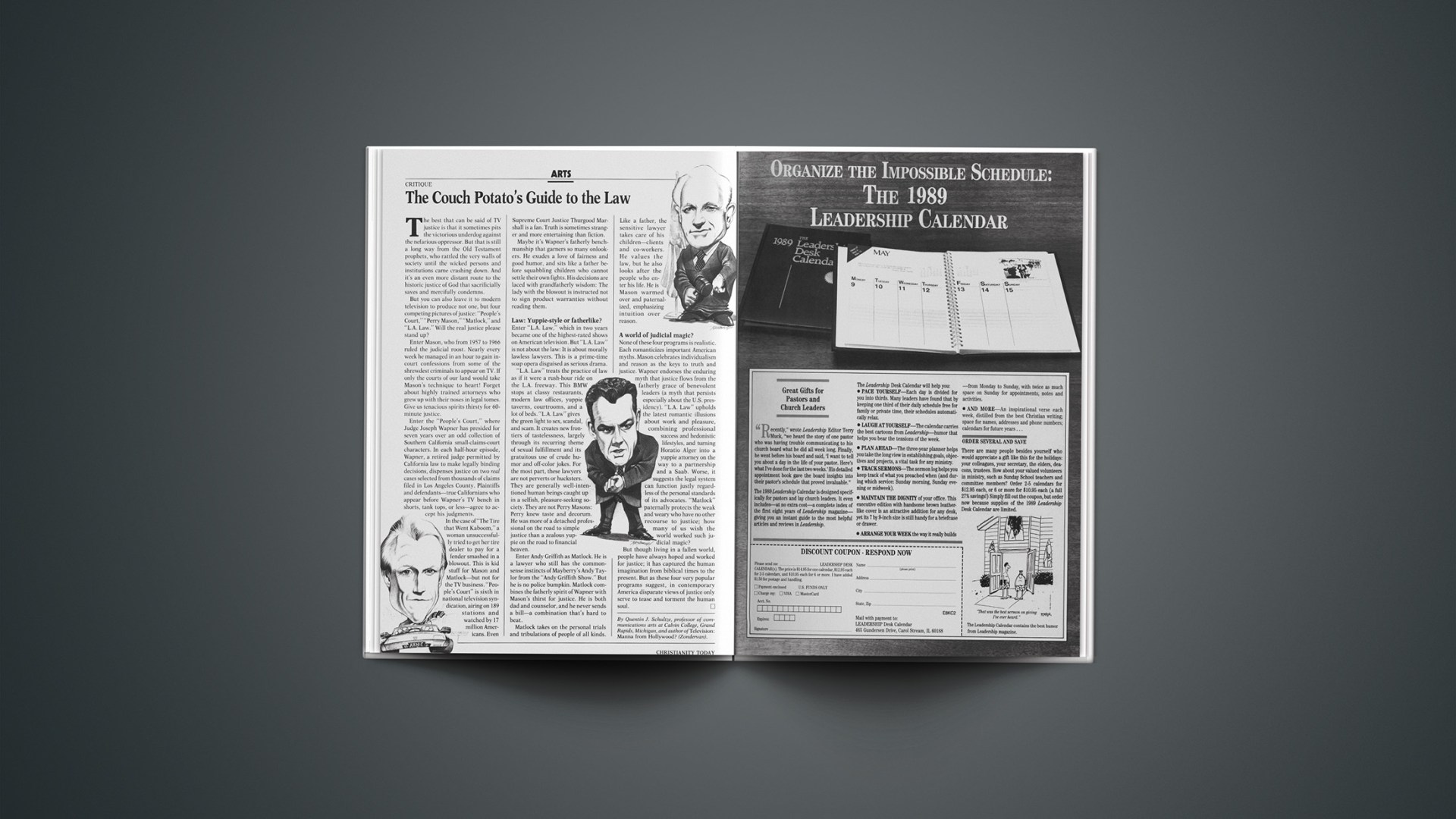
Enter Mason, who from 1957 to 1966 ruled the judicial roost. Nearly every week he managed in an hour to gain in-court confessions from some of the shrewdest criminals to appear on TV. If only the courts of our land would take Mason’s technique to heart! Forget about highly trained attorneys who grew up with their noses in legal tomes. Give us tenacious spirits thirsty for 60-minute justice.
Enter the “People’s Court,” where Judge Joseph Wapner has presided for seven years over an odd collection of Southern California small-claims-court characters. In each half-hour episode, Wapner, a retired judge permitted by California law to make legally binding decisions, dispenses justice on two real cases selected from thousands of claims filed in Los Angeles County. Plaintiffs and defendants—true Californians who appear before Wapner’s TV bench in shorts, tank tops, or less—agree to accept his judgments.
In the case of “The Tire that Went Kaboom,” a woman unsuccessfully tried to get her tire dealer to pay for a fender smashed in a blowout. This is kid stuff for Mason and Matlock—but not for the TV business. “People’s Court” is sixth in national television syndication, airing on 189 stations and watched by 17 million Americans. Even Supreme Court Justice Thurgood Marshall is a fan. Truth is sometimes stranger and more entertaining than fiction.
Maybe it’s Wapner’s fatherly bench-manship that garners so many onlookers. He exudes a love of fairness and good humor, and sits like a father before squabbling children who cannot settle their own fights. His decisions are laced with grandfatherly wisdom: The lady with the blowout is instructed not to sign product warranties without reading them.
Law: Yuppie-style or fatherlike?
Enter “L.A. Law,” which in two years became one of the highest-rated shows on American television. But “L.A. Law” is not about the law: It is about morally lawless lawyers. This is a prime-time soap opera disguised as serious drama.
“L.A. Law” treats the practice of law as if it were a rush-hour ride on the L.A. freeway. This BMW stops at classy restaurants, modern law offices, yuppie taverns, courtrooms, and a lot of beds. “L.A. Law” gives the green light to sex, scandal, and scam. It creates new frontiers of tastelessness, largely through its recurring theme of sexual fulfillment and its gratuitous use of crude humor and off-color jokes. For the most part, these lawyers are not perverts or hucksters. They are generally well-intentioned human beings caught up in a selfish, pleasure-seeking society. They are not Perry Masons: Perry knew taste and decorum. He was more of a detached professional on the road to simple justice than a zealous yuppie on the road to financial heaven.
Enter Andy Griffith as Matlock. He is a lawyer who still has the commonsense instincts of Mayberry’s Andy Taylor from the “Andy Griffith Show.” But he is no police bumpkin. Matlock combines the fatherly spirit of Wapner with Mason’s thirst for justice. He is both dad and counselor, and he never sends a bill—a combination that’s hard to beat.
Matlock takes on the personal trials and tribulations of people of all kinds. Like a father, the sensitive lawyer takes care of his children—clients and co-workers. He values the law, but he also looks after the people who enter his life. He is Mason warmed over and paternalized, emphasizing intuition over reason.
A world of judicial magic?
None of these four programs is realistic. Each romanticizes important American myths. Mason celebrates individualism and reason as the keys to truth and justice. Wapner endorses the enduring myth that justice flows from the fatherly grace of benevolent leaders (a myth that persists especially about the U.S. presidency). “L.A. Law” upholds the latest romantic illusions about work and pleasure, combining professional success and hedonistic lifestyles, and turning Horatio Alger into a yuppie attorney on the way to a partnership and a Saab. Worse, it suggests the legal system can function justly regardless of the personal standards of its advocates. “Matlock” paternally protects the weak and weary who have no other recourse to justice; how many of us wish the world worked such judicial magic?
But though living in a fallen world, people have always hoped and worked for justice; it has captured the human imagination from biblical times to the present. But as these four very popular programs suggest, in contemporary America disparate views of justice only serve to tease and torment the human soul.
By Quentin J. Schultze, professor of communications arts at Calvin College, Grand Rapids, Michigan, and author of Television: Manna from Hollywood? (Zondervan).