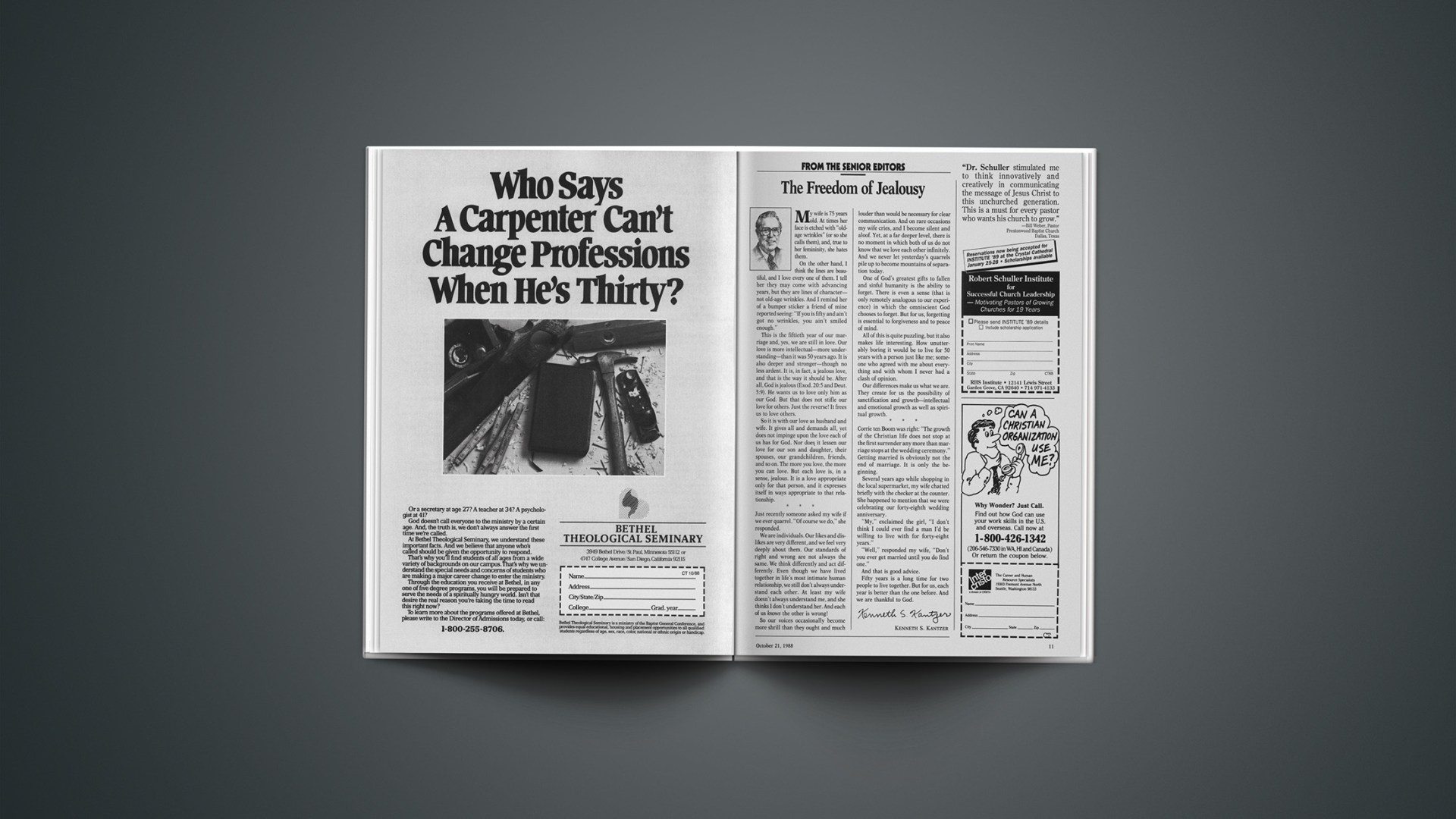

My wife is 75 years old. At times her face is etched with “old-age wrinkles” (or so she calls them), and, true to her femininity, she hates them.
On the other hand, I think the lines are beautiful, and I love every one of them. I tell her they may come with advancing years, but they are lines of character—not old-age wrinkles. And I remind her of a bumper sticker a friend of mine reported seeing: “If you is fifty and ain’t got no wrinkles, you ain’t smiled enough.”
This is the fiftieth year of our marriage and, yes, we are still in love. Our love is more intellectual—more understanding—than it was 50 years ago. It is also deeper and stronger—though no less ardent. It is, in fact, a jealous love, and that is the way it should be. After all, God is jealous (Exod. 20:5 and Deut. 5:9). He wants us to love only him as our God. But that does not stifle our love for others. Just the reverse! It frees us to love others.
So it is with our love as husband and wife. It gives all and demands all, yet does not impinge upon the love each of us has for God. Nor does it lessen our love for our son and daughter, their spouses, our grandchildren, friends, and so on. The more you love, the more you can love. But each love is, in a sense, jealous. It is a love appropriate only for that person, and it expresses itself in ways appropriate to that relationship.
Just recently someone asked my wife if we ever quarrel. “Of course we do,” she responded.
We are individuals. Our likes and dislikes are very different, and we feel very deeply about them. Our standards of right and wrong are not always the same. We think differently and act differently. Even though we have lived together in life’s most intimate human relationship, we still don’t always understand each other. At least my wife doesn’t always understand me, and she thinks I don’t understand her. And each of us knows the other is wrong!
So our voices occasionally become more shrill than they ought and much louder than would be necessary for clear communication. And on rare occasions my wife cries, and I become silent and aloof. Yet, at a far deeper level, there is no moment in which both of us do not know that we love each other infinitely. And we never let yesterday’s quarrels pile up to become mountains of separation today.
One of God’s greatest gifts to fallen and sinful humanity is the ability to forget. There is even a sense (that is only remotely analogous to our experience) in which the omniscient God chooses to forget. But for us, forgetting is essential to forgiveness and to peace of mind.
All of this is quite puzzling, but it also makes life interesting. How unutterably boring it would be to live for 50 years with a person just like me; someone who agreed with me about everything and with whom I never had a clash of opinion.
Our differences make us what we are. They create for us the possibility of sanctification and growth—intellectual and emotional growth as well as spiritual growth.
Corrie ten Boom was right: “The growth of the Christian life does not stop at the first surrender any more than marriage stops at the wedding ceremony.” Getting married is obviously not the end of marriage. It is only the beginning.
Several years ago while shopping in the local supermarket, my wife chatted briefly with the checker at the counter. She happened to mention that we were celebrating our forty-eighth wedding anniversary.
“My,” exclaimed the girl, “I don’t think I could ever find a man I’d be willing to live with for forty-eight years.”
“Well,” responded my wife, “Don’t you ever get married until you do find one.”
And that is good advice.
Fifty years is a long time for two people to live together. But for us, each year is better than the one before. And we are thankful to God.
KENNETH S. KANTZER