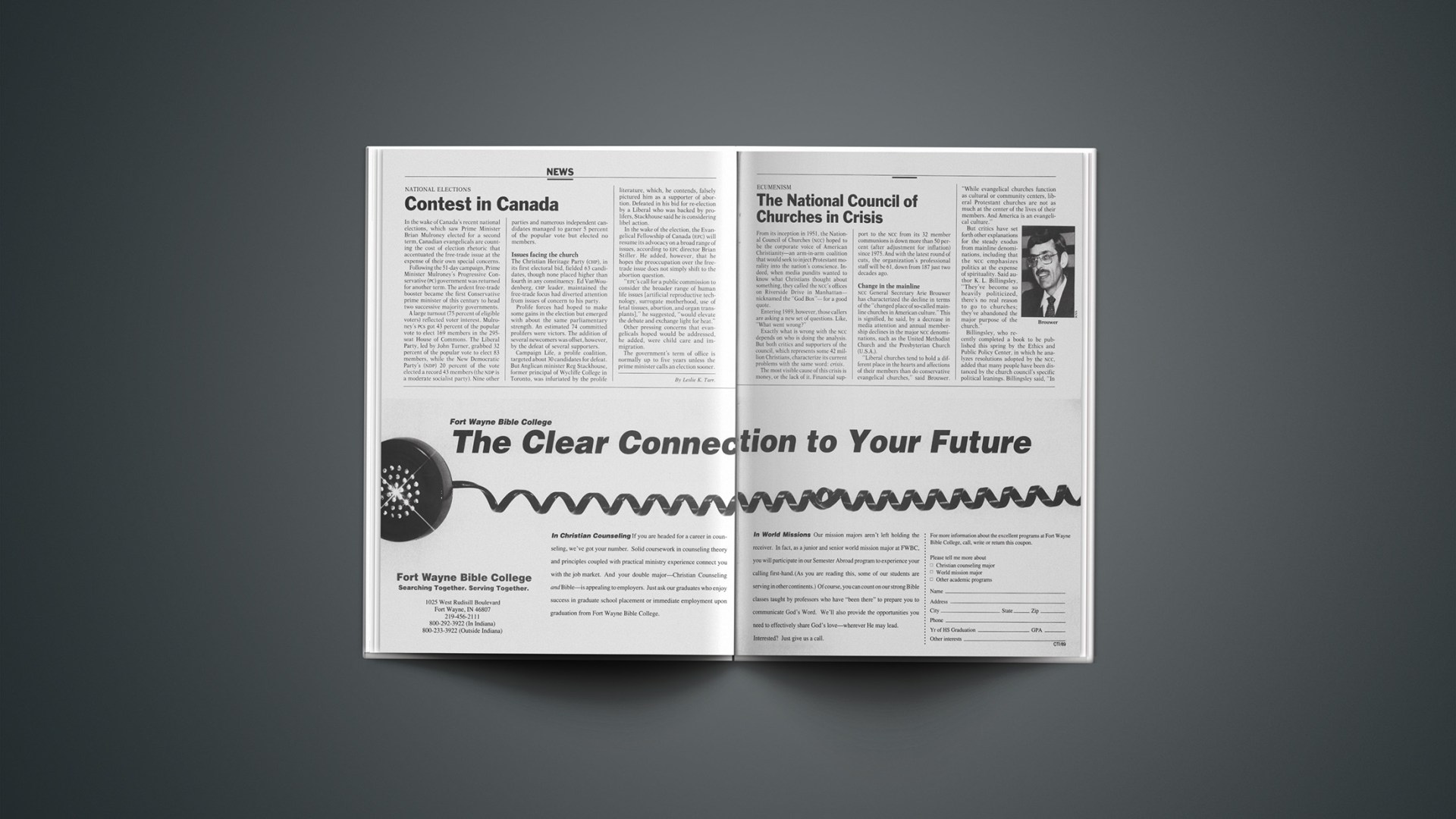

Many opponents of the NCC have similar criticisms of its counterpart, the World Council of Churches (WCC; see preceding article). James Van Hoeven has served for over a year on the staff of the World Alliance of Reformed Churches, whose offices in Geneva, Switzerland, are in the same building as World Council headquarters. Though not a WCC staff member, he participates in several of its programs. An ordained minister (Reformed Church in America), Van Hoeven discussed the WCC with CHRISTIANITY TODAY.
To what extent is criticism of the World Council fair?
Because it seeks to be relevant, the WCC lives on the edge of controversy. Sometimes controversial policies have resulted from difficult decisions. What stands out is the Program to Combat Racism’s support of the African National Congress (ANC).
But isn’t it reasonably objectionable when a church policy supports the violent overthrow of a government?
Yes, it is, and the decision to support the ANC was controversial even within WCC ranks. But this needs context. There are presently well over 15,000 people, including 4,000 children, being detained in South Africa, who were put in prison without trial. This type of activity has been going on for years. On the part of the oppressed people, there has been incredible restraint.
I believe that Jesus taught an ethic of nonviolence. But having been to South Africa, I can at least understand why some people simply can’t take it anymore. To label the ANC terroristic without acknowledging the tactics used by the South African government is irresponsible. The church, sooner or later, has got to raise the question of the legitimacy of governments, to view Romans 13 in light of Romans 12 and Revelation 13 and God’s imperative for justice. My own predecessors in the Reformed Church of America advocated taking up arms against the British during the American revolution.
Critics accuse the WCC of focusing more on the failures of democratic systems than of communist governments. Is this accurate?
I begin—and I think the World Council begins—with the principle that wherever there are human needs or human-rights violations, the church should be present to stand with victims, to provide food or whatever else is needed. In the documents I’ve read—and they have been many—I’m satisfied that the WCC’s statements and policies include critiques of both Western and Eastern bloc countries.
But, according to critics, that’s precisely the problem. The WCC treats the East and West as morally equivalent. Shouldn’t the worst violators be the most criticized?
I agree in principle with this concern. But with the advances under glasnost and perestroika, it is becoming less and less relevant. Along with many Christians from Soviet bloc nations, I readily acknowledge the excesses of Soviet rule in recent decades. But today most of the gross violations of human rights, with exceptions such as Romania, Cuba, and perhaps Nicaragua, are occurring in countries ruled by right-wing dictatorships, some of them supported either directly or indirectly by the U.S.
On the theological level, critics charge that universalism runs rampant through the WCC.
One must distinguish between study documents and official WCC positions. The WCC charter confesses Christ as the only Lord and Savior of the world. However, spiritual growth is often best achieved by putting new and sometimes radical ideas on the table for discussion. But the organization’s official stands must represent its constituency, which is largely evangelical, especially in the Third World.
What impression of the WCC would you like to leave with evangelicals?
Every day I sit with people from North, South, East, and West. So some of what the WCC says and does will not suit those with a Western orientation. At its best, the WCC encourages the church to transcend national boundaries in order to focus on Christ’s kingdom. I urge critics to seek dialogue in order to put an end to the perpetuation of myths.