






ROBERT BROW1Robert Brow is rector of Saint James’s Anglican Church in Kingston, Ontario, Canada.
Dear Doctor:
You wondered what I was doing praying with one of your patients in the hospital. I’ll tell you, by explaining seven principles, or means, of spiritual healing.
The first principle has to do with relief from guilt. You know the vast literature about the consequences of guilt. You have seen the ulcers, skin conditions, sleeplessness, migraines, cancer, and other problems that come from an overwhelming sense of moral failure. And most of the people you send to a psychiatrist are bothered by guilt. I try, therefore, to help the person I visit to recognize his or her sense of moral failure and accept forgiveness from God.
Three years ago a woman drove 100 miles to see me because of guilt. She felt responsible for the suicide of her brother-in-law. She had nightmares, headaches, and skin sores. No medicines had helped. I asked her if she believed God forgives murderers, and she said yes. So I asked her to accept God’s forgiveness as if she had really murdered her brother-in-law. Actually, all she felt guilty about was failing to answer his call for help. But when I prayed, and assured her of forgiveness, she drove home, slept well, and was healed within days.
There is a second reason I pray with some of your patients. You know as well as I that hatred, anger, jealousy, and resentment have terrible effects: They cause high blood pressure, palpitations, and pain in the guts—to use layman’s language. So the second principle of spiritual healing is that the person must be helped to transmute hatred, anger, jealousy, and resentment into love. One way I do this is to listen carefully, and then help the person express the bad feelings in prayer to God.
Our Need For Rest
You also deal with people every day who are sick because of pressure, frustration at work, and worries about money, all of which relate to the third principle of healing: our need of rest. I get little arthritic pains myself when I have too much running through my mind. But while I have acquired the happy ability to lie down and drop off to sleep within two minutes, and have a cottage to escape to on my day off, what of those who do not enjoy such luxuries? Some solve the problem with increasing amounts of alcohol. You have pills that can help. My task is to help a patient relax in God’s care, rearrange life’s priorities, and take time for genuine recreation.
You have also doubtless read the massive evidence that shows that babies who are not touched and cuddled can literally die. This need of ours to be touched, whatever our age, has to do with another aspect of healing. That is why I often sit by a sick patient’s side and hold his or her hand as I pray. I am amazed not only at how much the patient appreciates it, but also at how often he or she can then find courage to start getting better.
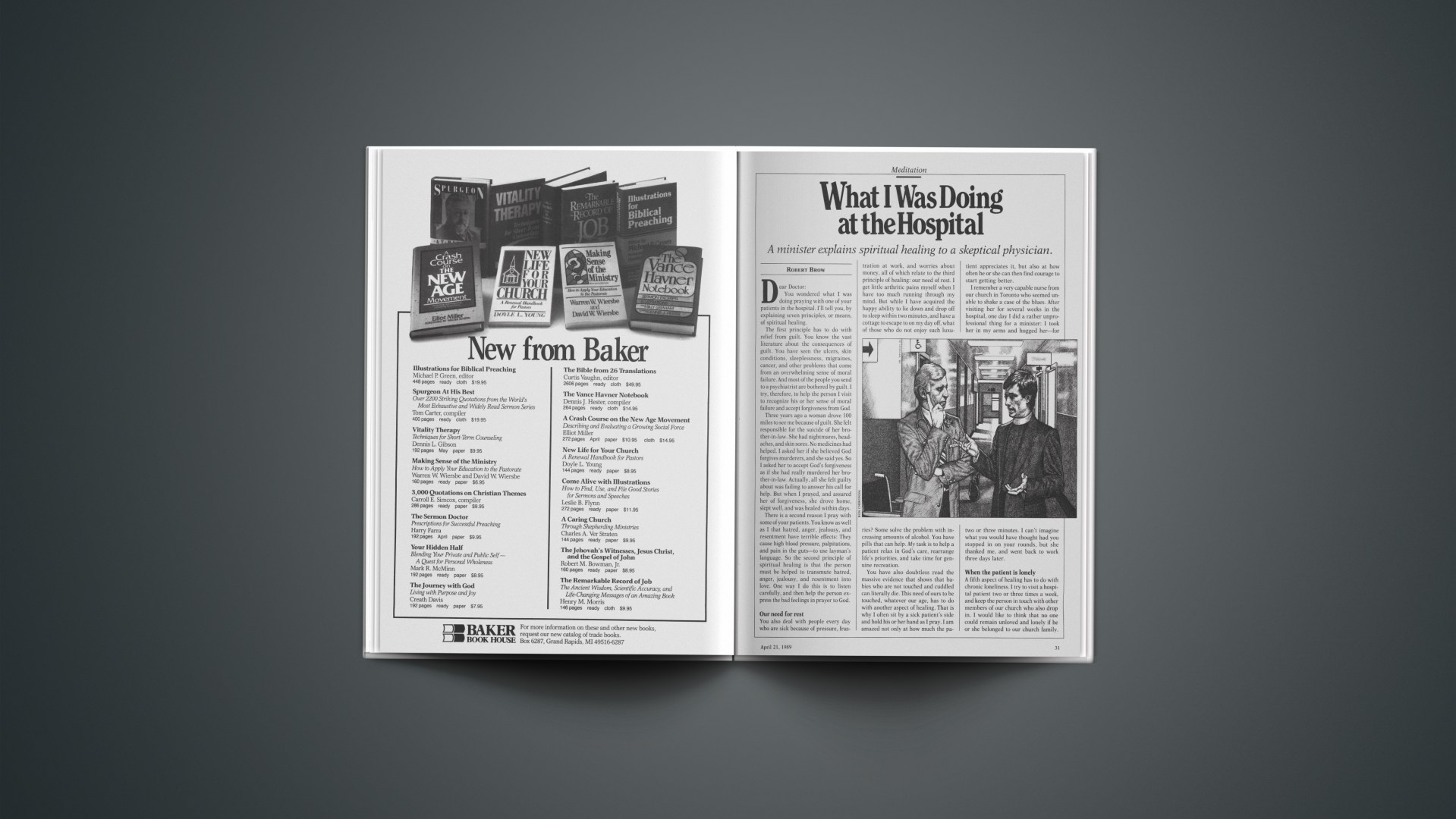
I remember a very capable nurse from our church in Toronto who seemed unable to shake a case of the blues. After visiting her for several weeks in the hospital, one day I did a rather unprofessional thing for a minister: I took her in my arms and hugged her—for two or three minutes. I can’t imagine what you would have thought had you stopped in on your rounds, but she thanked me, and went back to work three days later.
When The Patient Is Lonely
A fifth aspect of healing has to do with chronic loneliness. I try to visit a hospital patient two or three times a week, and keep the person in touch with other members of our church who also drop in. I would like to think that no one could remain unloved and lonely if he or she belonged to our church family. Often we fail. But if loneliness is a cause of sickness, then I assume that being a part of a loving community is one means of spiritual healing.
The sixth means of healing that you recognize every day is the importance of faith. One of your main tasks as a doctor is to maintain the patient’s faith in you. When faith goes, healing is hindered. And as you know, doctors have proved you can give a placebo of pink water, a bread pill, or a harmless injection, and, if the patient believes such things will cure him, healing often takes place. The problem is that doctors—and ministers—are fallible; it is important as soon as possible to transfer a person’s faith from the human means to God himself. Whenever we do that, spiritual healing can happen. And if healing should not come, a patient who has faith will be more ready to die with dignity and in peace, which is a kind of healing in itself.
Rooting For The Sick
Let me mention one more means of healing, which you may find more problematical. Whenever someone really cares and longs for the good of another, there is prayer. When you found yourself waking up and praying again and again that night when your own daughter was in intensive care, you were praying, even though I know you insist you are an agnostic. I believe that when a lot of people are rooting for a person who is sick, healing is very much easier than if everybody wished that person were dead. So one of my tasks was to assure your patient in the hospital that I was praying for her. I also told her that many other people were praying for her, and that we mention her by name in our services.
We also give thanks when we pray for her—especially now that she is on the road to recovery.







