
There’s a certain relish to be found in arguing with one’s ideological opponents; but it becomes awkward when you find yourself disagreeing with people you greatly admire and with whom you usually agree.
I have felt this awkwardness recently. First, with William F. Buckley; I can count on one hand the number of times I’ve disagreed with Bill in the quarter-century that we’ve been friends. Then with Milton Friedman, my economic guru during my years in politics. And with George Shultz, a much-respected colleague when we served together in the White House.
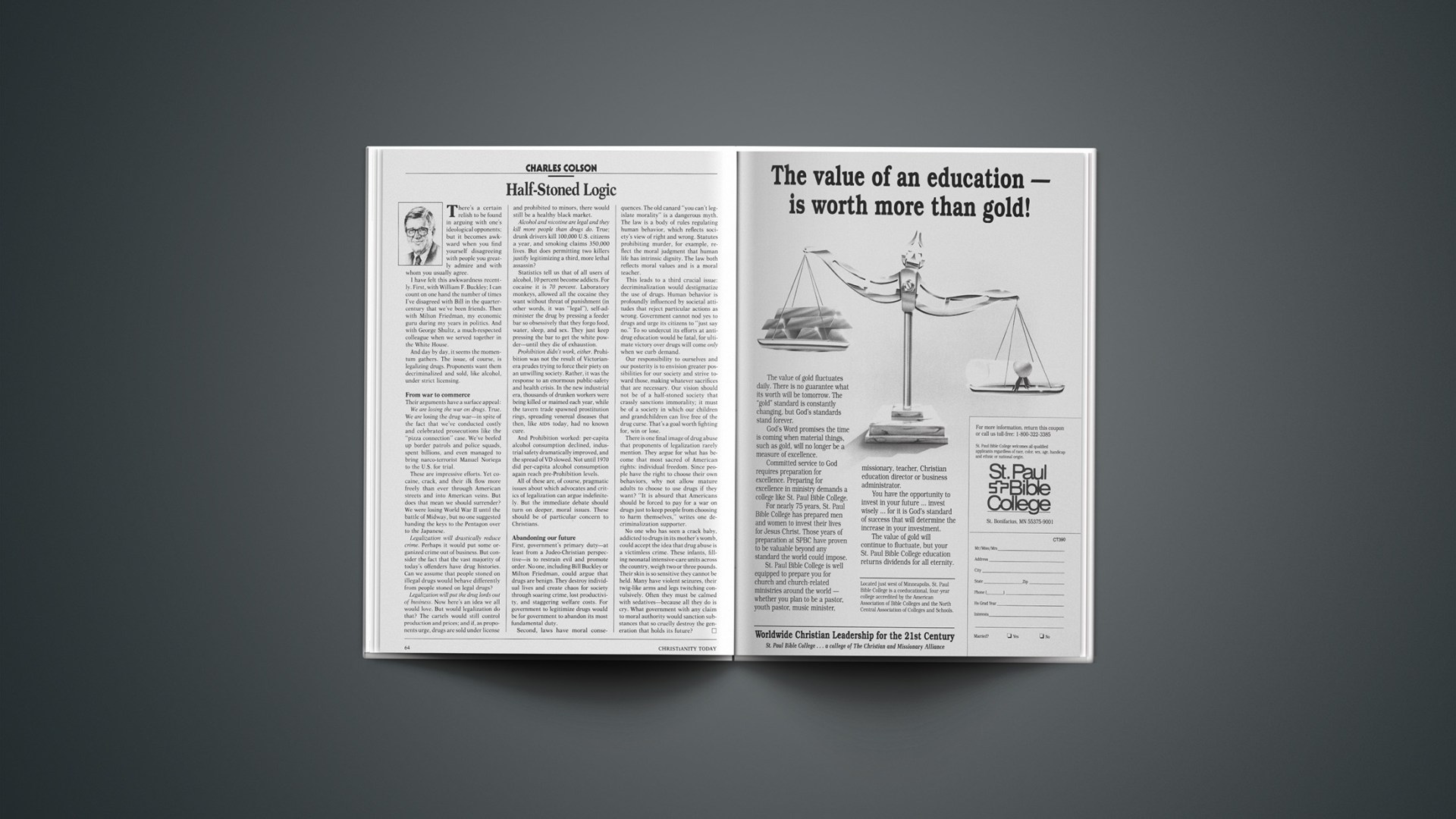
And day by day, it seems the momentum gathers. The issue, of course, is legalizing drugs. Proponents want them decriminalized and sold, like alcohol, under strict licensing.
From War To Commerce
Their arguments have a surface appeal: We are losing the war on drugs. True. We are losing the drug war—in spite of the fact that we’ve conducted costly and celebrated prosecutions like the “pizza connection” case. We’ve beefed up border patrols and police squads, spent billions, and even managed to bring narco-terrorist Manuel Noriega to the U.S. for trial.
These are impressive efforts. Yet cocaine, crack, and their ilk flow more freely than ever through American streets and into American veins. But does that mean we should surrender? We were losing World War II until the battle of Midway, but no one suggested handing the keys to the Pentagon over to the Japanese.
Legalization will drastically reduce crime. Perhaps it would put some organized crime out of business. But consider the fact that the vast majority of today’s offenders have drug histories. Can we assume that people stoned on illegal drugs would behave differently from people stoned on legal drugs?
Legalization will put the drug lords out of business. Now here’s an idea we all would love. But would legalization do that? The cartels would still control production and prices; and if, as proponents urge, drugs are sold under license and prohibited to minors, there would still be a healthy black market.
Alcohol and nicotine are legal and they kill more people than drugs do. True; drunk drivers kill 100,000 U.S. citizens a year, and smoking claims 350,000 lives. But does permitting two killers justify legitimizing a third, more lethal assassin?
Statistics tell us that of all users of alcohol, 10 percent become addicts. For cocaine it is 70 percent. Laboratory monkeys, allowed all the cocaine they want without threat of punishment (in other words, it was “legal”), self-administer the drug by pressing a feeder bar so obsessively that they forgo food, water, sleep, and sex. They just keep pressing the bar to get the white powder—until they die of exhaustion.
Prohibition didn’t work, either. Prohibition was not the result of Victorianera prudes trying to force their piety on an unwilling society. Rather, it was the response to an enormous public-safety and health crisis. In the new industrial era, thousands of drunken workers were being killed or maimed each year, while the tavern trade spawned prostitution rings, spreading venereal diseases that then, like AIDS today, had no known cure.
And Prohibition worked: per-capita alcohol consumption declined, industrial safety dramatically improved, and the spread of VD slowed. Not until 1970 did per-capita alcohol consumption again reach pre-Prohibition levels.
All of these are, of course, pragmatic issues about which advocates and critics of legalization can argue indefinitely. But the immediate debate should turn on deeper, moral issues. These should be of particular concern to Christians.
Abandoning Our Future
First, government’s primary duty—at least from a Judeo-Christian perspective—is to restrain evil and promote order. No one, including Bill Buckley or Milton Friedman, could argue that drugs are benign. They destroy individual lives and create chaos for society through soaring crime, lost productivity, and staggering welfare costs. For government to legitimize drugs would be for government to abandon its most fundamental duty.
Second, laws have moral consequences. The old canard “you can’t legislate morality” is a dangerous myth. The law is a body of rules regulating human behavior, which reflects society’s view of right and wrong. Statutes prohibiting murder, for example, reflect the moral judgment that human life has intrinsic dignity. The law both reflects moral values and is a moral teacher.
This leads to a third crucial issue: decriminalization would destigmatize the use of drugs. Human behavior is profoundly influenced by societal attitudes that reject particular actions as wrong. Government cannot nod yes to drugs and urge its citizens to “just say no.” To so undercut its efforts at antidrug education would be fatal, for ultimate victory over drugs will come only when we curb demand.
Our responsibility to ourselves and our posterity is to envision greater possibilities for our society and strive toward those, making whatever sacrifices that are necessary. Our vision should not be of a half-stoned society that crassly sanctions immorality; it must be of a society in which our children and grandchildren can live free of the drug curse. That’s a goal worth fighting for, win or lose.
There is one final image of drug abuse that proponents of legalization rarely mention. They argue for what has become that most sacred of American rights: individual freedom. Since people have the right to choose their own behaviors, why not allow mature adults to choose to use drugs if they want? “It is absurd that Americans should be forced to pay for a war on drugs just to keep people from choosing to harm themselves,” writes one decriminalization supporter.
No one who has seen a crack baby, addicted to drugs in its mother’s womb, could accept the idea that drug abuse is a victimless crime. These infants, filling neonatal intensive-care units across the country, weigh two or three pounds. Their skin is so sensitive they cannot be held. Many have violent seizures, their twig-like arms and legs twitching convulsively. Often they must be calmed with sedatives—because all they do is cry. What government with any claim to moral authority would sanction substances that so cruelly destroy the generation that holds its future?