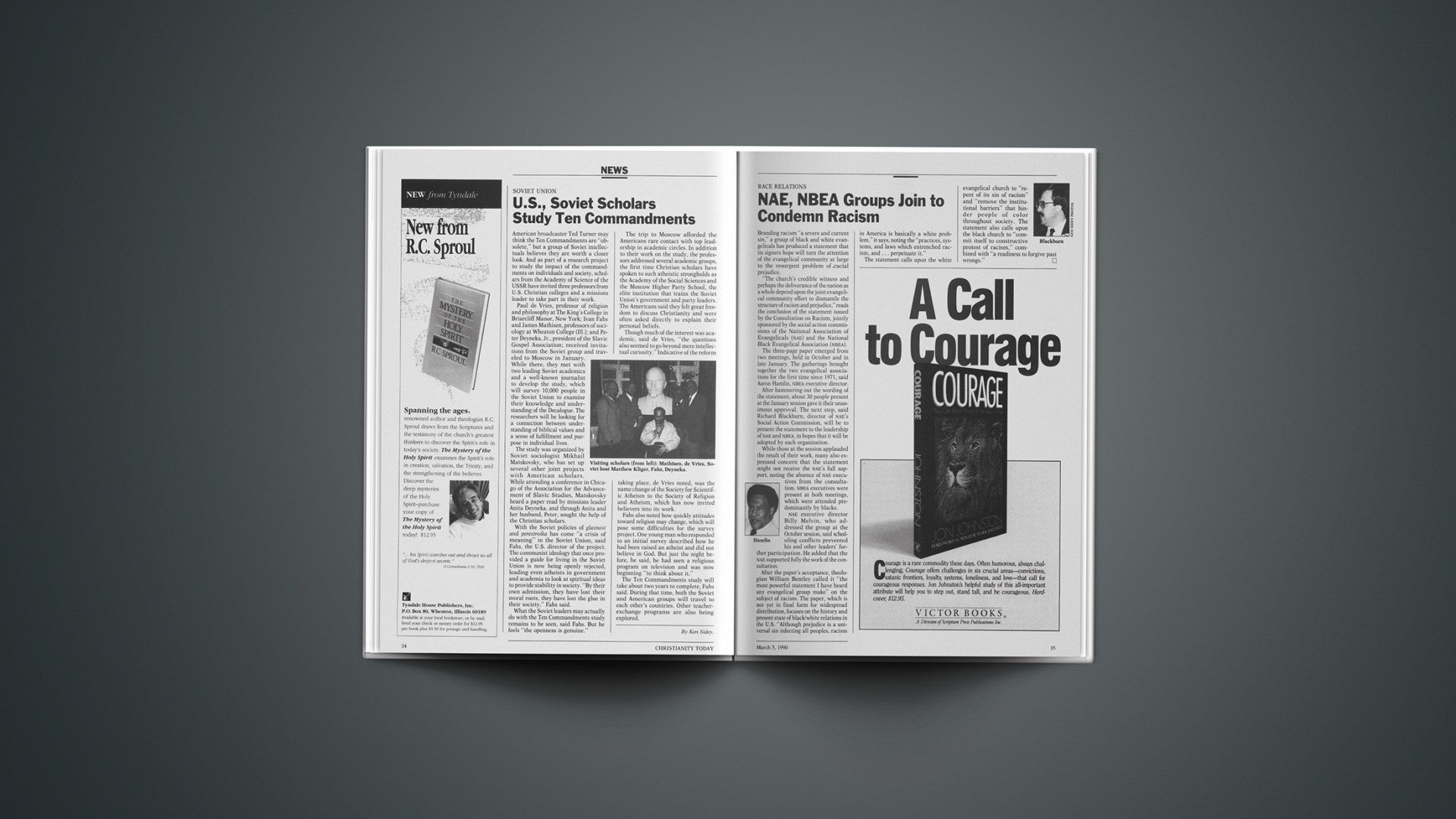

American broadcaster Ted Turner may think the Ten Commandments are “obsolete,” but a group of Soviet intellectuals believes they are worth a closer look. And as part of a research project to study the impact of the commandments on individuals and society, scholars from the Academy of Science of the USSR have invited three professors from U.S. Christian colleges and a missions leader to take part in their work.
Paul de Vries, professor of religion and philosophy at The King’s College in Briarcliff Manor, New York; Ivan Fahs and James Mathisen, professors of sociology at Wheaton College (Ill.); and Peter Deyneka, Jr., president of the Slavic Gospel Association; received invitations from the Soviet group and traveled to Moscow in January. While there, they met with two leading Soviet academics and a well-known journalist to develop the study, which will survey 10,000 people in the Soviet Union to examine their knowledge and understanding of the Decalogue. The researchers will be looking for a connection between understanding of biblical values and a sense of fulfillment and purpose in individual lives.
The study was organized by Soviet sociologist Mikhail Matskovsky, who has set up several other joint projects with American scholars. While attending a conference in Chicago of the Association for the Advancement of Slavic Studies, Matskovsky heard a paper read by missions leader Anita Deyneka, and through Anita and her husband, Peter, sought the help of the Christian scholars.
With the Soviet policies of glasnost and perestroika has come “a crisis of meaning” in the Soviet Union, said Fahs, the U.S. director of the project. The communist ideology that once provided a guide for living in the Soviet Union is now being openly rejected, leading even atheists in government and academia to look at spiritual ideas to provide stability in society. “By their own admission, they have lost their moral roots, they have lost the glue in their society,” Fahs said.
What the Soviet leaders may actually do with the Ten Commandments study remains to be seen, said Fahs. But he feels “the openness is genuine.”
The trip to Moscow afforded the Americans rare contact with top leadership in academic circles. In addition to their work on the study, the professors addressed several academic groups, the first time Christian scholars have spoken to such atheistic strongholds as the Academy of the Social Sciences and the Moscow Higher Party School, the elite institution that trains the Soviet Union’s government and party leaders. The Americans said they felt great freedom to discuss Christianity and were often asked directly to explain their personal beliefs.
Though much of the interest was academic, said de Vries, “the questions also seemed to go beyond mere intellectual curiosity.” Indicative of the reform taking place, de Vries noted, was the name change of the Society for Scientific Atheism to the Society of Religion and Atheism, which has now invited believers into its work.
Fahs also noted how quickly attitudes toward religion may change, which will pose some difficulties for the survey project. One young man who responded to an initial survey described how he had been raised an atheist and did not believe in God. But just the night before, he said, he had seen a religious program on television and was now beginning “to think about it.”
The Ten Commandments study will take about two years to complete, Fahs said. During that time, both the Soviet and American groups will travel to each other’s countries. Other teacher-exchange programs are also being explored.
By Ken Sidey.