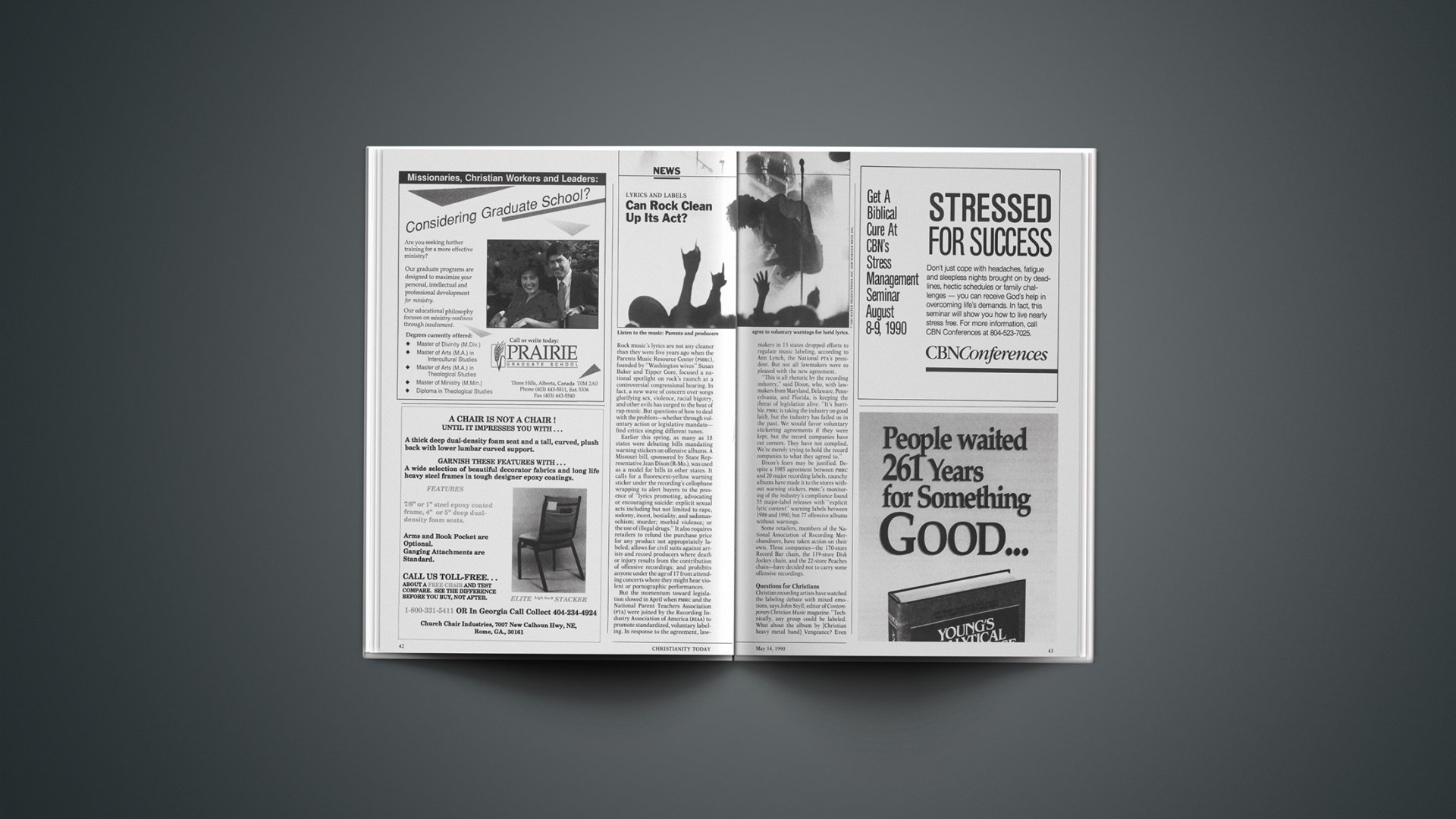

Rock music’s lyrics are not any cleaner than they were five years ago when the Parents Music Resource Center (PMRC), founded by “Washington wives” Susan Baker and Tipper Gore, focused a national spotlight on rock’s raunch at a controversial congressional hearing. In fact, a new wave of concern over songs glorifying sex, violence, racial bigotry, and other evils has surged to the beat of rap music. But questions of how to deal with the problem—whether through voluntary action or legislative mandate—find critics singing different tunes.
Earlier this spring, as many as 18 states were debating bills mandating warning stickers on offensive albums. A Missouri bill, sponsored by State Representative Jean Dixon (R-Mo.), was used as a model for bills in other states. It calls for a fluorescent-yellow warning sticker under the recording’s cellophane wrapping to alert buyers to the presence of “lyrics promoting, advocating or encouraging suicide: explicit sexual acts including but not limited to rape, sodomy, incest, bestiality, and sadomasochism; murder; morbid violence; or the use of illegal drugs.” It also requires retailers to refund the purchase price for any product not appropriately labeled; allows for civil suits against artists and record producers where death or injury results from the contribution of offensive recordings; and prohibits anyone under the age of 17 from attending concerts where they might hear violent or pornographic performances.
But the momentum toward legislation slowed in April when PMRC and the National Parent Teachers Association (PTA) were joined by the Recording Industry Association of America (RIAA) to promote standardized, voluntary labeling. In response to the agreement, lawmakers in 13 states dropped efforts to regulate music labeling, according to Ann Lynch, the National PTA’s president. But not all lawmakers were so pleased with the new agreement.
“This is all rhetoric by the recording industry,” said Dixon, who, with lawmakers from Maryland, Delaware, Pennsylvania, and Florida, is keeping the threat of legislation alive. “It’s horrible. PMRC is taking the industry on good faith, but the industry has failed us in the past. We would favor voluntary stickering agreements if they were kept, but the record companies have cut corners. They have not complied. We’re merely trying to hold the record companies to what they agreed to.”
Dixon’s fears may be justified. Despite a 1985 agreement between PMRC and 20 major recording labels, raunchy albums have made it to the stores without warning stickers. PMRC’s monitoring of the industry’s compliance found 55 major-label releases with “explicit lyric content” warning labels between 1986 and 1990, but 77 offensive albums without warnings.
Some retailers, members of the National Association of Recording Merchandisers, have taken action on their own. Three companies—the 170-store Record Bar chain, the 119-store Disk Jockey chain, and the 22-store Peaches chain—have decided not to carry some offensive recordings.
Questions For Christians
Christian recording artists have watched the labeling debate with mixed emotions, says John Styll, editor of Contemporary Christian Music magazine. “Technically, any group could be labeled. What about the album by [Christian heavy metal band] Vengeance? Even the cover of the album—which shows a nail driven through a hand—could raise questions. If the legislation were evenly applied, a Christian song about stomping on the head of the Devil—which does advocate violence, in a sense—could be labeled.
“If the proposed legislation forbids the production of a particular song, I would oppose that,” Styll says. “I don’t really think its intention is censorship, but it may have that effect.”
Christian musician Dana Key shares Dixon’s skepticism about the latest recording industry agreement. “I don’t have any confidence in the recording industry. In fact, I expect they will use this whole controversy as a way to generate more publicity and sell more records. They have not kept their promises, and the time is long since past for action.”
Key, who once debated musician Frank Zappa, an outspoken opponent of labeling, would accept a voluntary label that rates records, similar to movie ratings. He says the issue is not censorship. “It doesn’t restrict free speech, it merely educates parents.”
Bob DeMoss, a youth-culture specialist at Focus on the Family, testified in hearings on Tennessee’s labeling bill. He prefers that printed lyrics be included in each recording. “That would be the most helpful device in maximizing a parent’s ability to dialogue within the family about the family’s preferred entertainment selections,” he says.
If the industry fails to apply some voluntary system, such as that used by the motion picture makers, “then they invite the heavy hand of legislation,” DeMoss says. “So, as a last resort, legislation can work.”
“Let’s give them six months to see how they behave,” he says. “Yes, they’ve had five years, but what they haven’t had is a clear reading that the public is behind this. Now that the fire has been reignited by Jean Dixon and company, we want to see how they respond.”
By Steve Rabey.