
Living in an age of religious pluralism, we wonder why people in the sixteenth century would be tortured or drowned over the issue of mode of baptism.
When Luther, Zwingli, and others led their movements away from Catholicism, many practices were changed; but infant baptism, the accepted mode for most of Christian history, was not. Baptizing only adults—that is, people who chose to be baptized—was a radical idea that cut at the heart of both church and state. Yet it was just one of many revolutionary ideas typical of a diverse group called Anabaptists. Their movement is also known as the Radical Reformation.
Anabaptist Origins
The immediate issue creating the Anabaptist movement was not just baptism, however, but also civil government. (The two were related. To be baptized was a civil issue, and to refuse it tore a “seamless Christian society.”)
Under Ulrich Zwingli and the city council in Zurich, the Reformation was proceeding. But Conrad Grebel, Felix Manz, and other associates of Zwingli didn’t feel the Reformation was going far enough. They wanted to do away with the tithe, usury, and military service. Further, some of these radicals wanted a totally self-governing church, free of government interference.
Zwingli, who wanted gradual, orderly change, parted ways with them. On January 21, 1525, the Zurich council forbade the radicals from disseminating their views. That wintry evening, in a nearby village, the radicals met—and baptized each other. The name Anabaptist, meaning “rebaptizer,” was later given them by detractors.
Anabaptist Distinctives
These believers didn’t want to merely reform the church; they wanted to wholly restore it to its initial purity and simplicity. Such a church, they held, consists only of people who present themselves to be baptized.
Congregationalism was another key belief. The Anabaptists could find no justification for elaborate church bureaucracies. Decisions should be made not by a hierarchical leader but by the entire local assembly. In fact, the Anabaptists were the first to try to practice democracy in the congregation.
Another central teaching was the separation of church and state. The church, they said, is to be composed of free, “uncompelled” people. The state is not to use coercion on people’s consciences.
Jesus taught the way of nonviolence, the Anabaptists believed, and so pacifism became another important feature of their lives. Even the hated Turks must not be fought with a sword. By obeying Jesus’ clear commands, his followers should be distinct from society, even a society claiming to be Christian.
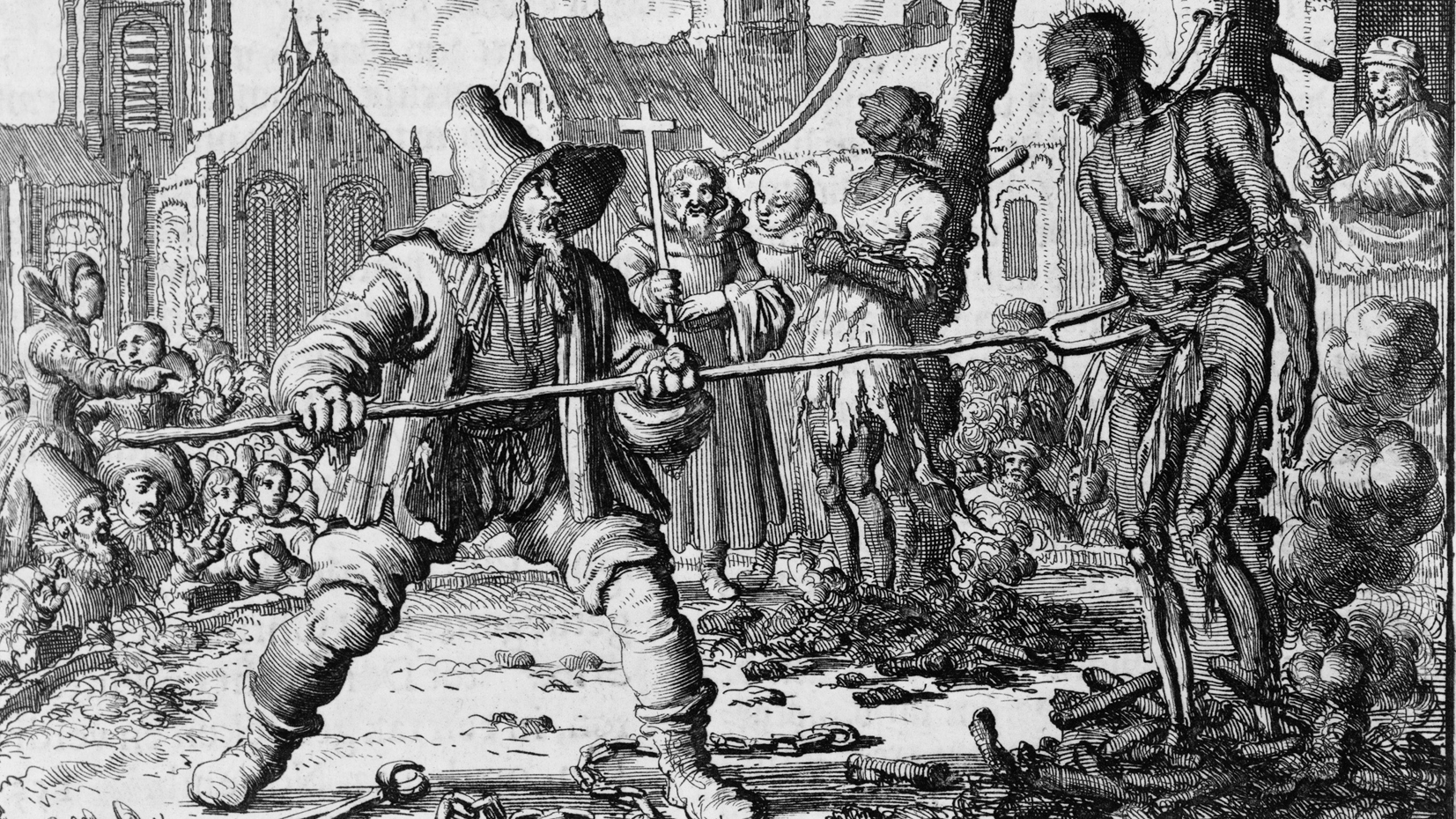
Didn’t Luther and the other great Reformers see the wisdom of the Anabaptists? They didn’t—partly because they thought the Anabaptists’ theology was amiss, partly because the Anabaptists seemed disorderly. In one extreme case in Münster in 1534–5, Anabaptists came to power and took up arms (temporarily throwing aside their taboo on violence), practiced polygamy (citing Old Testament precedents), and claimed bizarre revelations from God. To both Catholics and Protestants these extremes justified persecuting the Anabaptists, executing them by fire or sword or drowning.
Anabaptist Development
In spite of persecution, the movement spread, mostly among the lower classes. Since the Anabaptists had no official sanction, they had to increase their numbers by outright evangelism, something new in supposedly Christian Europe. Some courageous leaders emerged, particularly the former priest Menno Simons (1496–1561), a gifted organizer whose name has settled on the group called Mennonites. Other leaders included Conrad Grebel, Thomas Muntzer, Hans Hut, Pilgram Marpeck, Melchior Hoffmann, Jacob Hutter, and Balthasar Hubmaier. As you can guess from the names, most Anabaphsts were from German-speaking territories, always the area of their greatest strength. Though no one person tied the movement together, Anabaptists shared many central beliefs, which were set forth in the Schleitheim Confession in 1527.
Today you would not find a listing for “Churches-Anabaptist” in your local Yellow Pages. You would probably find listings for their descendants—Mennonite and Brethren churches, for example. There are hundreds of such churches in the U.S. and in the world. Though small in numbers compared with, say, Baptists or Methodists, their influence has been great, particularly in the areas of pacifism, community, and service.
Copyright © 1990 by the author or Christianity Today/Christian History magazine. Click here for reprint information on Christian History.