
RELIGIOUS REFUGEES
Coming To America
After being stranded for almost one year in the Soviet Union, more than 700 Soviet Christian and Jewish emigrés arrived in the United States late last month. The refugees were among some 6,000 caught by an abrupt change in U.S. immigration policy. Most had sold their homes and belongings and given up their jobs and ration cards in anticipation of settling in the U.S.
While waiting in the Soviet Union, the refugees, many of whom are Pentecostal believers, were harassed by government officials, the KGB, and hostile neighbors, said Serge Duss, coordinator of the Soviet refugee program of World Relief, which, with the U.S. State Department, planned the flights that brought the group to Chicago and will assist in settling them in the U.S.
EGYPT
Rumors Prompt Riots
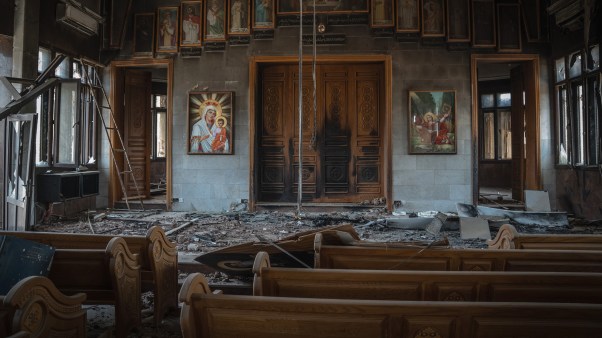
An Egyptian human-rights group has blamed a wave of anti-Christian violence in that country on a Muslim extremist group. During riots earlier this year in five cities and villages, 40 people were injured and five churches, two Christian organization headquarters, and numerous Christian-owned shops and businesses were damaged.
After conducting an independent investigation, the Egyptian Organization for Human Rights (EOHR) released a seven-page report that found the Muslim group Gammaa Islamyia guilty of “spreading provocative rumors” that were “accompanied by strong incitement to various forms of vengeance” aimed at Christians. Pamphlets distributed by the group accused local Coptic Christians of involvement in prostitution, drugs, and pornography. The EOHR report also faulted Egyptian government policy for failing to uphold the rights of Christian citizens and therefore contributing to the sectarian violence.
The Egyptian government has downplayed the violence as “limited incidents.” Interior Minister Zaki Badr said that if “elements of extremism from Islamic groups bear the greater responsibility for the events, we cannot overlook the assistant role played by elements of Christian extremism.”
SOVIET UNION
Popular Priest Murdered
Alexander Menn, a popular Russian Orthodox priest and biblical scholar, was murdered last month in Zagorsk. Speculation about his killer, who struck the 55-year-old priest on the back of the neck with an ax, initially pointed to the KGB and the anti-Semitic group Pamyat. Menn was an outspoken opponent of communism and was born a Jew, though he never practiced Judaism.
Soviet President Mikhail Gorbachev ordered an investigation of the murder, which authorities believe was carefully planned. Three suspects have been detained.
“Father Alexander,” as he was known, wrote ten books and numerous articles on comparative religion and church history, which were smuggled out of the Soviet Union and published under several pseudonyms. Last month he was to have begun serving as host of a regular television program. He was also noted for his criticism of the Russian Orthodox church’s cooperation with the Soviet Communist government and for his tolerance of other religions.
BOLIVIA
Constitutional Campaign
Evangelicals in Bolivia have launched a campaign to amend the constitution to allow for separation of church and state and end government restrictions on religious activity. Amendment sponsors want to delete a section of the constitution, which now reads, “The state recognizes and sustains the Apostolic and Roman Catholic religion,” and establish that “the state guarantees and protects the public exercise of all religious worship.” Felipe Kittelson, executive secretary of the National Association of Evangelicals of Bolivia, believes 100,000 petition signatures could be gathered by the end of this month.
The issue of church/state separation surfaced notably last January at Bolivia’s first presidential prayer breakfast. There, Pedro Moreno, general secretary of the Social Emergency Fund and an active Pentecostal layman, called for “neutrality of the state in matters of the church.” Though Bolivian President Paz Zamora has assured evangelical leaders he supports their work, his administration recently proposed strict controls on the activities of non-Catholic churches and organizations.
PEOPLE AND EVENTS
Briefly Noted
Launched: The Council of Churches for Britain and Ireland, which replaces the British Council of Churches. Unlike its predecessor organization, it includes full Roman Catholic participation.
Published: The first complete New Testament in the language of the Mongolian People’s Republic. According to the United Bible Societies, which undertook the 18-year translation effort, Mongolian is the last official national language in the world to receive the New Testament.
Restored: the Soviet citizenship of exiled Christian leader Georgi Vins, founder of Russian Gospel Ministries in Elkhart, Indiana, by edict of Soviet President Mikhail Gorbachev, which repealed previous actions of the Supreme Soviet. In an open letter in response to Gorbachev, Vins, who was exiled in 1979 after five years in prison, called for the Soviet leader to repeal other Soviet court findings against him and take further steps to assure freedom of religion in the Soviet Union.