
Christian organizations around the world who use one or more of the three film versions of Bible stories produced by the Genesis Project regularly report positive results from their film evangelism work. But they say they continue to be hounded by rumors that the Mormon Church is buying the rights to the films.
Are the rumors true? From all indications, no. But a review of what has happened to the various Genesis Project efforts provides insight into how the rumors may have gotten their start.
The Genesis Project, based in New York City, was formed in 1975 to film the entire Bible. It fell far short of that goal. In fact, it completed only three projects, including two word-for-word film versions of Genesis and Luke, known together as the New Media Bible. The third project was the popular JESUS film.
Based on the Gospel of Luke, JESUS was filmed simultaneously with the Luke film for the New Media Bible. But the film and the New Media Bible were two distinct ventures, whose rights are now owned by different entities.
Enter The Mormons
In the mideighties, the Church of Jesus Christ of Latter-day Saints (Mormons) became the biggest purchaser of copies of the New Media Bible. According to a 1987 letter written by the Genesis Project’s John Heyman to Kurt Goedelman of the Mormon-watch group Personal Freedom Outreach, Mormons bought some 80,000 copies of the Luke and Genesis New Media Bible tapes during a single six-month period.
Wrote Heyman, “It has been and continues to be the policy of the Genesis Project that whoever wishes to watch the biblical films that we have produced is more than free to do so.… In deciding to whom we will sell the product that we manufacture, we do not distinguish between Moslems, Buddhists, Jews or Christians.”
The Mormon church, which has a distribution agreement with the Genesis Project, offers the New Media Bible for sale through its Salt Lake Distribution Center but does not use the films for evangelism, said Don LeFevre, the church’s director of media relations. “The films are available churchwide in English, and are very popular among families who buy them for personal use,” he said. “They are also stocked at church libraries for Sunday school, lending libraries, and purchase. But they are not adaptable to missionary work.”
Genesis Project president John Roche, who is also president of Business Resource Publications, is rumored to be interested in selling all rights to the New Media Bible. Roche did not return CT’s calls. But Mormon church spokesman LeFevre said the church “is not interested in this.”
The Mormon church also disputes the accusation that it has edited the films to fit Mormon doctrine. “There are a couple of instances of minor editing,” said LeFevre, explaining that the editing consisted of fixing up minor production-quality problems, omitting scenes considered too violent for family viewing, and omitting certain scenes covering Cain and Abel who, LeFevre said, are portrayed as “Cro-Magnon-type people,” which in the church’s view implies support for the theory of evolution.
Source Of Confusion
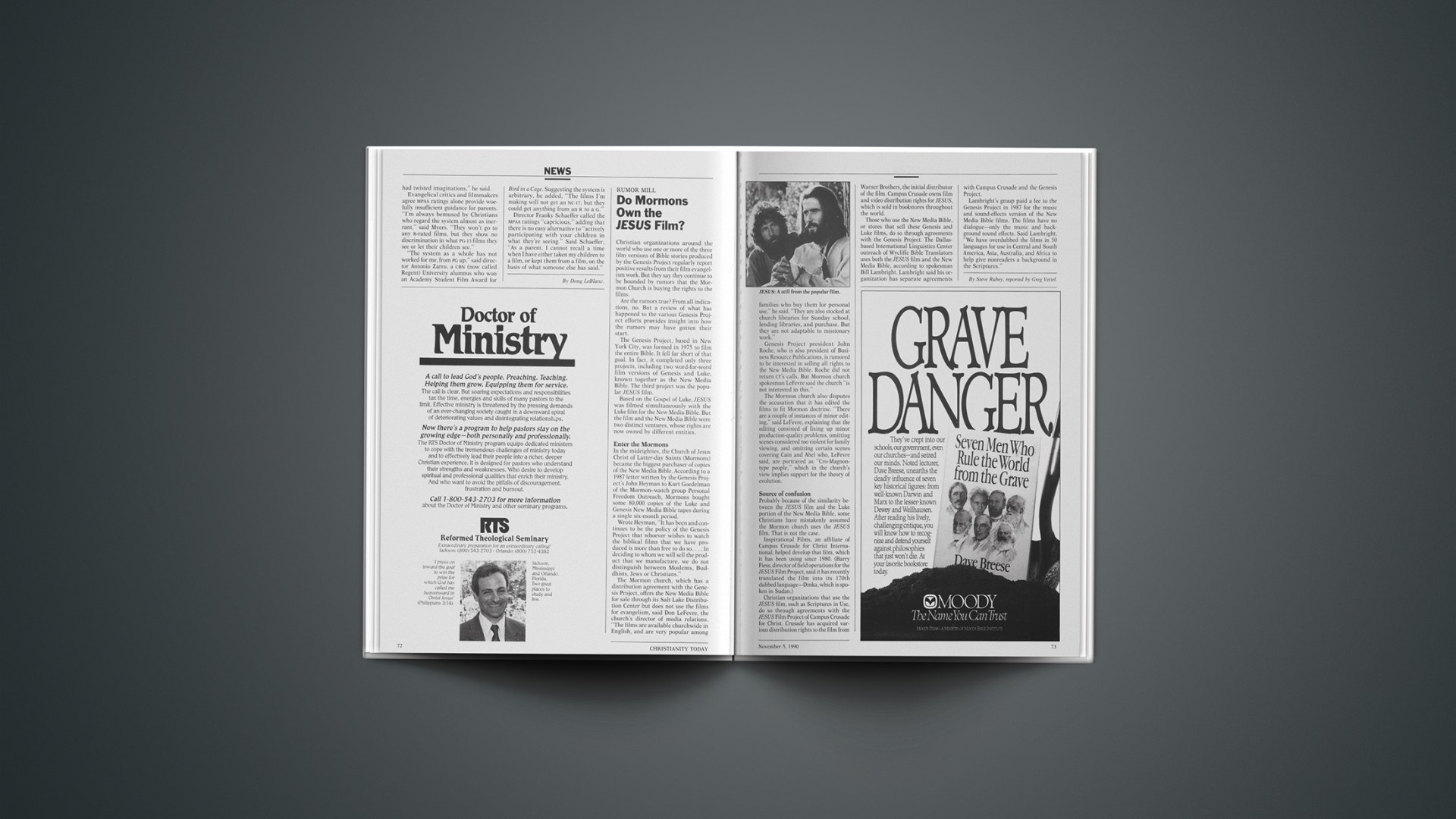
Probably because of the similarity between the JESUS film and the Luke portion of the New Media Bible, some Christians have mistakenly assumed the Mormon church uses the JESUS film. That is not the case.
Inspirational Films, an affiliate of Campus Crusade for Christ International, helped develop that film, which it has been using since 1980. (Barry Fiess, director of field operations for the JESUS Film Project, said it has recently translated the film into its 170th dubbed language—Dinka, which is spoken in Sudan.)
Christian organizations that use the JESUS film, such as Scriptures in Use, do so through agreements with the JESUS Film Project of Campus Crusade for Christ. Crusade has acquired various distribution rights to the film from Warner Brothers, the initial distributor of the film. Campus Crusade owns film and video distribution rights for JESUS, which is sold in bookstores throughout the world.
Those who use the New Media Bible, or stores that sell these Genesis and Luke films, do so through agreements with the Genesis Project. The Dallas-based International Linguistics Center outreach of Wycliffe Bible Translators uses both the JESUS film and the New Media Bible, according to spokesman Bill Lambright. Lambright said his organization has separate agreements with Campus Crusade and the Genesis Project.
Lambright’s group paid a fee to the Genesis Project in 1987 for the music and sound-effects version of the New Media Bible films. The films have no dialogue—only the music and background sound effects. Said Lambright, “We have overdubbed the films in 50 languages for use in Central and South America, Asia, Australia, and Africa to help give nonreaders a background in the Scriptures.”