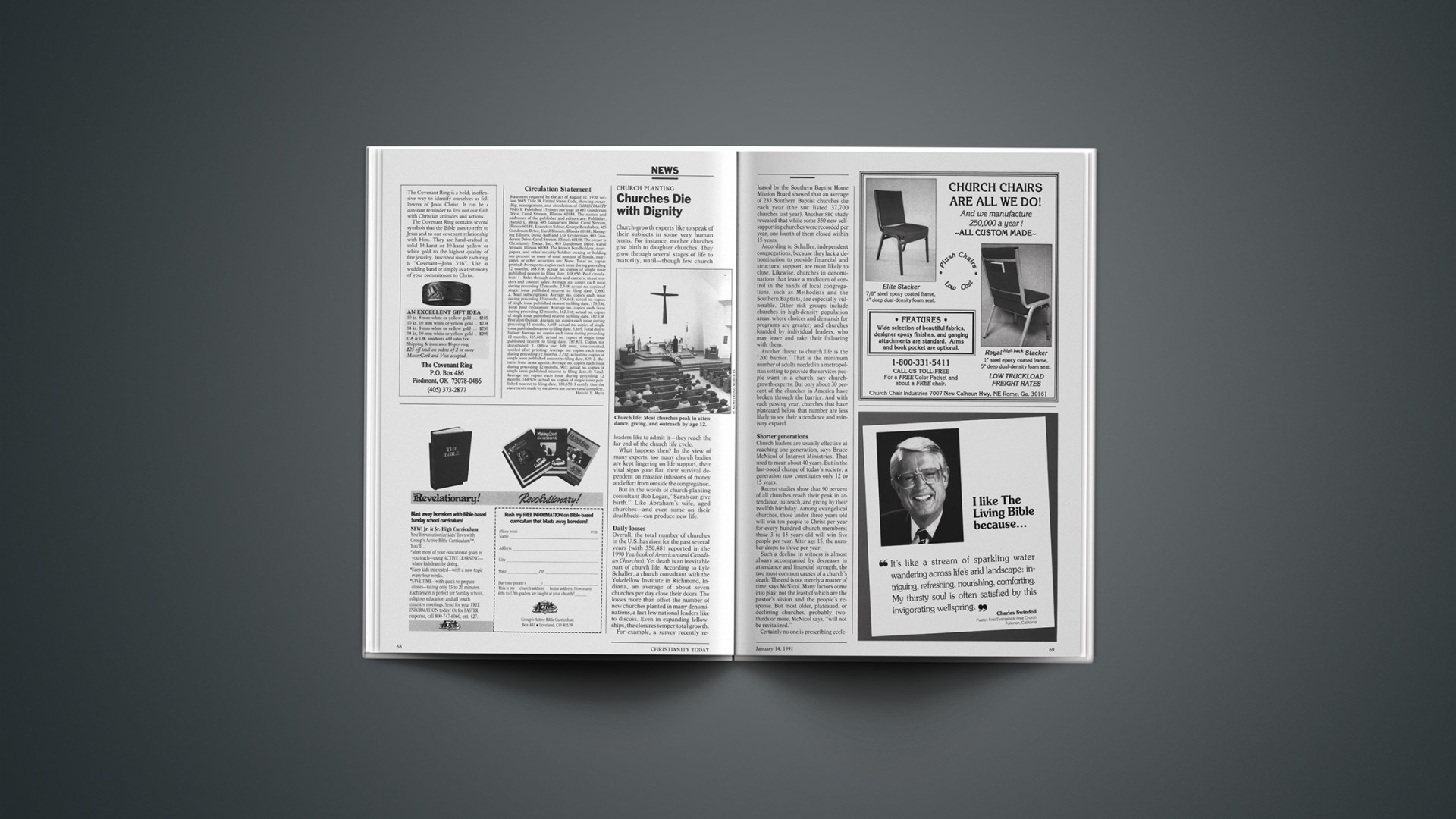

Church-growth experts like to speak of their subjects in some very human terms. For instance, mother churches give birth to daughter churches. They grow through several stages of life to maturity, until—though few church leaders like to admit it—they reach the far end of the church life cycle.
What happens then? In the view of many experts, too many church bodies are kept lingering on life support, their vital signs gone flat, their survival dependent on massive infusions of money and effort from outside the congregation.
But in the words of church-planting consultant Bob Logan, “Sarah can give birth.” Like Abraham’s wife, aged churches—and even some on their deathbeds—can produce new life.
Daily Losses
Overall, the total number of churches in the U.S. has risen for the past several years (with 350,481 reported in the 1990 Yearbook of American and Canadian Churches). Yet death is an inevitable part of church life. According to Lyle Schaller, a church consultant with the Yokefellow Institute in Richmond, Indiana, an average of about seven churches per day close their doors. The losses more than offset the number of new churches planted in many denominations, a fact few national leaders like to discuss. Even in expanding fellowships, the closures temper total growth.
For example, a survey recently released by the Southern Baptist Home Mission Board showed that an average of 235 Southern Baptist churches die each year (the SBC listed 37,700 churches last year). Another SBC study revealed that while some 350 new self-supporting churches were recorded per year, one-fourth of them closed within 15 years.
According to Schaller, independent congregations, because they lack a denomination to provide financial and structural support, are most likely to close. Likewise, churches in denominations that leave a modicum of control in the hands of local congregations, such as Methodists and the Southern Baptists, are especially vulnerable. Other risk groups include churches in high-density population areas, where choices and demands for programs are greater; and churches founded by individual leaders, who may leave and take their following with them.
Another threat to church life is the “200 barrier.” That is the minimum number of adults needed in a metropolitan setting to provide the services people want in a church, say church-growth experts. But only about 30 percent of the churches in America have broken through the barrier. And with each passing year, churches that have plateaued below that number are less likely to see their attendance and ministry expand.
Shorter Generations
Church leaders are usually effective at reaching one generation, says Bruce McNicol of Interest Ministries. That used to mean about 40 years. But in the fast-paced change of today’s society, a generation now constitutes only 12 to 15 years.
Recent studies show that 90 percent of all churches reach their peak in attendance, outreach, and giving by their twelfth birthday. Among evangelical churches, those under three years old will win ten people to Christ per year for every hundred church members; those 3 to 15 years old will win five people per year. After age 15, the number drops to three per year.
Such a decline in witness is almost always accompanied by decreases in attendance and financial strength, the two most common causes of a church’s death. The end is not merely a matter of time, says McNicol. Many factors come into play, not the least of which are the pastor’s vision and the people’s response. But most older, plateaued, or declining churches, probably two-thirds or more, McNicol says, “will not be revitalized.”
Certainly no one is prescribing ecclesiastical euthanasia. But conventional church-growth wisdom says, “It is easier to have a baby than to raise the dead.” Some dying churches merge with other congregations or relocate. Most disband, scattering their parishioners throughout the community. But a few congregations have begun to see the death of their church as a way to plant new churches.
One example comes from a suburban congregation that disbanded several years ago. The locally controlled church entrusted its property to Interest Ministries, which in turn rented the building to a Hispanic congregation, offering it for sale to them after five years at a greatly reduced price. Income from the property will provide for the retirement of three missionaries from the former church, and help finance other church-planting work.
“The credit belongs to the people in that church for having the vision to bring life out of their death,” says McNicol, whose ministry has helped arrange eight or ten such “births.”
Another example comes from a Presbyterian church in Florida. There, the sale of one property holding created the funds to start 12 new congregations.
Logical Connection
For years denominations have sold empty and unused church properties. But the idea of earmarking funds from the sale of older properties specifically for new church planting is still rare.
“It seems to me a logical connection,” says one denominational church planter, “one that could enable us to multiply our efforts.” But, he adds, “there are too many other places in the [denominational] budget that that money can end up.”
Another method of church reproduction that church planters say can happen late in life (or at any time) is a “hive off,” in which several like-minded members leave a church to begin a new one. To some, that sounds like a church split. Indeed, the departure may be prompted by strong differences of opinion and surrounded by hard feelings.
But consultants like Logan say a split often happens “when a church is pregnant and doesn’t know it.” Many times God will eventually bless both groups, Logan says, creating a new church and revitalizing an old one.
Many church observers believe most of the generation of churches planted just after World War II is in the final stages of its institutional life. At the same time, they see a wide variety of new church forms—and even “denominations”—emerging. What remains to be seen is the inheritence one generation will pass on to the next.