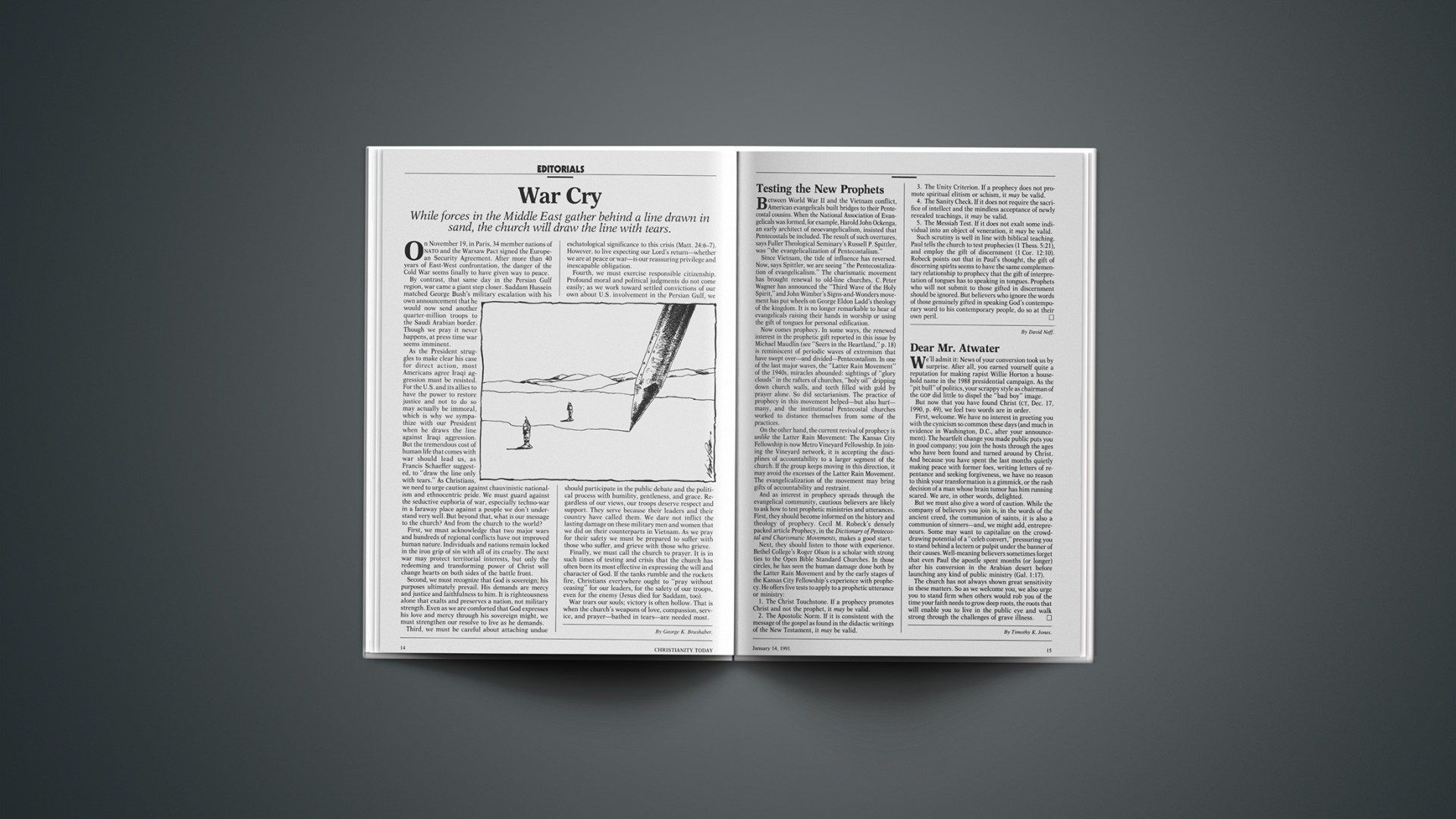

While forces in the Middle East gather behind a line drawn in sand, the church will draw the line with tears.
On November 19, in Paris, 34 member nations of NATO and the Warsaw Pact signed the European Security Agreement. After more than 40 years of East-West confrontation, the danger of the Cold War seems finally to have given way to peace.
By contrast, that same day in the Persian Gulf region, war came a giant step closer. Saddam Hussein matched George Bush’s military escalation with his own announcement that he would now send another quarter-million troops to the Saudi Arabian border. Though we pray it never happens, at press time war seems imminent.
As the President struggles to make clear his case for direct action, most Americans agree Iraqi aggression must be resisted. For the U.S. and its allies to have the power to restore justice and not to do so may actually be immoral, which is why we sympathize with our President when he draws the line against Iraqi aggression. But the tremendous cost of human life that comes with war should lead us, as Francis Schaeffer suggested, to “draw the line only with tears.” As Christians, we need to urge caution against chauvinistic nationalism and ethnocentric pride. We must guard against the seductive euphoria of war, especially techno-war in a faraway place against a people we don’t understand very well. But beyond that, what is our message to the church? And from the church to the world?
First, we must acknowledge that two major wars and hundreds of regional conflicts have not improved human nature. Individuals and nations remain locked in the iron grip of sin with all of its cruelty. The next war may protect territorial interests, but only the redeeming and transforming power of Christ will change hearts on both sides of the battle front.
Second, we must recognize that God is sovereign; his purposes ultimately prevail. His demands are mercy and justice and faithfulness to him. It is righteousness alone that exalts and preserves a nation, not military strength. Even as we are comforted that God expresses his love and mercy through his sovereign might, we must strengthen our resolve to live as he demands.
Third, we must be careful about attaching undue eschatological significance to this crisis (Matt. 24:6–7). However, to live expecting our Lord’s return—whether we are at peace or war—is our reassuring privilege and inescapable obligation.
Fourth, we must exercise responsible citizenship. Profound moral and political judgments do not come easily; as we work toward settled convictions of our own about U.S. involvement in the Persian Gulf, we should participate in the public debate and the political process with humility, gentleness, and grace. Regardless of our views, our troops deserve respect and support. They serve because their leaders and their country have called them. We dare not inflict the lasting damage on these military men and women that we did on their counterparts in Vietnam. As we pray for their safety we must be prepared to suffer with those who suffer, and grieve with those who grieve.
Finally, we must call the church to prayer. It is in such times of testing and crisis that the church has often been its most effective in expressing the will and character of God. If the tanks rumble and the rockets fire, Christians everywhere ought to “pray without ceasing” for our leaders, for the safety of our troops, even for the enemy (Jesus died for Saddam, too).
War tears our souls; victory is often hollow. That is when the church’s weapons of love, compassion, service, and prayer—bathed in tears—are needed most.