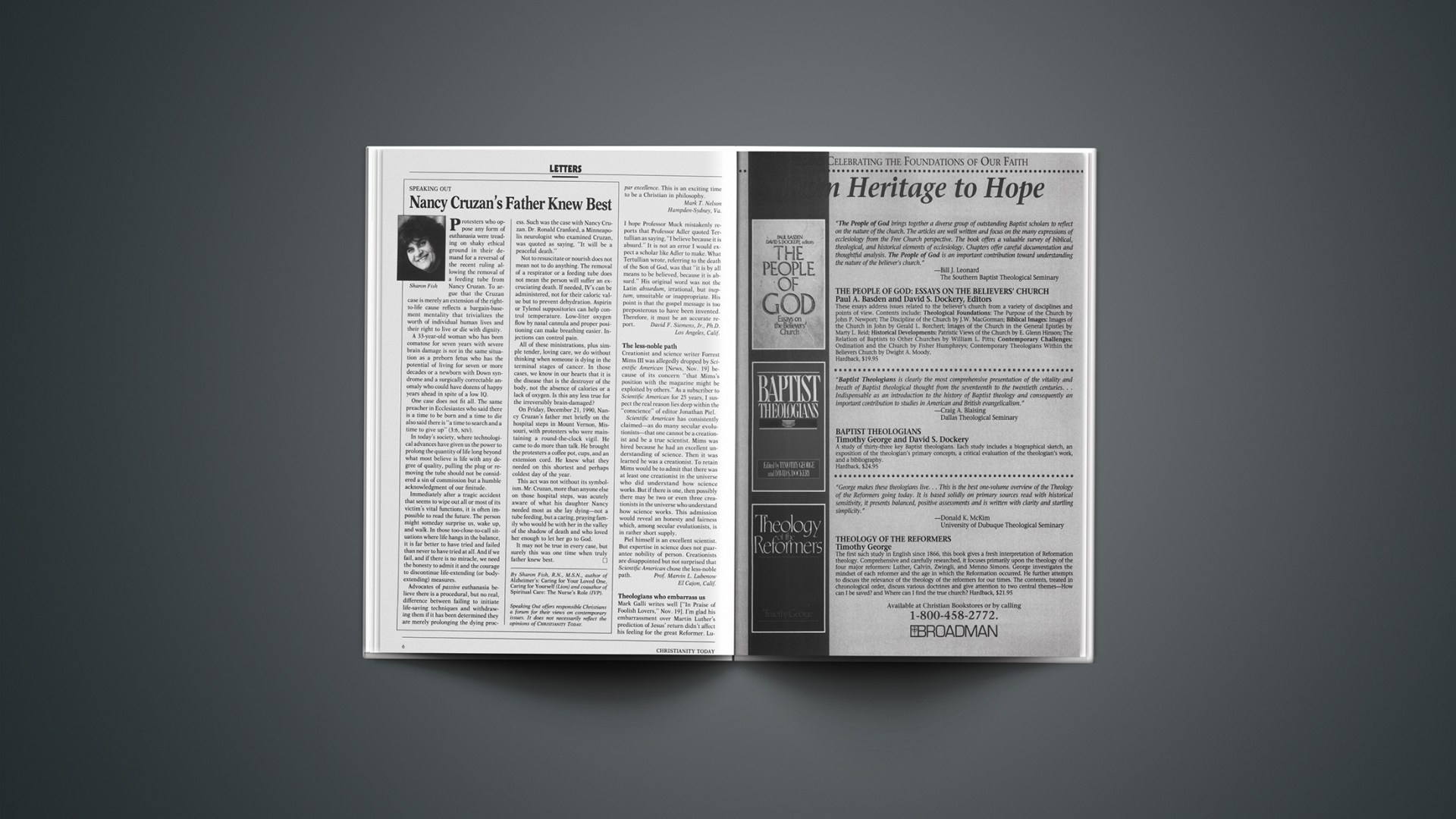

Protesters who oppose any form of euthanasia were treading on shaky ethical ground in their demand for a reversal of the recent ruling allowing the removal of a feeding tube from Nancy Cruzan. To argue that the Cruzan case is merely an extension of the right-to-life cause reflects a bargain-basement mentality that trivializes the worth of individual human lives and their right to live or die with dignity.
A 33-year-old woman who has been comatose for seven years with severe brain damage is not in the same situation as a preborn fetus who has the potential of living for seven or more decades or a newborn with Down syndrome and a surgically correctable anomaly who could have dozens of happy years ahead in spite of a low IQ.
One case does not fit all. The same preacher in Ecclesiastes who said there is a time to be born and a time to die also said there is “a time to search and a time to give up” (3:6, NIV).
In today’s society, where technological advances have given us the power to prolong the quantity of life long beyond what most believe is life with any degree of quality, pulling the plug or removing the tube should not be considered a sin of commission but a humble acknowledgment of our finitude.
Immediately after a tragic accident that seems to wipe out all or most of its victim’s vital functions, it is often impossible to read the future. The person might someday surprise us, wake up, and walk. In those too-close-to-call situations where life hangs in the balance, it is far better to have tried and failed than never to have tried at all. And if we fail, and if there is no miracle, we need the honesty to admit it and the courage to discontinue life-extending (or body-extending) measures.
Advocates of passive euthanasia believe there is a procedural, but no real, difference between failing to initiate life-saving techniques and withdrawing them if it has been determined they are merely prolonging the dying process. Such was the case with Nancy Cruzan. Dr. Ronald Cranford, a Minneapolis neurologist who examined Cruzan, was quoted as saying, “It will be a peaceful death.”
Not to resuscitate or nourish does not mean not to do anything. The removal of a respirator or a feeding tube does not mean the person will suffer an excruciating death. If needed, IV’s can be administered, not for their caloric value but to prevent dehydration. Aspirin or Tylenol suppositories can help control temperature. Low-liter oxygen flow by nasal cannula and proper positioning can make breathing easier. Injections can control pain.
All of these ministrations, plus simple tender, loving care, we do without thinking when someone is dying in the terminal stages of cancer. In those cases, we know in our hearts that it is the disease that is the destroyer of the body, not the absence of calories or a lack of oxygen. Is this any less true for the irreversibly brain-damaged?
On Friday, December 21, 1990, Nancy Cruzan’s father met briefly on the hospital steps in Mount Vernon, Missouri, with protesters who were maintaining a round-the-clock vigil. He came to do more than talk. He brought the protesters a coffee pot, cups, and an extension cord. He knew what they needed on this shortest and perhaps coldest day of the year.
This act was not without its symbolism. Mr. Cruzan, more than anyone else on those hospital steps, was acutely aware of what his daughter Nancy needed most as she lay dying—not a tube feeding, but a caring, praying family who would be with her in the valley of the shadow of death and who loved her enough to let her go to God.
It may not be true in every case, but surely this was one time when truly father knew best.
By Sharon Fish, R.N., M.S.N., author of Alzheimer’s: Caring for Your Loved One, Caring for Yourself (Lion) and coauthor of Spiritual Care: The Nurse’s Role (IVP).
Speaking Out offers responsible Christians a forum for their views on contemporary issues. It does not necessarily reflect the opinions of CHRISTIANITY TODAY.