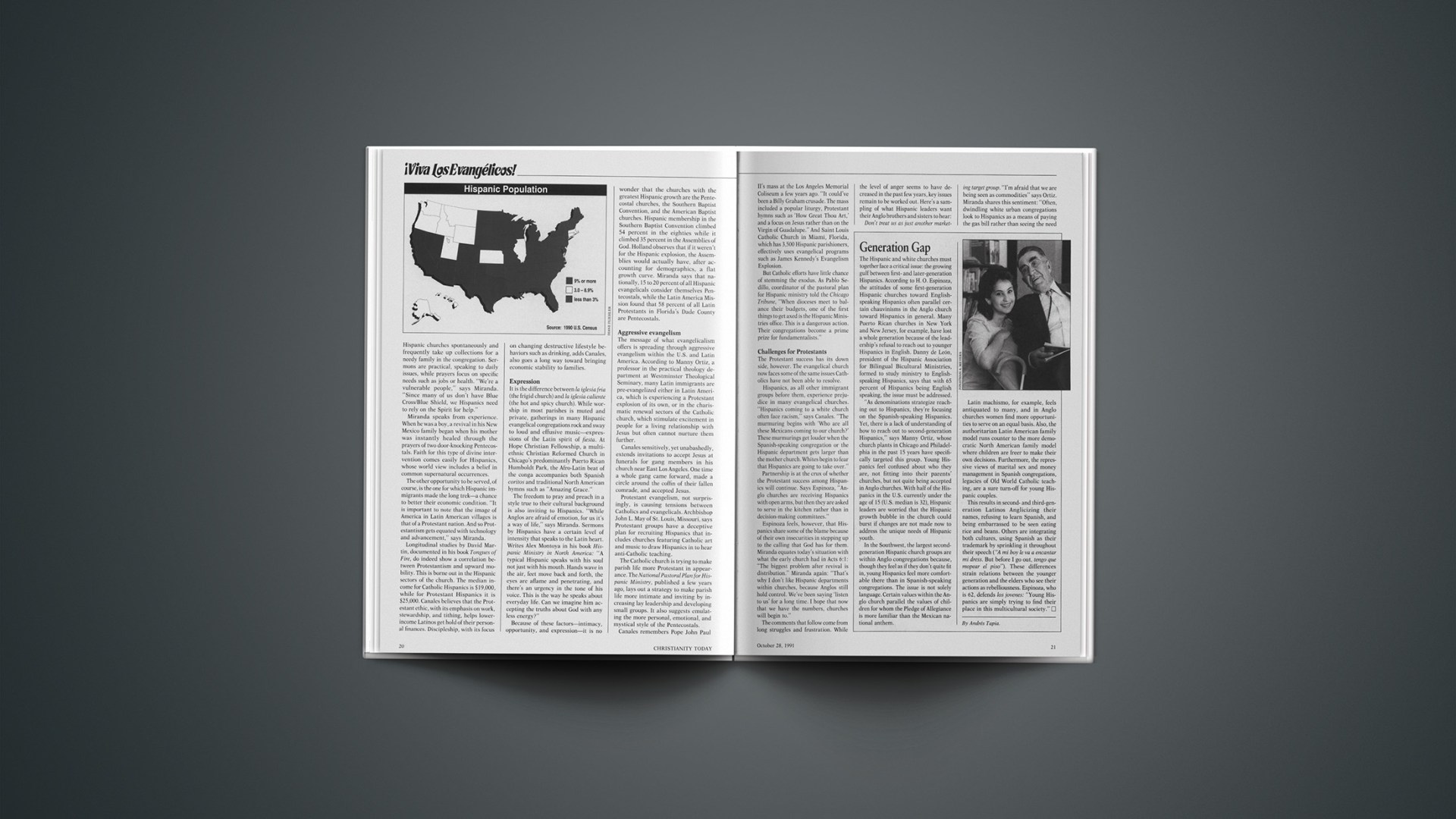

The Hispanic and white churches must together face a critical issue: the growing gulf between first- and later-generation Hispanics. According to H. O. Espinoza, the attitudes of some first-generation Hispanic churches toward English-speaking Hispanics often parallel certain chauvinisms in the Anglo church toward Hispanics in general. Many Puerto Rican churches in New York and New Jersey, for example, have lost a whole generation because of the leadership’s refusal to reach out to younger Hispanics in English. Danny de León, president of the Hispanic Association for Bilingual Bicultural Ministries, formed to study ministry to English-speaking Hispanics, says that with 65 percent of Hispanics being English speaking, the issue must be addressed.
“As denominations strategize reaching out to Hispanics, they’re focusing on the Spanish-speaking Hispanics. Yet, there is a lack of understanding of how to reach out to second-generation Hispanics,” says Manny Ortiz, whose church plants in Chicago and Philadelphia in the past 15 years have specifically targeted this group. Young Hispanics feel confused about who they are, not fitting into their parents’ churches, but not quite being accepted in Anglo churches. With half of the Hispanics in the U.S. currently under the age of 15 (U.S. median is 32), Hispanic leaders are worried that the Hispanic growth bubble in the church could burst if changes are not made now to address the unique needs of Hispanic youth.
In the Southwest, the largest second-generation Hispanic church groups are within Anglo congregations because, though they feel as if they don’t quite fit in, young Hispanics feel more comfortable there than in Spanish-speaking congregations. The issue is not solely language. Certain values within the Anglo church parallel the values of children for whom the Pledge of Allegiance is more familiar than the Mexican national anthem.
Latin machismo, for example, feels antiquated to many, and in Anglo churches women find more opportunities to serve on an equal basis. Also, the authoritarian Latin American family model runs counter to the more democratic North American family model where children are freer to make their own decisions. Furthermore, the repressive views of marital sex and money management in Spanish congregations, legacies of Old World Catholic teaching, are a sure turno-ff for young Hispanic couples.
This results in second- and third-generation Latinos Anglicizing their names, refusing to learn Spanish, and being embarrassed to be seen eating rice and beans. Others are integrating both cultures, using Spanish as their trademark by sprinkling it throughout their speech (“A mi boy le va a encantar mi dress. But before I go out, tengo que mopear el piso”). These differences strain relations between the younger generation and the elders who see their actions as rebelliousness. Espinoza, who is 62, defends los jovenes: “Young Hispanics are simply trying to find their place in this multicultural society.”
By Andrés Tapia.