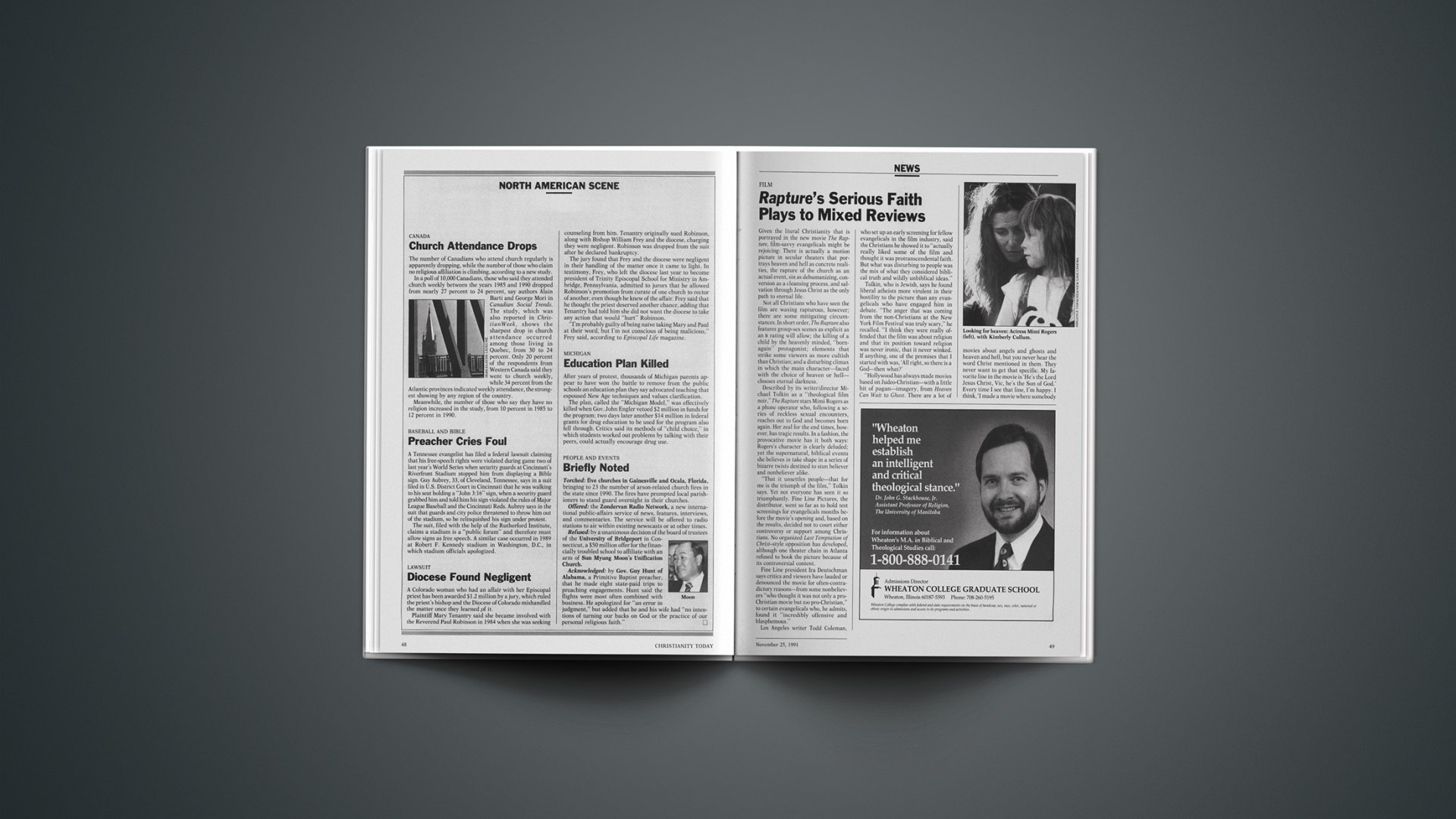

Given the literal Christianity that is portrayed in the new movie The Rapture, film-savvy evangelicals might be rejoicing: There is actually a motion picture in secular theaters that portrays heaven and hell as concrete realities, the rapture of the church as an actual event, sin as dehumanizing, conversion as a cleansing process, and salvation through Jesus Christ as the only path to eternal life.
Not all Christians who have seen the film are waxing rapturous, however; there are some mitigating circumstances. In short order, The Rapture also features group-sex scenes as explicit as an R rating will allow; the killing of a child by the heavenly minded, “born-again” protagonist; elements that strike some viewers as more cultish than Christian; and a disturbing climax in which the main character—faced with the choice of heaven or hell—chooses eternal darkness.
Described by its writer/director Michael Tolkin as a “theological film noir,” The Rapture stars Mimi Rogers as a phone operator who, following a series of reckless sexual encounters, reaches out to God and becomes born again. Her zeal for the end times, however, has tragic results. In a fashion, the provocative movie has it both ways: Rogers’s character is clearly deluded; yet the supernatural, biblical events she believes in take shape in a series of bizarre twists destined to stun believer and nonbeliever alike.
“That it unsettles people—that for me is the triumph of the film,” Tolkin says. Yet not everyone has seen it so triumphantly. Fine Line Pictures, the distributor, went so far as to hold test screenings for evangelicals months before the movie’s opening and, based on the results, decided not to court either controversy or support among Christians. No organized Last Temptation of Christ-style opposition has developed, although one theater chain in Atlanta refused to book the picture because of its controversial content.
Fine Line president Ira Deutschman says critics and viewers have lauded or denounced the movie for often-contradictory reasons—from some nonbelievers “who thought it was not only a pro-Christian movie but too pro-Christian,” to certain evangelicals who, he admits, found it “incredibly offensive and blasphemous.”
Los Angeles writer Todd Coleman, who set up an early screening for fellow evangelicals in the film industry, said the Christians he showed it to “actually really liked some of the film and thought it was protranscendental faith. But what was disturbing to people was the mix of what they considered biblical truth and wildly unbiblical ideas.”
Tolkin, who is Jewish, says he found liberal atheists more virulent in their hostility to the picture than any evangelicals who have engaged him in debate. “The anger that was coming from the non-Christians at the New York Film Festival was truly scary,” he recalled. “I think they were really offended that the film was about religion and that its position toward religion was never ironic, that it never winked. If anything, one of the premises that I started with was, ‘All right, so there is a God—then what?’
“Hollywood has always made movies based on Judeo-Christian—with a little bit of pagan—imagery, from Heaven Can Wait to Ghost. There are a lot of movies about angels and ghosts and heaven and hell, but you never hear the word Christ mentioned in them. They never want to get that specific. My favorite line in the movie is ‘He’s the Lord Jesus Christ, Vic, he’s the Son of God.’ Every time I see that line, I’m happy. I think, ‘I made a movie where somebody says that with a straight face!’ ”
Film critic Michael Medved, cohost of the PBS show “Sneak Previews,” often lobbies for portrayal of religious life on screen but wishes that Tolkin, for one, hadn’t taken a stab at it. In a speech last month, Medved called the film “the most clear example I have ever seen of many, many examples of the antireligious bigotry that thrives in Hollywood.… Every Christian that you meet in this movie is weird, has twitches, is crazy, is disgusting.”
Ironically, Medved, who is Jewish, appears to be more upset about the portrayal of Christians than Ted Baehr, who reviewed The Rapture in Movie-guide, his watchdog publication for Christian families.
“Christians will be upset by the extensive nudity and pornographic sex scenes,” Baehr said, recommending that his readers not see it for that reason. But, he asserted, this is “not a heretical movie” and it “does portray an honest attempt to present salvation.
“It forces the audience to make a decision,” Baehr told CT, going so far as to call it a “well-crafted film” that could be “a powerful witness to those who do not know God.”
By Chris Willman, with Heidi Campbell.