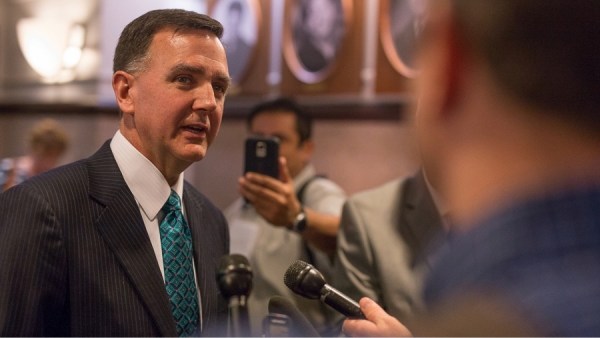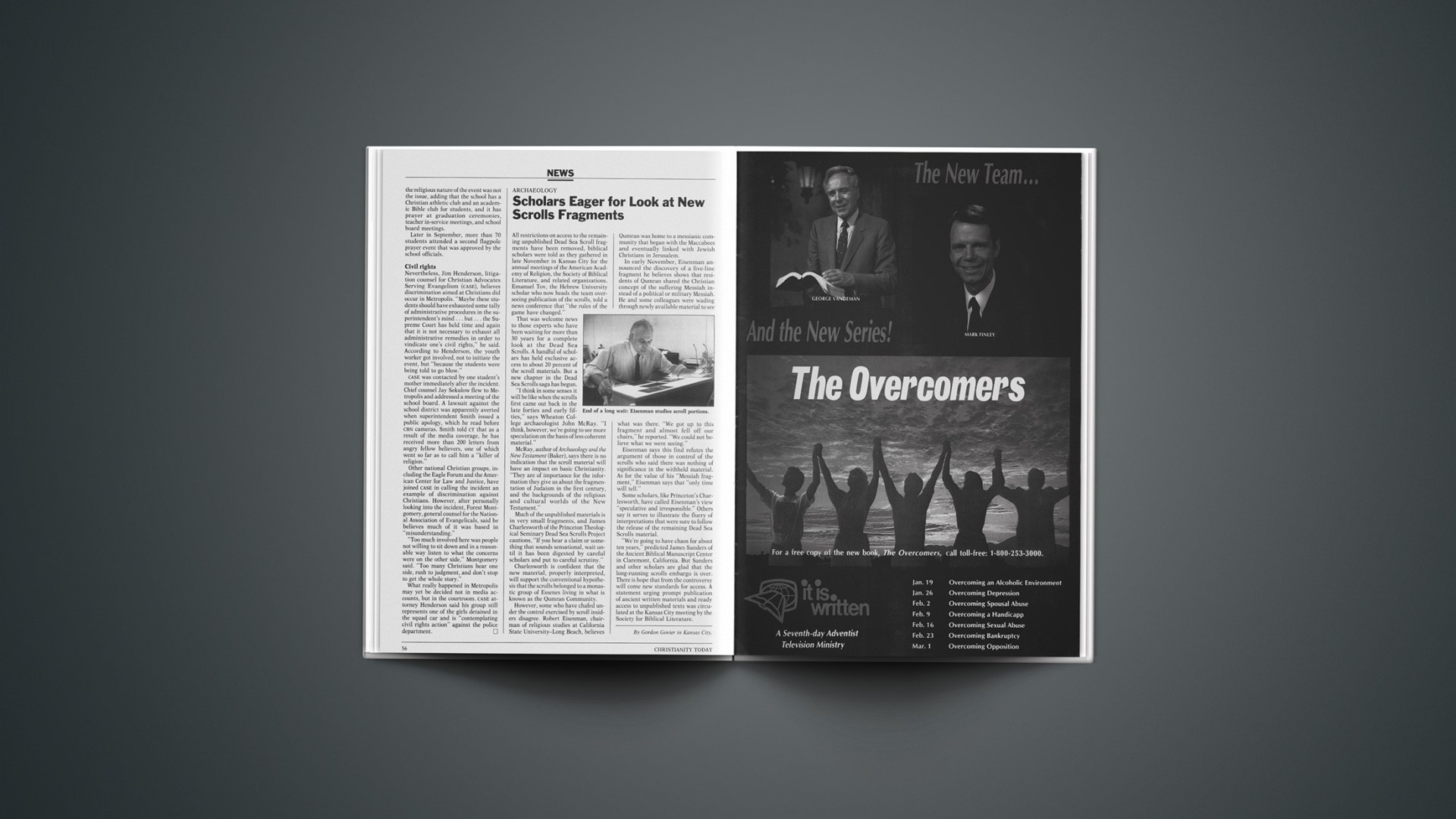

All restrictions on access to the remaining unpublished Dead Sea Scroll fragments have been removed, biblical scholars were told as they gathered in late November in Kansas City for the annual meetings of the American Academy of Religion, the Society of Biblical Literature, and related organizations. Emanuel Tov, the Hebrew University scholar who now heads the team overseeing publication of the scrolls, told a news conference that “the rules of the game have changed.”
That was welcome news to those experts who have been waiting for more than 30 years for a complete look at the Dead Sea Scrolls. A handful of scholars has held exclusive access to about 20 percent of the scroll materials. But a new chapter in the Dead Sea Scrolls saga has begun.
“I think in some senses it will be like when the scrolls first came out back in the late forties and early fifties,” says Wheaton College archaeologist John McRay. “I think, however, we’re going to see more speculation on the basis of less coherent material.”
McRay, author of Archaeology and the New Testament (Baker), says there is no indication that the scroll material will have an impact on basic Christianity. “They are of importance for the information they give us about the fragmentation of Judaism in the first century, and the backgrounds of the religious and cultural worlds of the New Testament.”
Much of the unpublished materials is in very small fragments, and James Charlesworth of the Princeton Theological Seminary Dead Sea Scrolls Project cautions, “If you hear a claim or something that sounds sensational, wait until it has been digested by careful scholars and put to careful scrutiny.”
Charlesworth is confident that the new material, properly interpreted, will support the conventional hypothesis that the scrolls belonged to a monastic group of Essenes living in what is known as the Qumran Community.
However, some who have chafed under the control exercised by scroll insiders disagree. Robert Eisenman, chairman of religious studies at California State University-Long Beach, believes Qumran was home to a messianic community that began with the Maccabees and eventually linked with Jewish Christians in Jerusalem.
In early November, Eisenman announced the discovery of a five-line fragment he believes shows that residents of Qumran shared the Christian concept of the suffering Messiah instead of a political or military Messiah. He and some colleagues were wading through newly available material to see what was there. “We got up to this fragment and almost fell off our chairs,” he reported. “We could not believe what we were seeing.”
Eisenman says this find refutes the argument of those in control of the scrolls who said there was nothing of significance in the withheld material. As for the value of his “Messiah fragment,” Eisenman says that “only time will tell.”
Some scholars, like Princeton’s Charlesworth, have called Eisenman’s view “speculative and irresponsible.” Others say it serves to illustrate the flurry of interpretations that were sure to follow the release of the remaining Dead Sea Scrolls material.
“We’re going to have chaos for about ten years,” predicted James Sanders of the Ancient Biblical Manuscript Center in Claremont, California. But Sanders and other scholars are glad that the long-running scrolls embargo is over. There is hope that from the controversy will come new standards for access. A statement urging prompt publication of ancient written materials and ready access to unpublished texts was circulated at the Kansas City meeting by the Society for Biblical Literature.
By Gordon Govier in Kansas City.