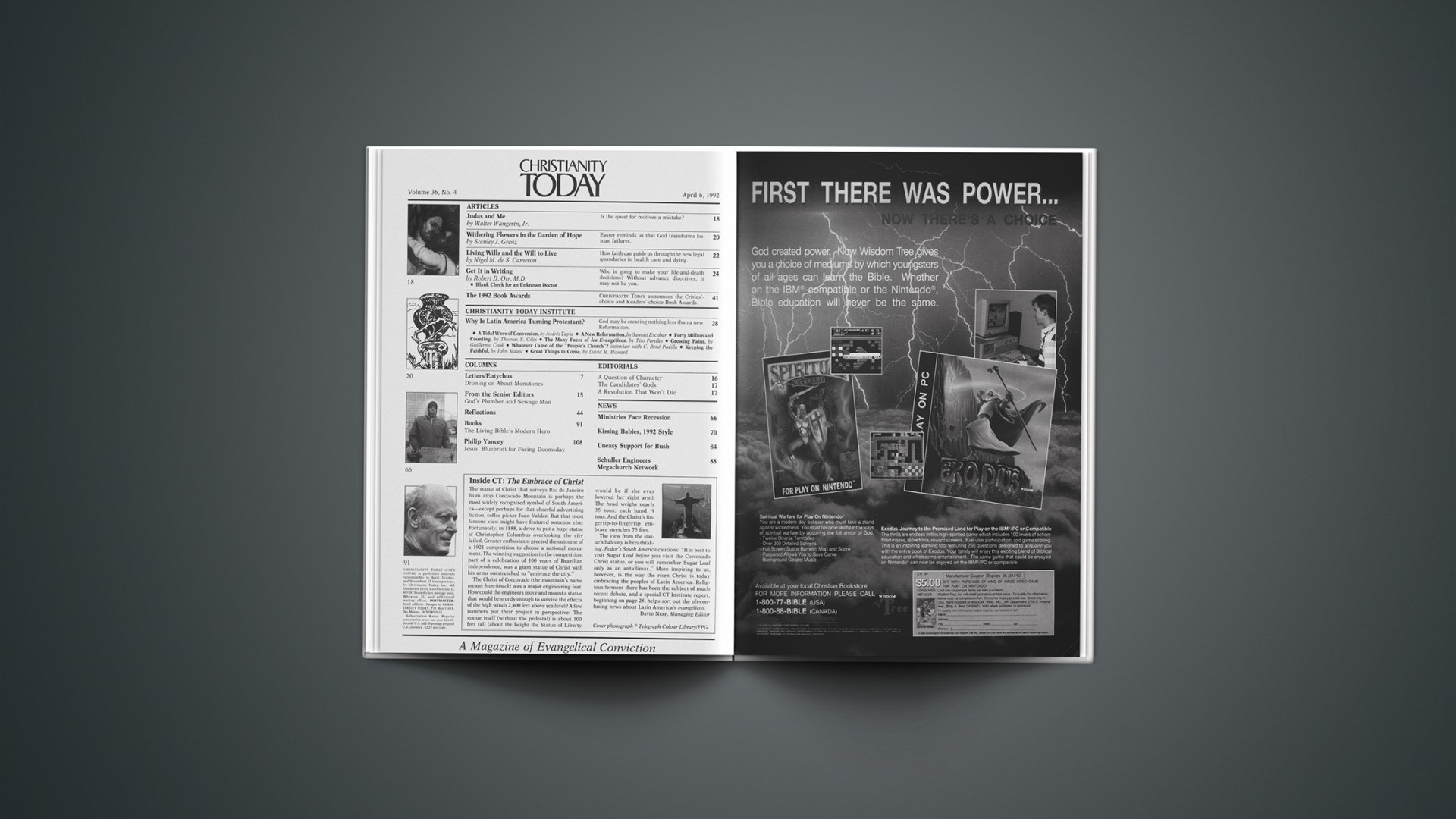
The Embrace of Christ

The statue of Christ that surveys Rio de Janeiro from atop Corcovado Mountain is perhaps the most widely recognized symbol of South America—except perhaps for that cheerful advertising fiction, coffee picker Juan Valdez. But that most famous view might have featured someone else: Fortunately, in 1888, a drive to put a huge statue of Christopher Columbus overlooking the city failed. Greater enthusiasm greeted the outcome of a 1921 competition to choose a national monument. The winning suggestion in the competition, part of a celebration of 100 years of Brazilian independence, was a giant statue of Christ with his arms outstretched to “embrace the city.”

The Christ of Corcovado (the mountain’s name means hunchback) was a major engineering feat. How could the engineers move and mount a statue that would be sturdy enough to survive the effects of the high winds 2,400 feet above sea level? A few numbers put their project in perspective: The statue itself (without the pedestal) is about 100 feet tall (about the height the Statue of Liberty would be if she ever lowered her right arm). The head weighs nearly 35 tons; each hand, 9 tons. And the Christ’s fingertip-to-fingertip embrace stretches 75 feet.

The view from the statue’s balcony is breathtaking. Fodor’s South America cautions: “It is best to visit Sugar Loaf before you visit the Corcovado Christ statue, or you will remember Sugar Loaf only as an anticlimax.” More inspiring to us, however, is the way the risen Christ is today embracing the peoples of Latin America. Religious ferment there has been the subject of much recent debate, and a special CT Institute report, beginning on page 28, helps sort out the oft-confusing news about Latin America’s evangélicos.

DAVID NEFF, Managing Editor

Cover photograph © Telegraph Colour Library/FPG.

Our Latest

Public Theology Project

Trump’s AI Jesus Might Be the Messiah We’ve Been Looking For

Perhaps this blasphemous image can expose what we’ve become—and, ironically, lead the way back to what’s real.

Changing Times and Technology

In 1981, CT helped evangelicals navigate debates over Ronald Reagan, genetic engineering, television, and male headship.

Partying in Joy and Sorrow

Christ has freed us to be a party people, even in grief and pain.

News

A New Approach to Native Missions Starts with the Past

Janel Breitenstein

A painful history with church-run schools has many Indigenous people wary of Christianity. Native ministries are working to share the real Jesus.

The Russell Moore Show

Malcolm Guite on Re-Enchanting a Disenchanted World

Why do ancient stories refuse to die, and what can we learn from them?

My Family Resisted Iran’s Regime. My Hope Is Not in Foreign Intervention.

Sara Afshari

Jesus spoke peace to his disciples as they hid. Iranian Christians modeled for me that same resistance with grace.

Wire Story

Beth Moore Is Leaving Her Ego Behind

Bob Smietana - Religion News Service

Eyeing retirement, the prolific Bible teacher still longs for discipleship in a fractured church.

Excerpt

Sorting out Truth and Lies After Divorce

Vaneetha Rendall Risner

An excerpt from This Was Never the Plan: Walking With God Through the Heartache of Divorce.

addApple PodcastsDown ArrowDown ArrowDown Arrowarrow_left_altLeft ArrowLeft ArrowRight ArrowRight ArrowRight Arrowarrow_up_altUp ArrowUp ArrowAvailable at Amazoncaret-downCloseCloseellipseEmailEmailExpandExpandExternalExternalFacebookfacebook-squarefolderGiftGiftGooglegoogleGoogle KeephamburgerInstagraminstagram-squareLinkLinklinkedin-squareListenListenListenChristianity TodayCT Creative Studio Logologo_orgMegaphoneMenuMenupausePinterestPlayPlayPocketPodcastprintremoveRSSRSSSaveSavesaveSearchSearchsearchSpotifyStitcherTelegramTable of ContentsTable of Contentstwitter-squareWhatsAppXYouTubeYouTube