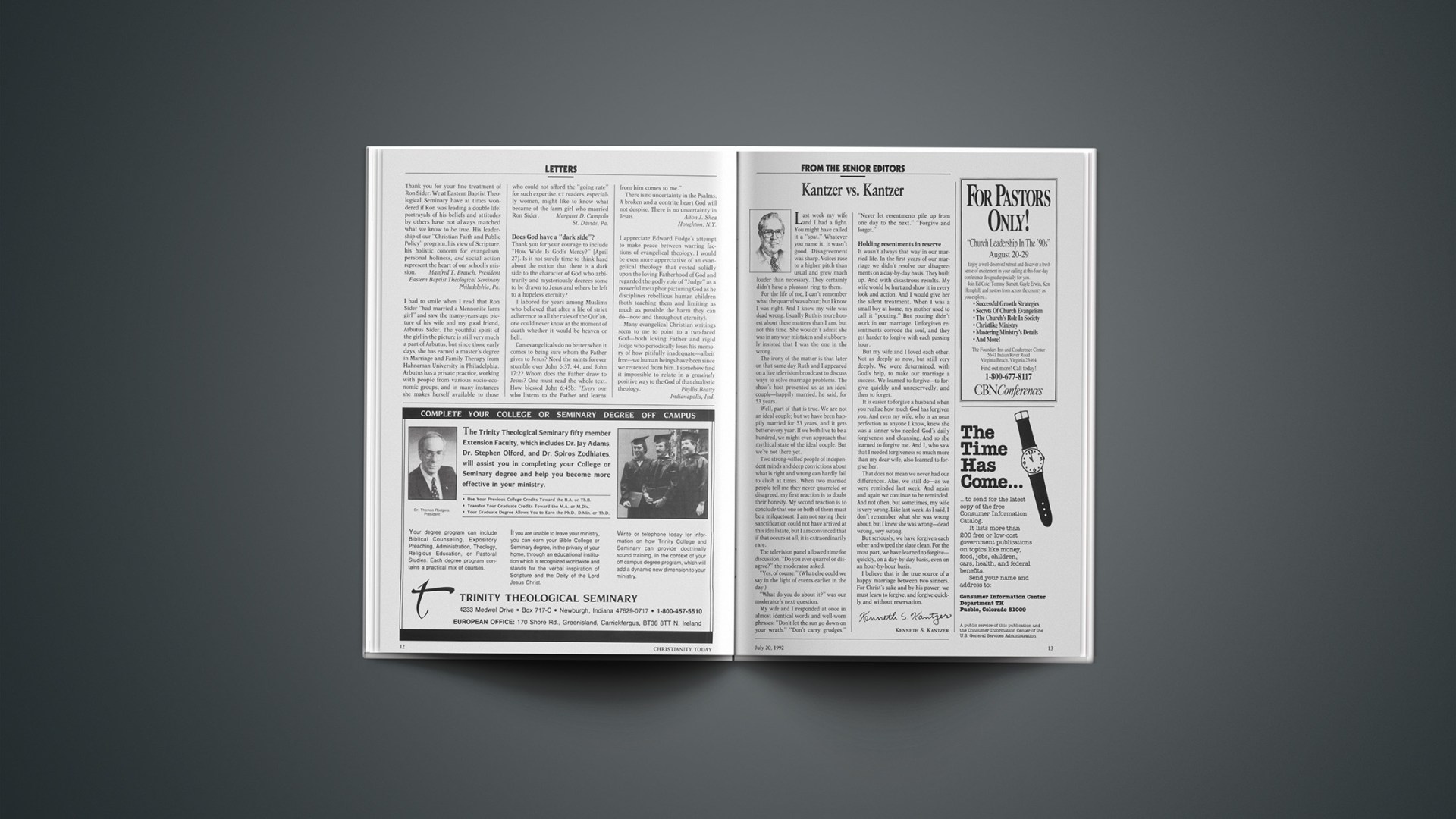

Last week my wife and I had a fight. You might have called it a “spat.” Whatever you name it, it wasn’t good. Disagreement was sharp. Voices rose to a higher pitch than usual and grew much louder than necessary. They certainly didn’t have a pleasant ring to them.
For the life of me, I can’t remember what the quarrel was about; but I know I was right. And I know my wife was dead wrong. Usually Ruth is more honest about these matters than I am, but not this time. She wouldn’t admit she was in any way mistaken and stubbornly insisted that I was the one in the wrong.
The irony of the matter is that later on that same day Ruth and I appeared on a live television broadcast to discuss ways to solve marriage problems. The show’s host presented us as an ideal couple—happily married, he said, for 53 years.
Well, part of that is true. We are not an ideal couple; but we have been happily married for 53 years, and it gets better every year. If we both live to be a hundred, we might even approach that mythical state of the ideal couple. But we’re not there yet.
Two strong-willed people of independent minds and deep convictions about what is right and wrong can hardly fail to clash at times. When two married people tell me they never quarreled or disagreed, my first reaction is to doubt their honesty. My second reaction is to conclude that one or both of them must be a milquetoast. I am not saying their sanctification could not have arrived at this ideal state, but I am convinced that if that occurs at all, it is extraordinarily rare.
The television panel allowed time for discussion. “Do you ever quarrel or disagree?” the moderator asked.
“Yes, of course.” (What else could we say in the light of events earlier in the day.)
“What do you do about it?” was our moderator’s next question.
My wife and I responded at once in almost identical words and well-worn phrases: “Don’t let the sun go down on your wrath.” “Don’t carry grudges.” “Never let resentments pile up from one day to the next.” “Forgive and forget.”
Holding Resentments In Reserve
It wasn’t always that way in our married life. In the first years of our marriage we didn’t resolve our disagreements on a day-by-day basis. They built up. And with disastrous results. My wife would be hurt and show it in every look and action. And I would give her the silent treatment. When I was a small boy at home, my mother used to call it “pouting.” But pouting didn’t work in our marriage. Unforgiven resentments corrode the soul, and they get harder to forgive with each passing hour.
But my wife and I loved each other. Not as deeply as now, but still very deeply. We were determined, with God’s help, to make our marriage a success. We learned to forgive—to forgive quickly and unreservedly, and then to forget.
It is easier to forgive a husband when you realize how much God has forgiven you. And even my wife, who is as near perfection as anyone I know, knew she was a sinner who needed God’s daily forgiveness and cleansing. And so she learned to forgive me. And I, who saw that I needed forgiveness so much more than my dear wife, also learned to forgive her.
That does not mean we never had our differences. Alas, we still do—as we were reminded last week. And again and again we continue to be reminded. And not often, but sometimes, my wife is very wrong. Like last week. As I said, I don’t remember what she was wrong about, but I knew she was wrong—dead wrong, very wrong.
But seriously, we have forgiven each other and wiped the slate clean. For the most part, we have learned to forgive—quickly, on a day-by-day basis, even on an hour-by-hour basis.
I believe that is the true source of a happy marriage between two sinners. For Christ’s sake and by his power, we must learn to forgive, and forgive quickly and without reservation.
KENNETH S. KANTZER