William Ward (1769–1823)
Radical, and “spiritual father”
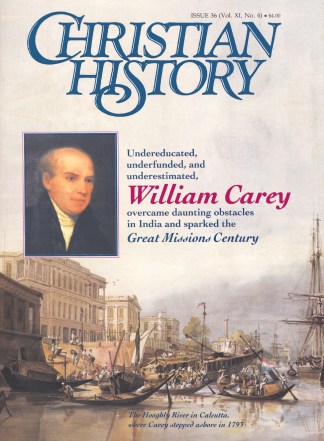
William Ward, a printer and editor, met William Carey just before Carey sailed for India. Carey invited Ward to set up a printing press there for Scripture translations, and in 1799 Ward arrived with the Marshmans and others. He later married the widow of fellow missionary John Fountain.
Ward set up the first mission press in North India. He also translated, wrote, and preached at every opportunity; some considered him Serampore’s finest preacher. Two years after his arrival, he toured the interior with first convert Krishna Pal preaching and distributing Scriptures. “His knowledge of the character and habits of the natives surpassed that of either of his colleagues,” wrote one observer, “and few Europeans have ever been more successful in dealing with [the natives].”
Ward had radical sympathies that twice landed him in court during his editorial days in England. He had belonged to a “questionable” political society and “embibed in democratic notions created by the French Revolution.” He was acquitted both times.
In India, Ward’s intellectual curiosity thrived. After several years’ research he wrote A View of the History, Literature, and Mythology of the Hindoos, including a minute description of their manners and customs, and translations from their principal works. He later worked with Joshua Marshman in producing Indian periodicals.
For William Carey, Ward was a godsend. Ward was 30 when he came to Serampore, and he captured the admiration of an adolescent Felix Carey, who was bound for trouble. Felix was soon working at the press, and under Ward’s influence, he became a Christian. “How often he has upheld me,” Felix said, “when my feet well-nigh slipped! He was my spiritual father.”
Ward’s health forced him to return to England in 1819. For four years he negotiated in the brewing struggle between the Serampore team and the Baptist Mission Society. He also toured England, America, and Holland to speak and raise support for the ministries in India. “The door of faith is open to the Hindoos, and who shall shut it?” he proclaimed. “The chain of caste is broken, and who shall mend it?”
Sixteen months after his return to the mission, Ward died of cholera. His own hymn describes the rewards of the Serampore work, as well as the struggles:
Yes, we are safe beneath Thy shade,
And shall be so midst India’s heat:
What should a missionary dread,
For devils crouch at Jesus’ feet.
There, sweetest Saviour! let Thy cross
Win many Hindoo hearts to thee;
This shall make up for every loss,
While Thou art ours eternally.
Hannah & Joshua Marshman (1767–1847; 1768–1837)
“First woman missionary to India” and brilliant educator
Industrious Hannah Marshman became known as the “first woman missionary to India.” A “mother” of the mission, she ran the large mission household and cared for many: mentally ill Dorothy Carey; the widow and children of William Grant (who had died less than three weeks after arriving in India); and the young and pregnant widow of John Fountain. With William Ward, she disciplined the unruly Carey boys.
Hannah felt burdened for Indian women, who, in her words, did little more than “boil their rice and bathe their children.” Around 1800 she established and began operating a school for young women. It became a model in India. By 1926, in fact, there were 14 other such institutions in the country.
As a young man, Joshua Marshman had been placed on a lengthy probation pending his admission to a church. His offense: he had too much “head knowledge” of religion. He was esteemed by Carey and Ward as the most astute scholar among them.
In Bristol, England, Joshua had been principal of a charity school. In India he and Hannah operated two boarding schools for English children and one non-fee school for Indian children. The schools’ income, in fact, helped make the Serampore mission financially independent.
In addition to running the schools, Joshua joined in translating and preaching. He was a sharp-tongued speaker, and often he came home bloodied from bricks thrown by Indians who were irritated by both his manner and his message. Carey once contrasted his personality and Marshman’s by saying, “In point of zeal, he is Luther, I am Erasmus.”
Joshua became in Serampore what Andrew Fuller was in London—the campaigner, debater, and fund raiser (so much of a fund raiser that he was impersonated at government balls).
In the local government he ran interference for mission interests, writing letters and making visits, including one to the Danish king.
In 1818 Joshua launched “Friend of India,” the first Bengali periodical. As he said, “If ever the Gospel stands in India, it must be by native opposed to native, demonstrating its excellence above all other systems.”
Joshua Marshman worked for 15 years in his spare time to produce the first, though soon surpassed, Chinese translation of the Bible (and added a Chinese grammar). Some have wondered why: Serampore was more than 600 miles from China.
The Marshmans were attacked by the mission’s supporters for living lavishly on mission funds. In truth, the Marshmans’ home was better furnished because of the extensive entertaining they did in connection with the schools—an arrangement accepted by the Serampore team. But the Marshmans were deeply wounded by the accusations.
Joshua Marshman outlived both Ward and Carey. In his final months, he was depressed and mentally distressed. He died before news could reach him that the mission was about to be broken up; it officially ceased the day after his burial.
Vinita Hampton Wright, a regular contributor to CHRISTIAN HISTORY, is co-editor of World Shapers: A Treasury of Quotes from Great Missionaries (Harold Shaw, 1991).
Copyright © 1992 by the author or Christianity Today/Christian History magazine.Click here for reprint information on Christian History.