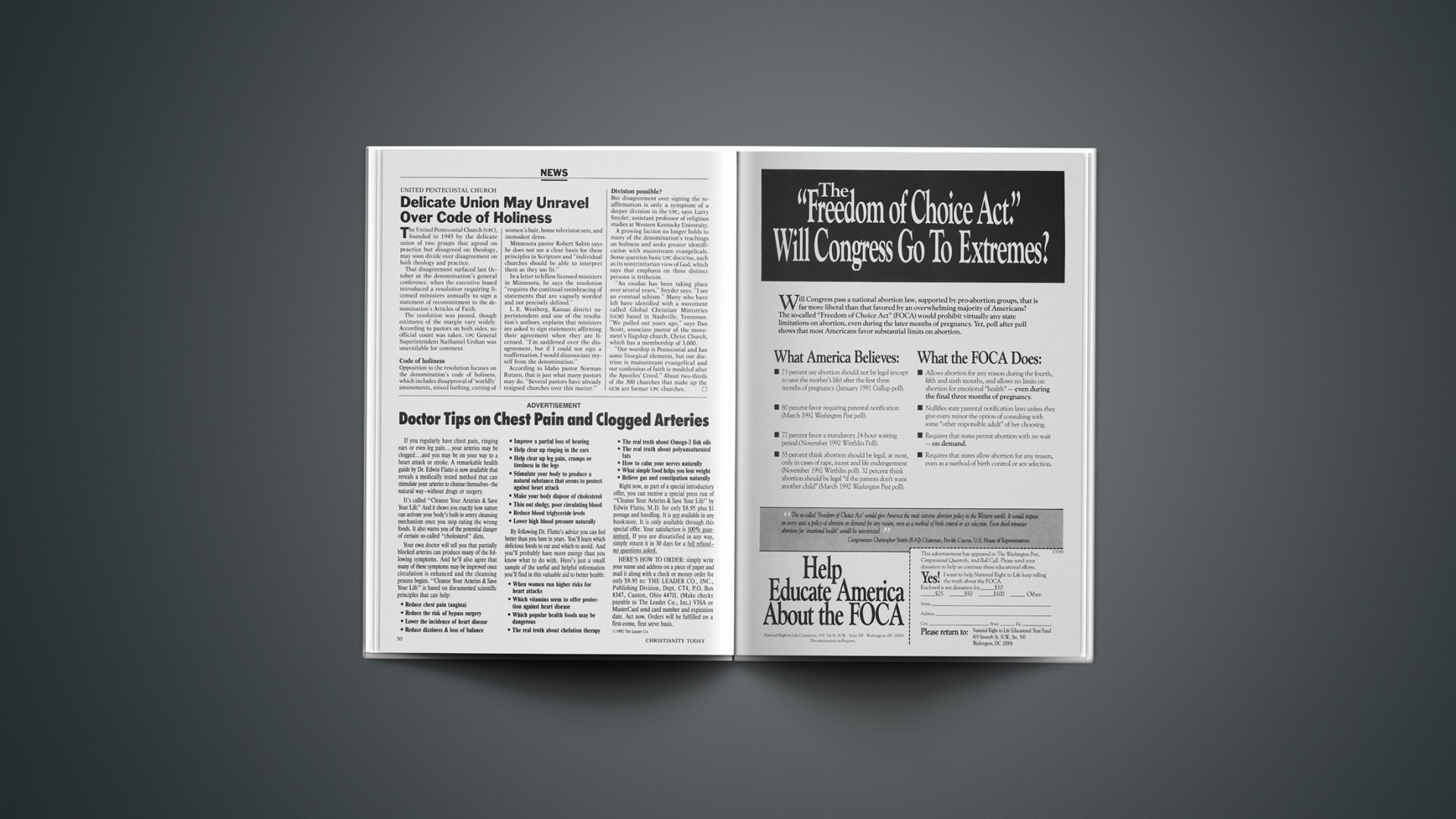

The United Pentecostal Church (UPC), founded in 1945 by the delicate union of two groups that agreed on practice but disagreed on theology, may soon divide over disagreement on both theology and practice.
That disagreement surfaced last October at the denomination’s general conference, when the executive board introduced a resolution requiring licensed ministers annually to sign a statement of recommitment to the denomination’s Articles of Faith.
The resolution was passed, though estimates of the margin vary widely. According to pastors on both sides, no official count was taken. UPC General Superintendent Nathaniel Urshan was unavailable for comment.
Code of holiness
Opposition to the resolution focuses on the denomination’s code of holiness, which includes disapproval of ‘worldly’ amusements, mixed bathing, cutting of women’s hair, home television sets, and immodest dress.
Minnesota pastor Robert Sabin says he does not see a clear basis for these principles in Scripture and “individual churches should be able to interpret them as they see fit.”
In a letter to fellow licensed ministers in Minnesota, he says the resolution “requires the continual reembracing of statements that are vaguely worded and not precisely defined.”
L. E. Westberg, Kansas district superintendent and one of the resolution’s authors, explains that ministers are asked to sign statements affirming their agreement when they are licensed. “I’m saddened over the disagreement, but if I could not sign a reaffirmation, I would disassociate myself from the denomination.”
According to Idaho pastor Norman Rutzen, that is just what many pastors may do. “Several pastors have already resigned churches over this matter.”
Division possible?
But disagreement over signing the reaffirmation is only a symptom of a deeper division in the UPC, says Larry Snyder, assistant professor of religious studies at Western Kentucky University.
A growing faction no longer holds to many of the denomination’s teachings on holiness and seeks greater identification with mainstream evangelicals. Some question basic UPC doctrine, such as its nontrinitarian view of God, which says that emphasis on three distinct persons is tritheism.
“An exodus has been taking place over several years,” Snyder says. “I see an eventual schism.” Many who have left have identified with a movement called Global Christian Ministries (GCM) based in Nashville, Tennessee. “We pulled out years ago,” says Dan Scott, associate pastor of the movement’s flagship church, Christ Church, which has a membership of 3,000.
“Our worship is Pentecostal and has some liturgical elements, but our doctrine is mainstream evangelical and our confession of faith is modeled after the Apostles’ Creed.” About two-thirds of the 300 churches that make up the GCM are former UPC churches.