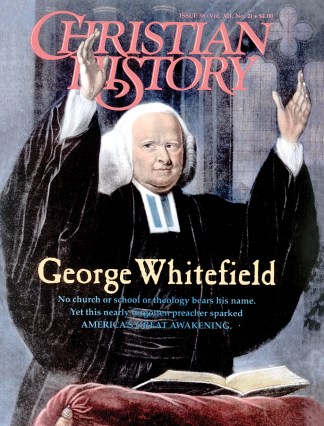
When George Whitefield first journeyed through America’s southern colonies, he was deeply disturbed by how slaves were brutalized by their masters. In 1740, in an angry, open letter to three southern colonies, he wrote: “Your dogs are caressed and fondled at your tables; but your slaves who are frequently styled dogs or beasts, have not an equal privilege. They are scarce permitted to pick up the crumbs which fall from their masters’ tables.… Although I pray God the slaves may never be permitted to get the upper hand, yet should such a thing be permitted by Providence, all good men must acknowledge the judgment would be just.”
Whitefield was genuinely concerned for blacks: “Their consciences are awake, and consequently prepared in good measure for hearing the gospel.” When preaching to mixed crowds, he often addressed African-Americans as a group, and he chastised slaveholders for not teaching their slaves about Christ.
He also purchased 5,000 acres in Pennsylvania to build a school “for the instruction of these poor creatures.” He intended to do the same in South Carolina. (Neither project succeeded.)
Many African-Americans felt Whitefield’s concern. During a stay in Charleston, he reported, “Several of the Negroes did their work in less time than usual, that they might come to hear me.”
For the most part, though, Whitefield’s sermons avoided talk about masters’ duties to slaves, though not the reverse: “Though [God] hath now called you [slaves] into his own family … he doth not call you thereby from the service of your masters according to the flesh.”
Later, Whitefield took an unfortunate stand. In 1740, he had established an orphanage, called Bethesda, in Georgia. By 1747, both colony and orphanage were suffering economically. The reason, according to Whitefield?
“The constitution of that colony [Georgia] is very bad, and it is impossible for the inhabitants to subsist without the use of slaves.”
The solution? Whitefield allowed some friends to purchase for him “a plantation and slaves, which I propose to devote to the support of Bethesda.… One Negro has been given me. Some more I purpose to purchase this week.”
By the late 1740s, Whitefield advocated legalizing slavery in Georgia. His concern for orphans had won out over his concern for blacks: “Had Negroes been allowed, I should now have had a sufficiency to support a great many orphans without expending above half the sum that has been laid out.”
Whitefield was not out of step with the times. By 1776, only one denomination in America—the Quakers—had declared slaveholding a sin.
As an evangelist, Whitefield was unconventional and remarkable. Lamentably, his views on slavery were conventional and unremarkable.
Mark Galli is Associate Editor of Christian History.
Copyright © 1993 by the author or Christianity Today/Christian History magazine.Click here for reprint information on Christian History.