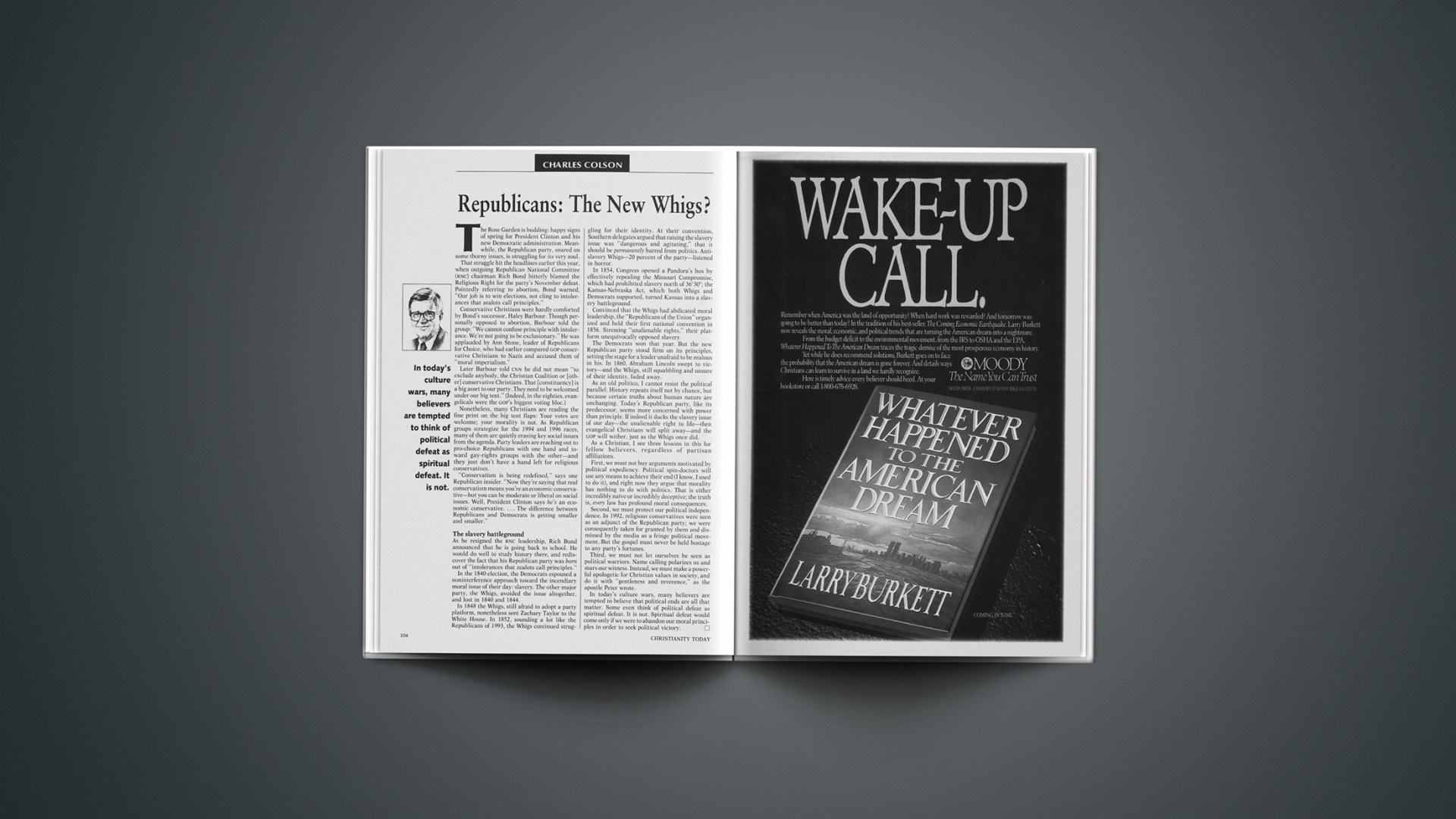

The Rose Garden is budding: happy signs of spring for President Clinton and his new Democratic administration. Meanwhile, the Republican party, snared on some thorny issues, is struggling for its very soul.
That struggle hit the headlines earlier this year, when outgoing Republican National Committee (RNC) chairman Rich Bond bitterly blamed the Religious Right for the party’s November defeat. Pointedly referring to abortion, Bond warned, “Our job is to win elections, not cling to intolerances that zealots call principles.”
Conservative Christians were hardly comforted by Bond’s successor, Haley Barbour. Though personally opposed to abortion, Barbour told the group: “We cannot confuse principle with intolerance. We’re not going to be exclusionary.” He was applauded by Ann Stone, leader of Republicans for Choice, who had earlier compared GOP conservative Christians to Nazis and accused them of “moral imperialism.”
Later Barbour told CNN he did not mean “to exclude anybody, the Christian Coalition or [other] conservative Christians. That [constituency] is a big asset to our party. They need to be welcomed under our big tent.” (Indeed, in the eighties, evangelicals were the GOP’s biggest voting bloc.)
Nonetheless, many Christians are reading the fine print on the big tent flaps: Your votes are welcome; your morality is not. As Republican groups strategize for the 1994 and 1996 races, many of them are quietly erasing key social issues from the agenda. Party leaders are reaching out to pro-choice Republicans with one hand and toward gay-rights groups with the other—and they just don’t have a hand left for religious conservatives.
“Conservatism is being redefined,” says one Republican insider. “Now they’re saying that real conservatism means you’re an economic conservative—but you can be moderate or liberal on social issues. Well, President Clinton says he’s an economic conservative.… The difference between Republicans and Democrats is getting smaller and smaller.”
The slavery battleground
As he resigned the RNC leadership, Rich Bond announced that he is going back to school. He would do well to study history there, and rediscover the fact that his Republican party was born out of “intolerances that zealots call principles.” In the 1840 election, the Democrats espoused a noninterference approach toward the incendiary moral issue of their day: slavery. The other major party, the Whigs, avoided the issue altogether, and lost in 1840 and 1844.
In 1848 the Whigs, still afraid to adopt a party platform, nonetheless sent Zachary Taylor to the White House. In 1852, sounding a lot like the Republicans of 1993, the Whigs continued struggling for their identity. At their convention, Southern delegates argued that raising the slavery issue was “dangerous and agitating,” that it should be permanently barred from politics. Antislavery Whigs—20 percent of the party—listened in horror.
In 1854, Congress opened a Pandora’s box by effectively repealing the Missouri Compromise, which had prohibited slavery north of 36’30”; the Kansas-Nebraska Act, which both Whigs and Democrats supported, turned Kansas into a slavery battleground.
Convinced that the Whigs had abdicated moral leadership, the “Republicans of the Union” organized and held their first national convention in 1856. Stressing “unalienable rights,” their platform unequivocally opposed slavery.
The Democrats won that year. But the new Republican party stood firm on its principles, setting the stage for a leader unafraid to be zealous in his. In 1860, Abraham Lincoln swept to victory—and the Whigs, still squabbling and unsure of their identity, faded away.
As an old politico, I cannot resist the political parallel. History repeats itself not by chance, but because certain truths about human nature are unchanging. Today’s Republican party, like its predecessor, seems more concerned with power than principle. If indeed it ducks the slavery issue of our day—the unalienable right to life—then evangelical Christians will split away—and the GOP will wither, just as the Whigs once did.
As a Christian, I see three lessons in this for fellow believers, regardless of partisan affiliations.
First, we must not buy arguments motivated by political expediency. Political spin-doctors will use any means to achieve their end (I know, I used to do it), and right now they argue that morality has nothing to do with politics. That is either incredibly naive or incredibly deceptive; the truth is, every law has profound moral consequences.
Second, we must protect our political independence. In 1992, religious conservatives were seen as an adjunct of the Republican party; we were consequently taken for granted by them and dismissed by the media as a fringe political movement. But the gospel must never be held hostage to any party’s fortunes.
Third, we must not let ourselves be seen as political warriors. Name calling polarizes us and mars our witness. Instead, we must make a powerful apologetic for Christian values in society, and do it with “gentleness and reverence,” as the apostle Peter wrote.
In today’s culture wars, many believers are tempted to believe that political ends are all that matter. Some even think of political defeat as spiritual defeat. It is not. Spiritual defeat would come only if we were to abandon our moral principles in order to seek political victory.
Loren Wilkinson is the writer/editor of Earthkeeping in the ’90s (Eerdmans) and the coauthor, with his wife, Mary Ruth Wilkinson, of Caring for Creation in Your Own Backyard (Servant). He teaches at Regent College in Vancouver, British Columbia, Canada.