





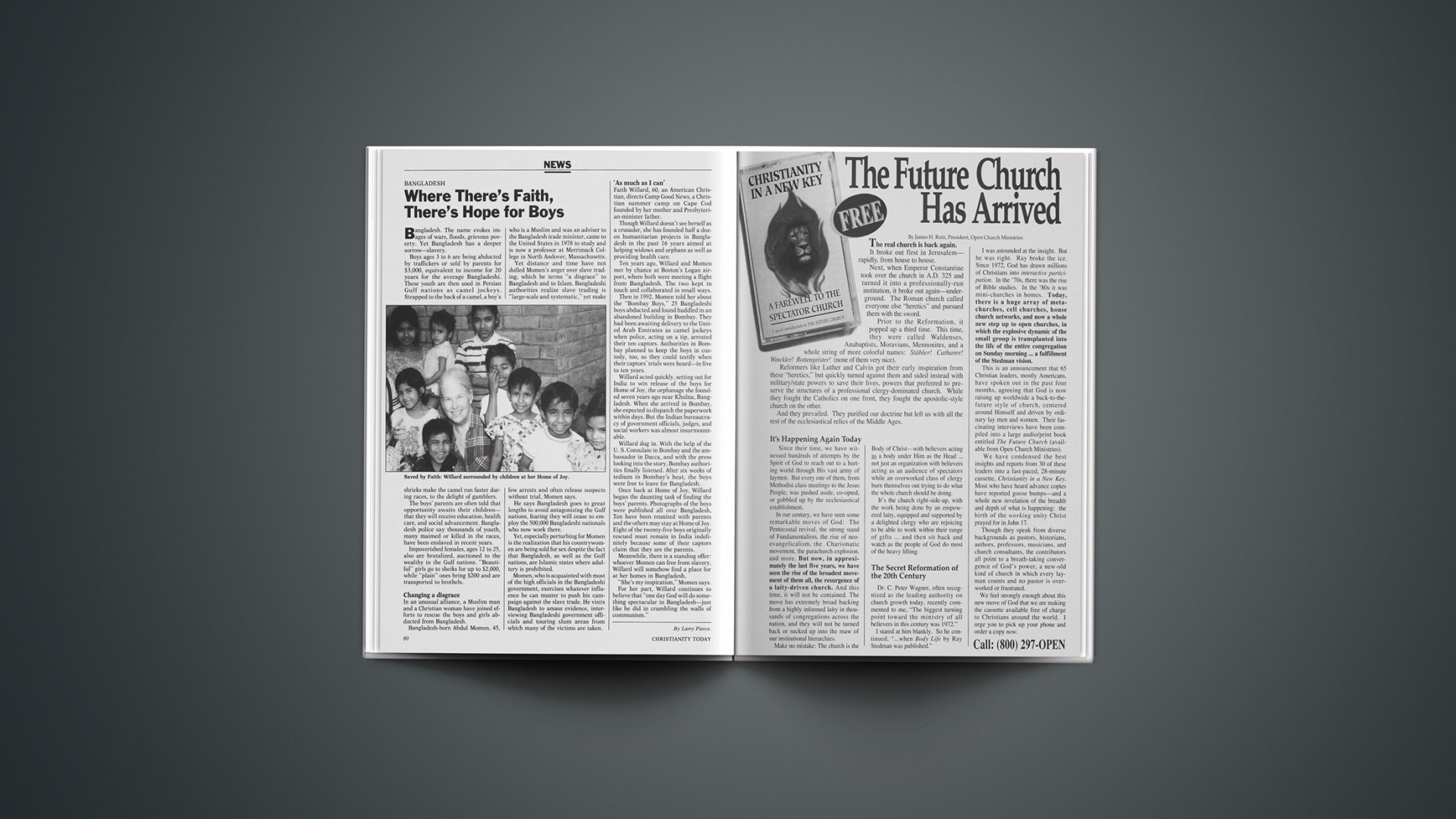

Bangladesh. The name evokes images of wars, floods, grievous poverty. Yet Bangladesh has a deeper sorrow—slavery.
Boys ages 3 to 6 are being abducted by traffickers or sold by parents for $3,000, equivalent to income for 20 years for the average Bangladeshi. These youth are then used in Persian Gulf nations as camel jockeys. Strapped to the back of a camel, a boy’s shrieks make the camel run faster during races, to the delight of gamblers.
The boys’ parents are often told that opportunity awaits their children—that they will receive education, health care, and social advancement. Bangladesh police say thousands of youth, many maimed or killed in the races, have been enslaved in recent years.
Impoverished females, ages 12 to 25, also are brutalized, auctioned to the wealthy in the Gulf nations. “Beautiful” girls go to sheiks for up to $2,000, while “plain” ones bring $200 and are transported to brothels.
Changing a disgrace
In an unusual alliance, a Muslim man and a Christian woman have joined efforts to rescue the boys and girls abducted from Bangladesh.
Bangladesh-born Abdul Momen, 45, who is a Muslim and was an adviser to the Bangladesh trade minister, came to the United States in 1978 to study and is now a professor at Merrimack College in North Andover, Massachusetts.
Yet distance and time have not dulled Momen’s anger over slave trading, which he terms “a disgrace” to Bangladesh and to Islam. Bangladeshi authorities realize slave trading is “large-scale and systematic,” yet make few arrests and often release suspects without trial, Momen says.
He says Bangladesh goes to great lengths to avoid antagonizing the Gulf nations, fearing they will cease to employ the 500,000 Bangladeshi nationals who now work there.
Yet, especially perturbing for Momen is the realization that his countrywomen are being sold for sex despite the fact that Bangladesh, as well as the Gulf nations, are Islamic states where adultery is prohibited.
Momen, who is acquainted with most of the high officials in the Bangladeshi government, exercises whatever influence he can muster to push his campaign against the slave trade. He visits Bangladesh to amass evidence, interviewing Bangladeshi government officials and touring slum areas from which many of the victims are taken.
‘As much as I can’
Faith Willard, 60, an American Christian, directs Camp Good News, a Christian summer camp on Cape Cod founded by her mother and Presbyterian-minister father.
Though Willard doesn’t see herself as a crusader, she has founded half a dozen humanitarian projects in Bangladesh in the past 16 years aimed at helping widows and orphans as well as providing health care.
Ten years ago, Willard and Momen met by chance at Boston’s Logan airport, where both were meeting a flight from Bangladesh. The two kept in touch and collaborated in small ways.
Then in 1992, Momen told her about the “Bombay Boys,” 25 Bangladeshi boys abducted and found huddled in an abandoned building in Bombay. They had been awaiting delivery to the United Arab Emirates as camel jockeys when police, acting on a tip, arrested their ten captors. Authorities in Bombay planned to keep the boys in custody, too, so they could testify when their captors’ trials were heard—in five to ten years.
Willard acted quickly, setting out for India to win release of the boys for Home of Joy, the orphanage she founded seven years ago near Khulna, Bangladesh. When she arrived in Bombay, she expected to dispatch the paperwork within days. But the Indian bureaucracy of government officials, judges, and social workers was almost insurmountable.
Willard dug in. With the help of the U.S. Consulate in Bombay and the ambassador in Dacca, and with the press looking into the story, Bombay authorities finally listened. After six weeks of tedium in Bombay’s heat, the boys were free to leave for Bangladesh.
Once back at Home of Joy, Willard began the daunting task of finding the boys’ parents. Photographs of the boys were published all over Bangladesh, Ten have been reunited with parents and the others may stay at Home of Joy. Eight of the twenty-five boys originally rescued must remain in India indefinitely because some of their captors claim that they are the parents.
Meanwhile, there is a standing offer: whoever Momen can free from slavery, Willard will somehow find a place for at her homes in Bangladesh.
“She’s my inspiration,” Momen says.
For her part, Willard continues to believe that “one day God will do something spectacular in Bangladesh—just like he did in crumbling the walls of communism.”
By Larry Pierce.







