In this series

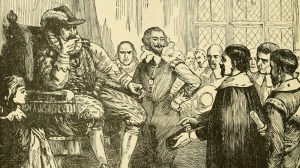
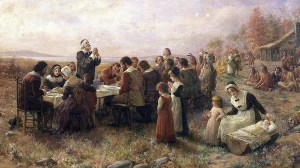
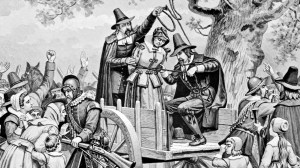
Critic H. L. Mencken once said, wrongly, “Puritanism is the haunting fear that someone, somewhere, may be happy.” On the contrary, Puritans read good books and enjoyed music. They drank beer with meals and rum at weddings. Puritans swam and skated, hunted and fished, and played at archery and bowling (as long as the games were not in a public tavern or on Sunday).
The famous “Pilgrims,” who landed at Plymouth Rock in 1620, were so radical they were usually disliked and sometimes hated. Unlike most Puritans, they did not seek to reform the Church of England; they thought the church was beyond help.
Most weddings in New England were performed not by ministers but by magistrates. Wedding rings, seen as “popish,” were not used.
The early settlers of Massachusetts included more than 100 graduates of Oxford and Cambridge. One historian termed Massachusetts “the best-educated community the world has ever known.”
In Puritan worship, a prayer could last an hour or more; a sermon, two hours. In a lifetime, a Puritan might hear 15,000 hours of preaching.
Within only six years of their arrival, while still trying to hew out an existence, the Puritans founded a religious college named Harvard. Puritans wanted highly educated ministers, not “Dumme Doggs,” as they called less-trained examples.
New England residents who failed to attend worship services on Sunday morning and afternoon were fined or put into stocks. Failing to glorify God for all his good gifts was a sacrilege.
Puritan women, though they didn’t receive a college education, were generally literate and often well-read. The only respectable female vocation in Puritan America was managing a household. But that “household” generally included large numbers of children, servants, apprentices, and even single men and women (who were required to live with families).
American Puritans did not celebrate religious holidays such as Easter or Christmas. The weekly “Lord’s Day” was celebration enough.
New England Puritans devised an approach to church membership that prevails in many churches today. By 1640, a person seeking membership was required to testify that he or she had been converted. Consequently, many settlers never became church members, even though only members could vote in civic affairs.
To permit undistracted worship of God, the Puritans did not use choirs, polyphonic hymns, or organs; they sang a cappella and in unison. No art adorned meeting houses (but paintings hung in many homes).
There was no religious freedom in New England. Quakers and Baptists were often forced to pay higher taxes or were banished.
American Puritans were hardworking but not capitalists in the modern sense. They placed common welfare ahead of self-interest and set modest caps on profit-making. Unemployment was virtually nonexistent in New England. A visitor from abroad testified, “In seven years I never saw a beggar.”
Puritans called Rhode Island “the latrine of New England” because it permitted all sorts of religious beliefs and made no religious requirements for citizenship.
Worshipers in New England were assigned seats by a committee. The best seats went to the minister and family. African-Americans and native Americans were assigned the lowest-ranked seats, usually in second-floor galleries. Men and women sat on opposite sides.
The American colonies became, in one historian’s words, “the most Protestant, Reformed, and Puritan commonwealths in the world.” When American colonists declared their independence in 1776, a full 75 percent came from Puritan roots.
Cassandra Niemczyk is an independent scholar who contributed to The Variety of American Evangelicalism (Tennessee, 1991).
Copyright © 1994 by the author or Christianity Today/Christian History magazine.Click here for reprint information on Christian History.