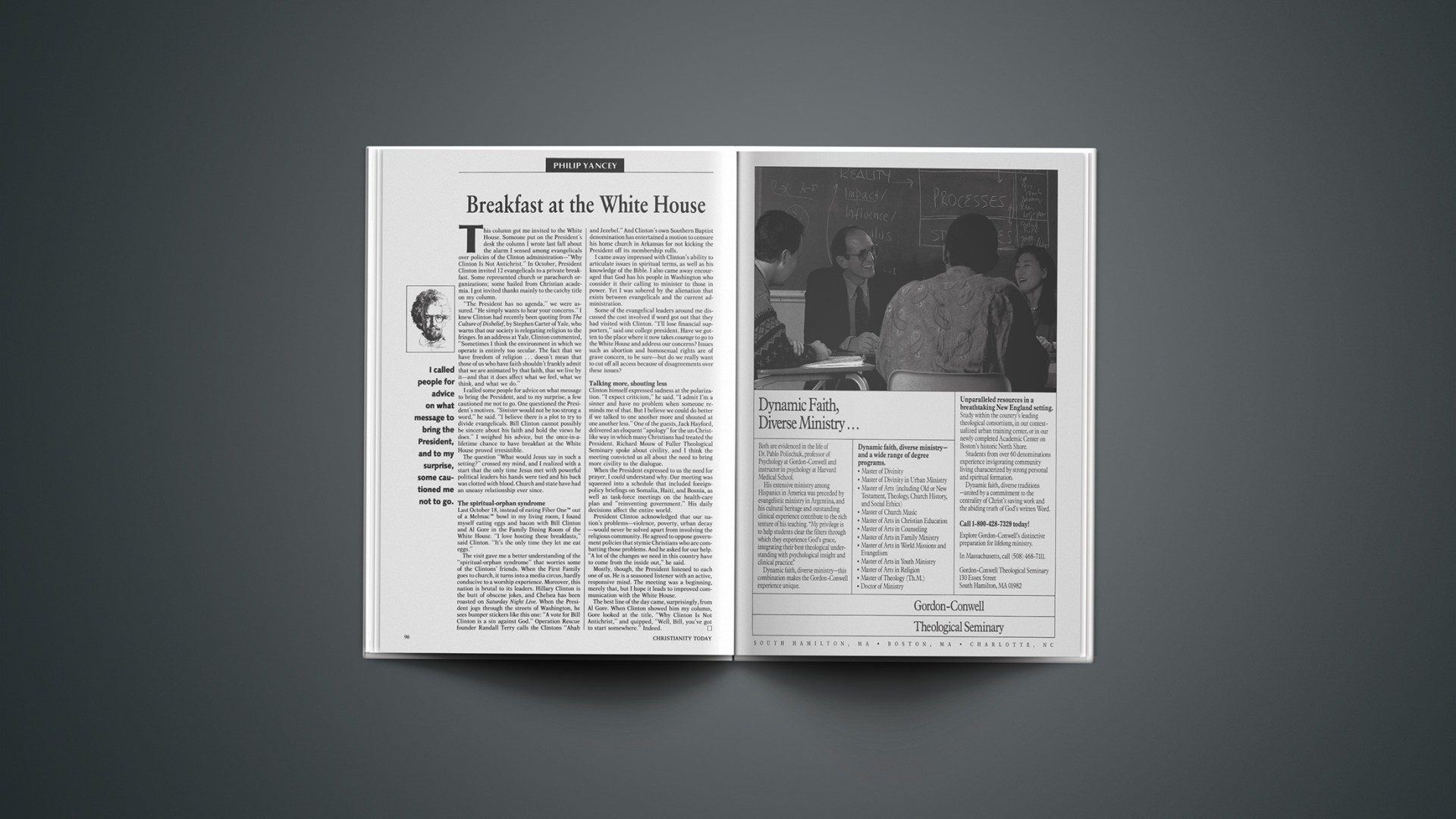
This column got me invited to the White House. Someone put on the President’s desk the column I wrote last fall about the alarm I sensed among evangelicals over policies of the Clinton administration—“Why Clinton Is Not Antichrist.” In October, President Clinton invited 12 evangelicals to a private breakfast. Some represented church or parachurch organizations; some hailed from Christian academia. I got invited thanks mainly to the catchy title on my column.
“The President has no agenda,” we were assured. “He simply wants to hear your concerns.” I knew Clinton had recently been quoting from The Culture of Disbelief, by Stephen Carter of Yale, who warns that our society is relegating religion to the fringes. In an address at Yale, Clinton commented, “Sometimes I think the environment in which we operate is entirely too secular. The fact that we have freedom of religion … doesn’t mean that those of us who have faith shouldn’t frankly admit that we are animated by that faith, that we live by it—and that it does affect what we feel, what we think, and what we do.”
I called some people for advice on what message to bring the President, and to my surprise, a few cautioned me not to go. One questioned the President’s motives. “Sinister would not be too strong a word,” he said. “I believe there is a plot to try to divide evangelicals. Bill Clinton cannot possibly be sincere about his faith and hold the views he does.” I weighed his advice, but the once-in-a-lifetime chance to have breakfast at the White House proved irresistible.
The question “What would Jesus say in such a setting?” crossed my mind, and I realized with a start that the only time Jesus met with powerful political leaders his hands were tied and his back was clotted with blood. Church and state have had an uneasy relationship ever since.
The spiritual-orphan syndrome
Last October 18, instead of eating Fiber One™ out of a Melmac™ bowl in my living room, I found myself eating eggs and bacon with Bill Clinton and Al Gore in the Family Dining Room of the White House. “I love hosting these breakfasts,” said Clinton. “It’s the only time they let me eat eggs.”
The visit gave me a better understanding of the “spiritual-orphan syndrome” that worries some of the Clintons’ friends. When the First Family goes to church, it turns into a media circus, hardly conducive to a worship experience. Moreover, this nation is brutal to its leaders. Hillary Clinton is the butt of obscene jokes, and Chelsea has been roasted on Saturday Night Live. When the President jogs through the streets of Washington, he sees bumper stickers like this one: “A vote for Bill Clinton is a sin against God.” Operation Rescue founder Randall Terry calls the Clintons “Ahab and Jezebel.” And Clinton’s own Southern Baptist denomination has entertained a motion to censure his home church in Arkansas for not kicking the President off its membership rolls.
I came away impressed with Clinton’s ability to articulate issues in spiritual terms, as well as his knowledge of the Bible. I also came away encouraged that God has his people in Washington who consider it their calling to minister to those in power. Yet I was sobered by the alienation that exists between evangelicals and the current administration.
Some of the evangelical leaders around me discussed the cost involved if word got out that they had visited with Clinton. “I’ll lose financial supporters,” said one college president. Have we gotten to the place where it now takes courage to go to the White House and address our concerns? Issues such as abortion and homosexual rights are of grave concern, to be sure—but do we really want to cut off all access because of disagreements over these issues?
Talking more, shouting less
Clinton himself expressed sadness at the polarization. “I expect criticism,” he said. “I admit I’m a sinner and have no problem when someone reminds me of that. But I believe we could do better if we talked to one another more and shouted at one another less.” One of the guests, Jack Hayford, delivered an eloquent “apology” for the un-Christ-like way in which many Christians had treated the President. Richard Mouw of Fuller Theological Seminary spoke about civility, and I think the meeting convicted us all about the need to bring more civility to the dialogue.
When the President expressed to us the need for prayer, I could understand why. Our meeting was squeezed into a schedule that included foreign-policy briefings on Somalia, Haiti, and Bosnia, as well as task-force meetings on the health-care plan and “reinventing government.” His daily decisions affect the entire world.
President Clinton acknowledged that our nation’s problems—violence, poverty, urban decay—would never be solved apart from involving the religious community. He agreed to oppose government policies that stymie Christians who are combatting those problems. And he asked for our help. “A lot of the changes we need in this country have to come from the inside out,” he said.
Mostly, though, the President listened to each one of us. He is a seasoned listener with an active, responsive mind. The meeting was a beginning, merely that, but I hope it leads to improved communication with the White House.
The best line of the day came, surprisingly, from Al Gore. When Clinton showed him my column, Gore looked at the title, “Why Clinton Is Not Antichrist,” and quipped, “Well, Bill, you’ve got to start somewhere.” Indeed.