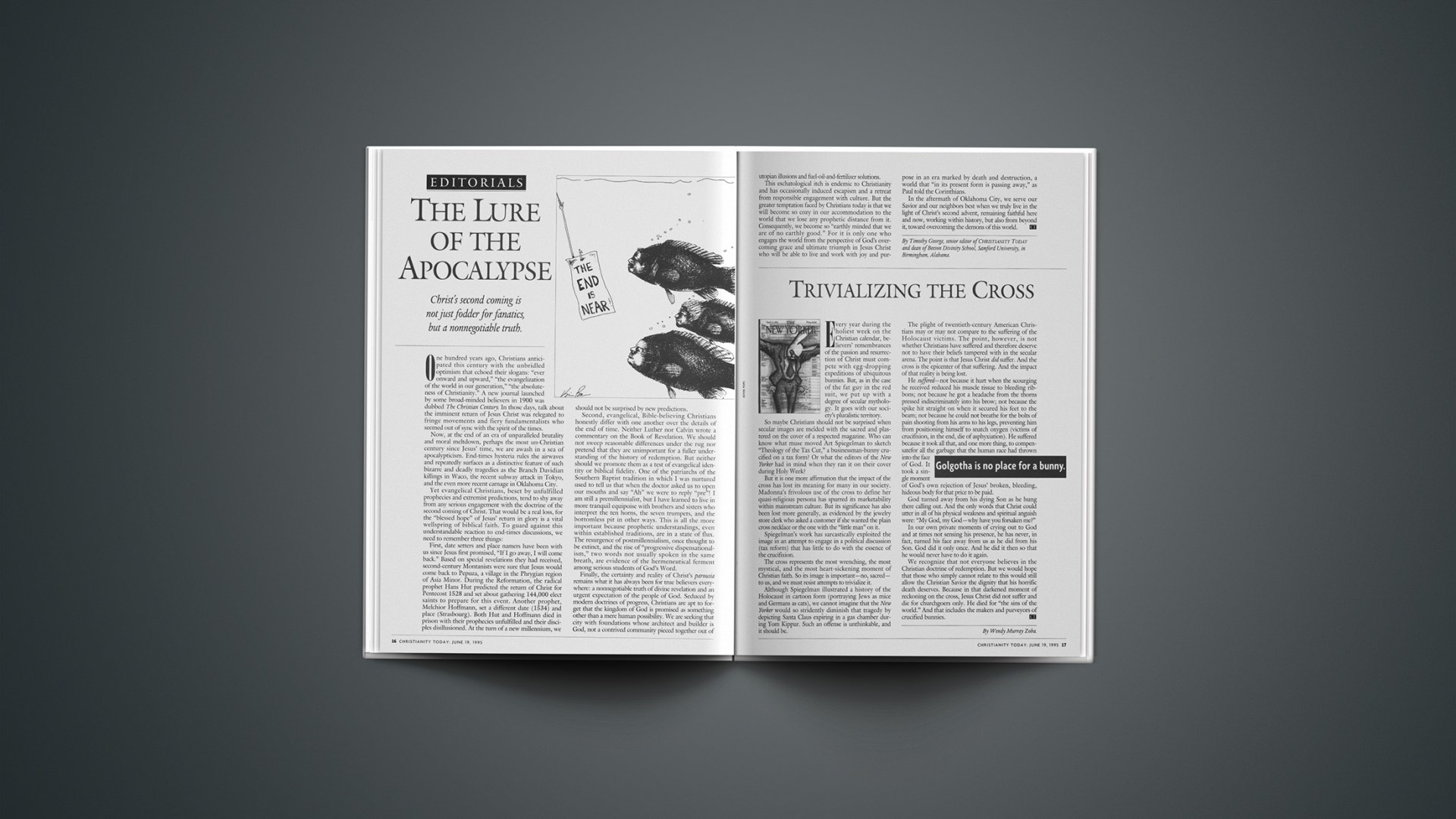

Every year during the holiest week on the Christian calendar, believers’ remembrances of the passion and resurrection of Christ must compete with egg-dropping expeditions of ubiquitous bunnies. But, as in the case of the fat guy in the red suit, we put up with a degree of secular mythology. It goes with our society’s pluralistic territory.
So maybe Christians should not be surprised when secular images are melded with the sacred and plastered on the cover of a respected magazine. Who can know what muse moved Art Spiegelman to sketch “Theology of the Tax Cut,” a businessman-bunny crucified on a tax form? Or what the editors of the New Yorker had in mind when they ran it on their cover during Holy Week?
But it is one more affirmation that the impact of the cross has lost its meaning for many in our society. Madonna’s frivolous use of the cross to define her quasi-religious persona has spurred its marketability within mainstream culture. But its significance has also been lost more generally, as evidenced by the jewelry store clerk who asked a customer if she wanted the plain cross necklace or the one with the “little man” on it.
Spiegelman’s work has sarcastically exploited the image in an attempt to engage in a political discussion (tax reform) that has little to do with the essence of the crucifixion.
The cross represents the most wrenching, the most mystical, and the most heart-sickening moment of Christian faith. So its image is important-no, sacred-to us, and we must resist attempts to trivialize it.
Although Spiegelman illustrated a history of the Holocaust in cartoon form (portraying Jews as mice and Germans as cats), we cannot imagine that the New Yorker would so stridently diminish that tragedy by depicting Santa Claus expiring in a gas chamber during Yom Kippur. Such an offense is unthinkable, and it should be.
The plight of twentieth-century American Christians may or may not compare to the suffering of the Holocaust victims. The point, however, is not whether Christians have suffered and therefore deserve not to have their beliefs tampered with in the secular arena. The point is that Jesus Christ did suffer. And the cross is the epicenter of that suffering. And the impact of that reality is being lost.
He suffered-not because it hurt when the scourging he received reduced his muscle tissue to bleeding ribbons; not because he got a headache from the thorns pressed indiscriminately into his brow; not because the spike hit straight on when it secured his feet to the beam; not because he could not breathe for the bolts of pain shooting from his arms to his legs, preventing him from positioning himself to snatch oxygen (victims of crucifixion, in the end, die of asphyxiation). He suffered because it took all that, and one more thing, to compensate for all the garbage that the human race had thrown into the face of God. It took a single moment of God’s own rejection of Jesus’ broken, bleeding, hideous body for that price to be paid.
God turned away from his dying Son as he hung there calling out. And the only words that Christ could utter in all of his physical weakness and spiritual anguish were: “My God, my God-why have you forsaken me?”
In our own private moments of crying out to God and at times not sensing his presence, he has never, in fact, turned his face away from us as he did from his Son. God did it only once. And he did it then so that he would never have to do it again.
We recognize that not everyone believes in the Christian doctrine of redemption. But we would hope that those who simply cannot relate to this would still allow the Christian Savior the dignity that his horrific death deserves. Because in that darkened moment of reckoning on the cross, Jesus Christ did not suffer and die for churchgoers only. He died for “the sins of the world.” And that includes the makers and purveyors of crucified bunnies.
Copyright © 1995 Christianity Today. Click for reprint information.
ctjun95mrw5T7017566b